
Now Reading: Why Waimea still scares the absolute shit out of every surfer
-
01
Why Waimea still scares the absolute shit out of every surfer
Why Waimea still scares the absolute shit out of every surfer
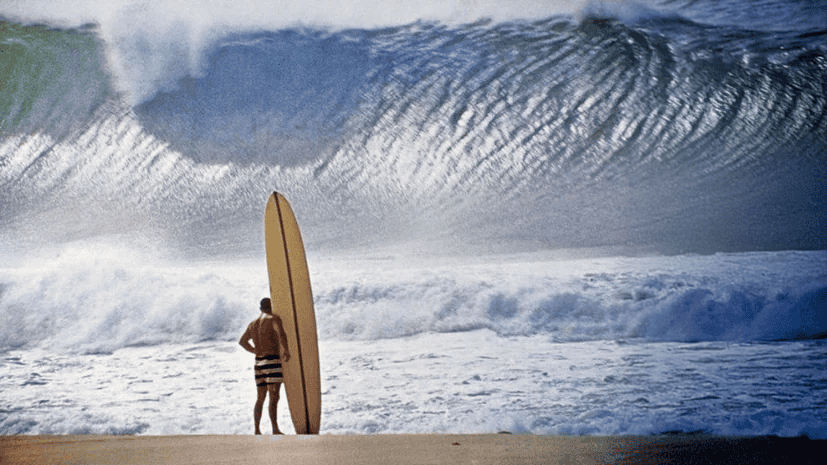
Waimea Bay on Oʻahu’s North Shore is one of the most iconic big-wave surf spots in the world. It sits between Haleʻiwa and Sunset Beach.
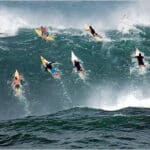
It’s the birthplace of big-wave surfing as we know it and the spiritual home of the Eddie Aikau Invitational. You may remember this competition only runs when Waimea hits a minimum of 20-foot Hawaiian (≈40-foot faces). So really, it happens maybe once every 5–10 years.
Wai means “water,” mea means “reddish,” “stained,” or “something of importance/feature.” So Waimea roughly means “reddish water” or “reddish-colored river/stream.”
When Waimea actually breaks
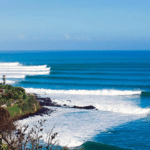
The first and only time I saw Waimea, it was flat. Of course it was—it was the middle of summer. But even during winter months Waimea doesn’t break that often, and even less often does it become real: meaning it hits at least 18 feet.
It’s a tricky one. Because once it gets to 30 feet or bigger, it becomes unrideable due to the closeout across the channel. And when it’s under 10 feet, locals call it “Waimea Shorebreak”—and it’s still dangerous. Wipeouts are another story. Apparently when you’re underwater Waimea is black, in comparison to Pipeline being white and Sunset being gray.
How Matt Warshaw describes it
Here’s how Matt Warshaw describes Waimea in the Encyclopedia of Surfing:
“Waimea hits peak only a handful of times during an average season. The character of the wave changes slightly with the direction of the incoming surf—north swells create an easier takeoff and longer wave; west swells are steeper and shorter. The ride is for the most part straightforward: a huge drop, often made at an angle, followed by a bottom turn, and a beeline race for the adjacent deep-water channel. Tuberiding is sometimes possible.
Although Waimea has long been dismissed by some as ‘just a drop’ (big-wave bulldog Buzzy Trent once described the break as ‘a mirage; now you see it, now you don’t’), this near-vertical plunge from crest to trough is in fact one of the sport’s greatest challenges, testing the surfer’s equipment, wave judgment, fitness, and nerve. The drop will often ‘jack’ (steepen and expand) without warning as the wave curls over, a phenomenon that can actually reverse the surfer’s forward motion and send him back up toward the crest—and then to an annihilating wipeout.”
A little history
According to Matt, some historians believe that Waimea was surfed by ancient Hawaiians, but no one really has solid evidence.
In the modern surfing world, Waimea crops up in 1943 when Woody Brown and Dickie Cross found themselves forced to paddle from Sunset Beach to Waimea, and Dickie drowned. When you hear and see this story in Riding Giants, you understand why it kept surfers away until 1957, when Greg Noll and a small group of surfers descended on Waimea on a 15-foot day. It got filmed, so of course it broke whatever the predecessor to the internet was—oh right, surf mags.
It stayed popular in the 60s, less so in the 70s and 80s, until Mavericks was “discovered” in the 90s—Mavericks broke more often—and Jaws came onto the scene with its tow-in surfing. Waimea had a comeback when big-wave paddle surfing (instead of tow-in) became a thing again in the early 2000s. Or rather, re-became a thing. Anyhoo, very much a back-to-the-future situation.