
Now Reading: What’s a Simmons, again?
-
01
What’s a Simmons, again?
What’s a Simmons, again?
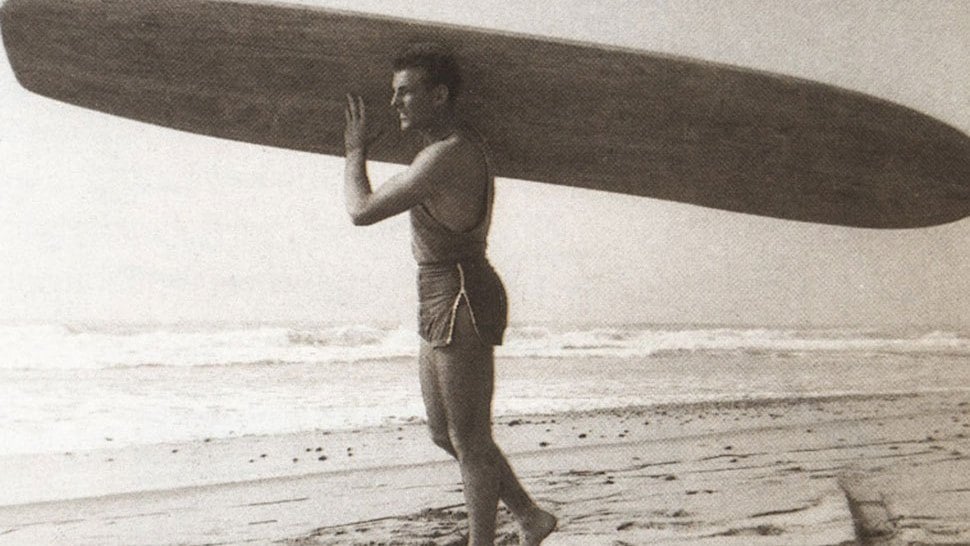
I’ve been wondering how many of us actually heard of a “Simmons”. I’d venture a guess that most younger or newer surfers never came across it, and it hasn’t had a slightest impact on their surfing. But if you ever hang around surfboard forums and someone said “well that’s basically a Simmons”, and you were wondering what the hell are they on about, this story is for you.
who bob simmons actually was
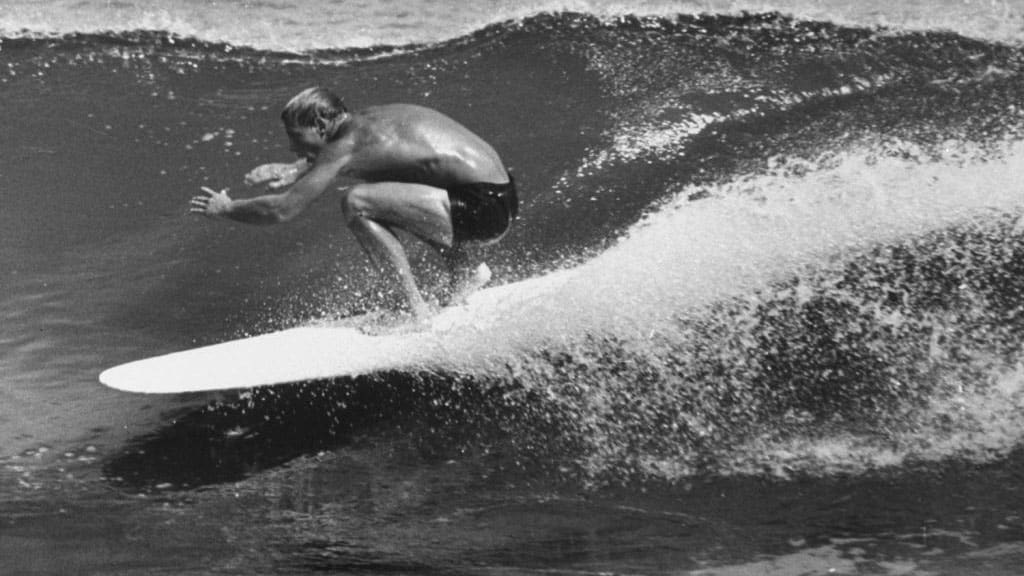
In short, a Simmons is a board designed by Bob Simmons, a surfer from Los Angeles, California.
Simmons wasn’t a typical surf industry figure. A high school dropout who nevertheless passed Caltech’s entrance exam, he studied engineering and mathematics, worked for Douglas Aircraft during and after World War II, and consumed technical literature obsessively—hydrodynamics, planing hull theory, drag coefficients, naval architecture.
In 1946, he obtained a detailed MIT study on planing hulls and began doing something no one else in surfing was doing at the time: applying formal scientific theory to surfboard design.
the original surfboard scientist
He was a surfboard scientist. While other shapers experimented through trial and error, Simmons calculated speed, drag, turbulence, rider weight, board volume. He wanted to know not just what worked, but why it worked that way.
As you might imagine, this made him deeply annoying to many of his shaper friends. His personality didn’t help. He was loud, scruffy, opinionated, socially abrasive, and frequently got into fights at surf spots. He was beaten up at Malibu, punched at San Onofre, and famously returned to Palos Verdes Cove at night with an axe to destroy boards after being attacked there earlier. What a joy.
But still, a surfboard design revolutionary.
what surfboards looked like before simmons
When Bob started surfing in the late 1930s, surfboards fell into two main categories. We had solid wooden planks that were heavy and barely maneuverable, and hollow “cigar box” boards that were lighter, but still difficult to control. Keep in mind the fin was not invented until 1935, so this was all still very new.
Overall the late 30s boards in California (Hawai’i was doing slightly better) were hard to paddle, harder to turn, and limited in how they could be ridden on a wave.
And as Bob was tall, lanky and physically limited by a fused left elbow, he felt those limitations acutely, and was determined to solve them.
the materials that changed everything
We’ll get into the Simmons shapes in a moment, because it’s the materials Bob used that changed the history of surfboard design.
While working at Douglas Aircraft, Bob encountered fiberglass, then a new aerospace material. By the mid-1940s, he was among the first surfers to coat boards in resin-saturated fiberglass cloth, dramatically increasing strength and water resistance.
Even more radical were his polystyrene foam “sandwich” boards, built with a foam core and thin plywood skins bonded together with industrial adhesives. These boards solved the problem of resin dissolving foam and predated commercial polyurethane foam surfboards by nearly a decade.
Depending on materials, Simmons boards weighed 20 pounds less than standard boards of the time—sometimes as little as 45–55 pounds, which was revolutionary then. And that’s how we eventually got modern epoxies, ladies and gents!
the simmons shape
Now, about the shape. Bob’s boards were funny looking by today’s standards. They had extra wide outlines of about 24 inches, square or diamond tails, spoon-shaped noses, very little rocker and usually twin fins placed near the rails to stabilize the wide tail.
As a result, these boards were designed to plane, not knife through the water. Bob didn’t care much for tight turns; he wanted to ride a wave as far as possible, even if it was small.
Even though many surfers didn’t like Bob’s boards—and even though shapers like Joe Quigg and Matt Kivlin refined his ideas into more user-friendly designs—they used (sorry) stole his concepts.
As shaper Reynolds Yater put it:
“Kivlin and Quigg made better boards—but would they have done that if Simmons hadn’t been doing what he was doing?”
a short life, a long legacy
Bob died at 35. They say comedy is tragedy plus time. He died as he lived, struck in the head by his own board, and drowned at Windansea in San Diego. He was inducted into the Surfing Hall of Fame in 1966.