
Now Reading: What on earth are glassed-in fins?
-
01
What on earth are glassed-in fins?
What on earth are glassed-in fins?
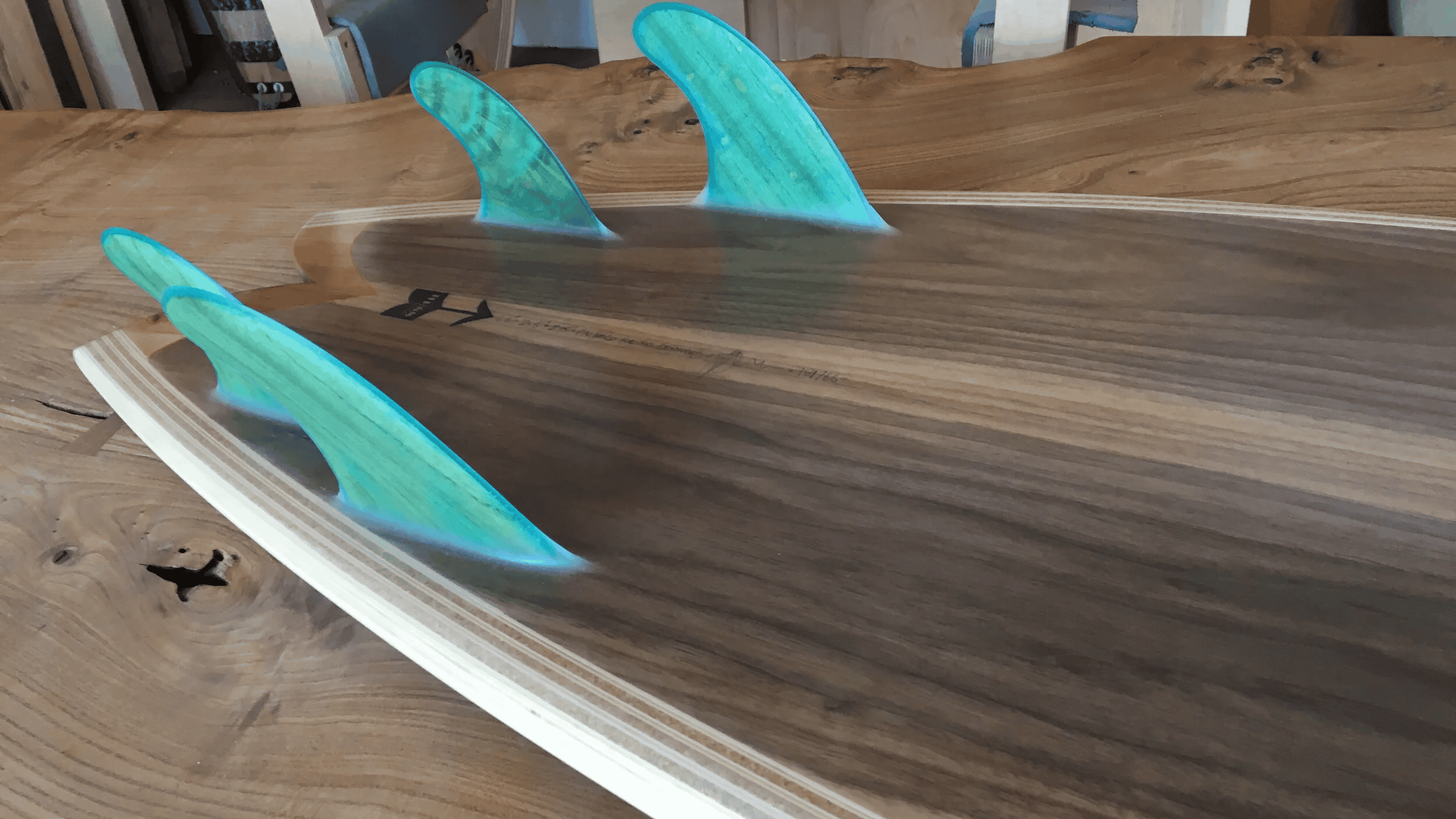
There’s something incredibly sexy about glassed-in fins. But do they still have a place in today’s surfing world?
from no fins to glass-ons
Before glassed-in fins became the norm, surfboards didn’t have fins at all. Surfers used to steer by dragging a hand or foot in the water, which worked—sort of—but wasn’t exactly efficient. That changed in 1935, when surf pioneer Tom Blake attached a keel from a speedboat to the bottom of his surfboard. Suddenly, the board could hold a line and turn with control.
As board construction evolved from solid wood to lighter balsa and eventually to foam-and-fiberglass laminates, so did fin design. By the 1940s and 1950s, board builders were glassing wooden or fiberglass fins directly onto boards as part of the lamination process.
This is what became known as the glassed-in, or “glass-on,” fin — a fin permanently attached to the board using fiberglass cloth and resin during shaping and glassing.
the standard for decades
From that point forward, glassed-in fins were everywhere. They were the standard for decades. If you bought a Velzy, Hobie, Yater, Bing, Noll, or just about any other board from the 1950s through the 1980s, it almost certainly came with a single, glassed-in fin.
The construction method fit naturally with the way boards were being built. You shaped the blank, placed the fin, and glassed the whole thing in one process. It was clean, durable, and gave the board a unified feel—surfers often describe it as the board and fin functioning as one, rather than two connected parts.
enter: fin systems
The rise of fin experimentation in the 1960s and 1970s began to shift that standard. As surfers explored twin fins, thrusters, and other multi-fin setups, they wanted to tweak their boards more easily. This opened the door for early removable fin systems. Still, it took a few more decades before plug-in fins became widespread.
It wasn’t until the late 1980s and early 1990s that removable fin systems like FCS and Futures became common in surfboard manufacturing. These systems allowed surfers to swap out fins based on wave conditions, travel without snapping off a glassed-in fin, and tinker with flex without needing a new board. By then, most performance shortboards were being made with fin boxes.
why some surfers still love them
Even with that shift, glassed-in fins never fully disappeared.
Many surfers still prefer them—especially on twin fins, single fins, or retro-style boards where feel and flow matter more than versatility.
For some, it’s about aesthetics; for others, it’s the way the board flexes and drives when everything is laminated together.