
Now Reading: We now know how to paddle like a pro
-
01
We now know how to paddle like a pro
We now know how to paddle like a pro
If you’ve ever wanted to paddle like a pro, now you can. Because a group of Australian scientists analyzed pro surfers to figure out what they do differently. The question is: do you really want to?
The scientific paper’s title is a bit of a mouthful: “Monitoring sprint-paddling technique in elite and sub-elite surfers using inertial sensors,” but I guess that’s what makes it legit.
We just love how they designed the experiment.
Picture 22 competitive surfers (female = 9, male = 13), motion sensors strapped to their backs and boards, sprint-paddling across an outdoor pool. Each used their preferred shortboard configured as a “thruster” (three-fin setup) to preserve natural movement.
And now picture being in the not-so-elite test group. Oh what a shame. 😜
They all lay prone on their boards in an outdoor pool, then sprint-paddled 15 m at maximum effort for two trials. During each stroke, they wore inertial measurement units (IMUs) mounted on the thoracic spine (T3–T4), the base of the sacrum, and the nose of their surfboard. Too much science, honestly.
📢 the important stuff
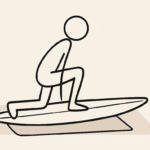
Turns out, elite surfers rotate their upper backs more effectively during each stroke. So it’s not just about shoulder reach—this is super coordinated thoracic rotation through the spine, helping drive the board forward with less strain and more flow. They also keep their boards impressively stable, minimizing bounce and side-to-side roll. That kind of control matters—less energy wasted means more efficient paddling.
Interestingly, they didn’t necessarily paddle faster than sub-elite surfers (feel better about them now!). What they did better was maintain speed between strokes. Less deceleration = smoother gliding. Who knew! So it’s not about paddling harder—it’s about not losing steam.
🏄🏻 women wobble more
The study also observed that female surfers, across the board, showed slightly less control in rotational stability.
The authors suggest this might reflect differences in body mass or upper-body output rather than skill or intent, but it’s a finding worth exploring further. If I had to guess—I’d say it’s down to upper-body composition, also known as boobs.
But, you’re probably wondering: what does this mean for me?
🤨 what do I do now?
We often think paddling is about arm strength, but this study reinforces what many seasoned surfers already know: paddling is a full-body operation. Core control, balance, rhythm, and spinal mobility all play a part—and the best surfers make it look easy because they’re working with their bodies, not against them.
The authors also floated a juicy idea: what if tech like these IMU sensors became a regular part of surf coaching? Imagine being able to measure your trunk rotation, board roll, and speed maintenance in real time—not from video or vague cues, but with actual data. Hmm. Not sure if that’s just going a tad too far.
Now imagine surfing becoming so obsessed with performance and the science of it all that it stops being fun. Wouldn’t you rather be just a sub-elite surfer after all?