
Now Reading: Surfing bigger waves is still easier than coming back from Mars
-
01
Surfing bigger waves is still easier than coming back from Mars
Surfing bigger waves is still easier than coming back from Mars

Surfing bigger waves. But, we’re not talking about “big waves,” just “little big waves.” You know—4ft+.
Why is it so hard to make the jump and take off on one of those, when in reality it’s only a tiny bit bigger than the beginner comfort zone of 2–3ft?
It’s frustrating. It stalls our progression. It makes us think we’re not real surfers.
You may be terrified of staring into the abyss, falling on the takeoff, wiping out in the shallows, or getting hit by your board. As there isn’t one single reason this happens, there’s no one-size-fits-all solution.
But just like Matt Damon going from growing potatoes in human poop on Mars to making it back to Earth—you can move from small surf to bigger conditions too. No matter how impossible it sounds right now.
staring into the abyss
You don’t have to suffer from vertigo or fear of heights to find bigger waves absolutely terrifying. The trick is not to look down.
Instead, do this. Eyes up, head follows. Look down the line and angle your takeoff. It automatically makes the wave feel smaller and less steep. Suddenly, your mind is focused only on the top 1–2ft of the wave.
And we like 1–2ft waves, don’t we?
You can also check out our story on how to deal with the drop specifically.
the board attack
The fear of getting whacked in the head, losing consciousness and drowning, or experiencing the “fin meets face” scenario would put anyone off surfing bigger waves.
The solution? Ditch the board. For now.
Bodysurfing and boogie boarding are safer options if you want to explore bigger conditions. Yes, this means you should be a confident swimmer. But even when you’re surfing, you shouldn’t rely on the buoyancy of your board. Plus, these two other flavors of surfing help you better understand how waves work. Warning: some surfers discover they prefer boogie boarding and never go back.
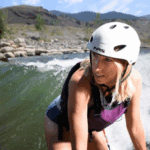
You can also wear a helmet to reduce the risk of getting whacked in the noggin.
pick your tide, pick your energy, pick your wave type
If landing on rocks or reef scares you, the simplest solution is not to surf in the shallows. Pick conditions where there’s plenty of water to be thrown into.
As for being thrown violently around—less wave energy is your best friend. Try surfing taller but less powerful waves first.
A slow, rolling, sloping bigger wave is not the same as a fast, closing-out bigger wave. They may be harder to catch, but they are less likely to thrash you.
learn to love the wipeout
Coming off the board in small waves—not a problem. But when the conditions get bigger, there’s always a risk of getting pummeled.
More experienced surfers recommend breath-hold training or even freediving practice to reduce the fear of drowning.
Also, go out with a surf buddy. Someone who will look out for you when things get dicey. That extra peace of mind can make a real difference.
trick the fear
Can you get rid of the fear of bigger waves? Yes—but only by actually doing it. It’s not the kind of fear you can fully train away on land or in tiny surf. Therapy didn’t work for us either.
It may help to realize it’s not the size itself—but the consequences your brain is reacting to. That’s why you might sometimes snag a bigger wave early in your surfing career, before you’re aware of all the things that could go wrong.
Try doing one thing at a time.
Can’t pop up consistently on smaller waves? Don’t try bigger ones yet.
Don’t know how to catch a wave at an angle? Don’t try bigger ones yet.
Only surfed in the tropics? Don’t try bigger cold-water waves yet.
You get the gist. Don’t rush it. Build confidence in smaller waves first. Then step up—and repeat—until the fear fades into background noise. Just barely audible.