Now Reading: Saving your surf hair and the ocean one spray at a time with Brittany Jones
-
01
Saving your surf hair and the ocean one spray at a time with Brittany Jones
Saving your surf hair and the ocean one spray at a time with Brittany Jones

You can listen to The Wipeout Weekly episode with Brittany Jones, surf-obssessed beginner and founder of Coconut Smuggler below or on your fav pod platform.
This Wipeout Weekly podcast episode transcript was abbreviated to a blog post format by my good friend Chad (ChatGPT). He takes liberties, you know.
You will find the full transcript below it. Host: Zuz Wilson | Guest: Brittany Jones
Zuz: You’re at the very start of your surfing journey, which is so exciting. How did you get into it?
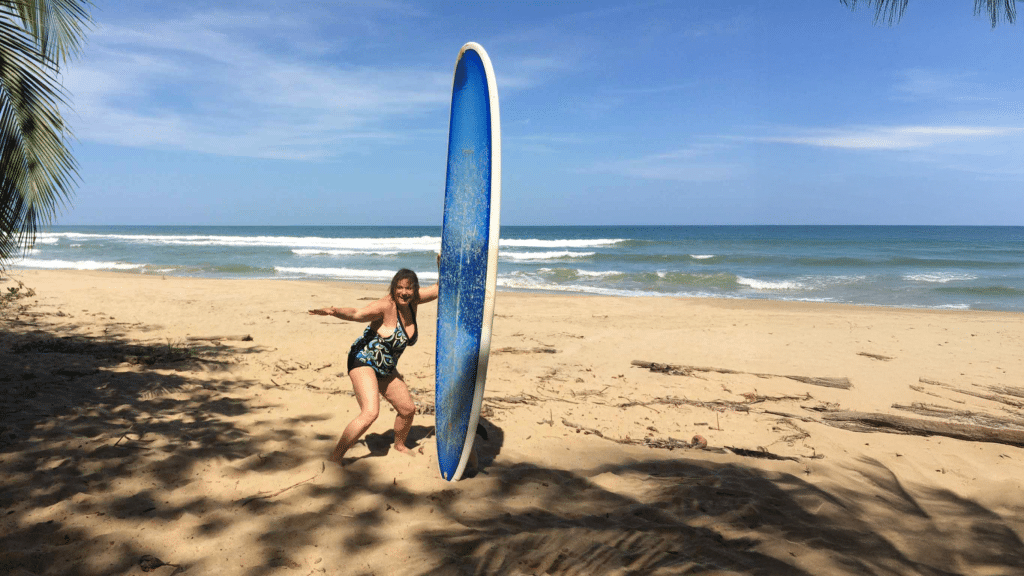
Brittany: I’ve always wanted to surf since I was a little girl. No idea why—I grew up in Colorado most of my life. I am originally from California, but I’ve just always been drawn to the ocean. I even lived in the Florida Keys for a while… no waves there, so no surfing.
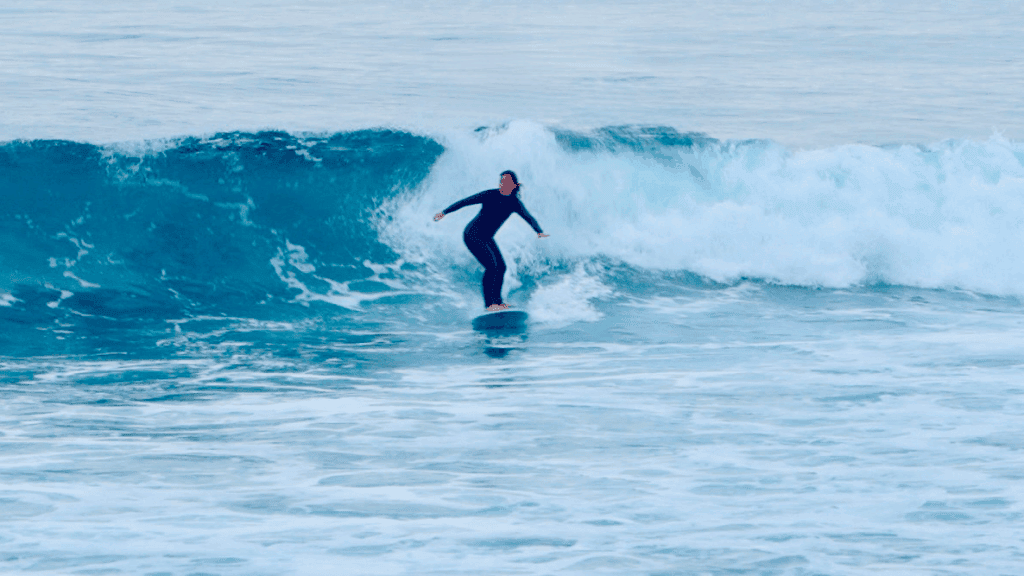
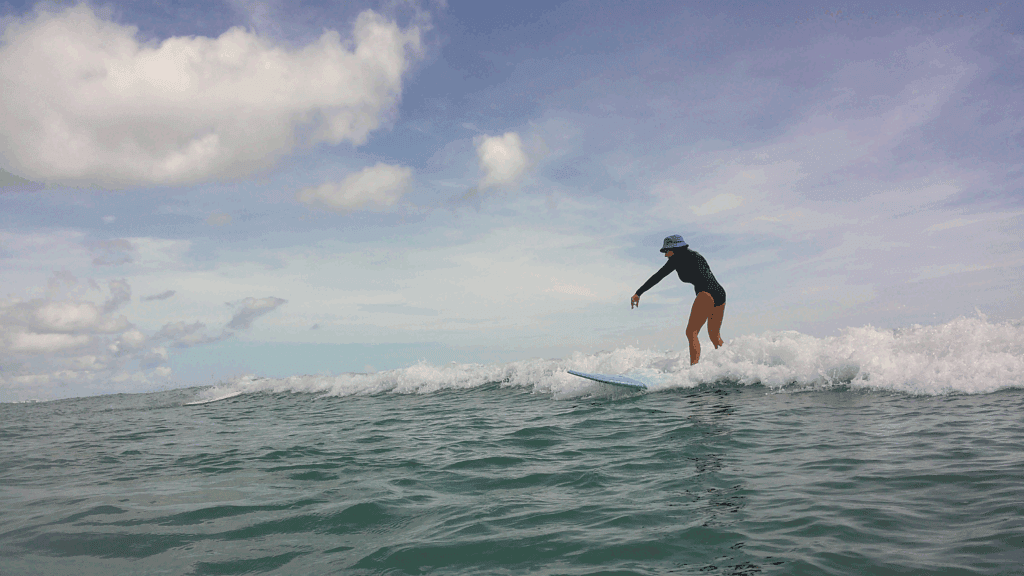
Here in Oceanside, my friend Babsy—who works at Surf & Fire—has been teaching me. I’m doing my best, and wow, it’s hard but exhilarating.
Zuz: Do you remember your first lesson?
Brittany: Oh, a whole lot of nothing happened! I barely got to my knees. But I loved it.
Zuz: What do you think about not using shampoo at all—the “no-poo” method? We’re so conditioned to shampoo then condition.
Brittany: I think it depends on you. Your lifestyle, diet, and health all affect your hair. I’ve seen people just rinse their hair—like one woman on the carnivore diet—and it still looks gorgeous.
Zuz: What about coconut oil?
Brittany: I love coconut oil as a treatment before you get in the water. It can act as a barrier. But too much can be heavy, and it’s not reef-safe. That’s why with Coconut Smuggler I wanted a reef-safe spray that protects your hair without harming the ocean.
Zuz: So your product—when do you use it?
Brittany: You use it before you surf or dive, and after. Before, it creates a barrier so your hair absorbs less saltwater. After, it helps detangle and restore moisture. The key is hydration and sealing it in.
Zuz: What actually makes surf hair such a tangled mess?
Brittany: Salt crystals. When saltwater dries in your hair, those tiny crystals grab onto each other and lock the strands together. That’s why it feels like a bird’s nest. If you can rinse with fresh water right away, you’ll cut down on the tangles.
Zuz: How does someone protect their hair if they’re surfing every day?
Brittany: Freshwater rinse immediately after, always. Use a leave-in conditioner or protective spray before. Wear your hair in a braid instead of a ponytail—it reduces breakage. And don’t overwash; aim for a good cleansing routine that keeps your scalp healthy without stripping oils.
Zuz: Any tips for people with short hair?
Brittany: Same principles—hydrate, protect, and rinse. Short hair might tangle less, but it can still get dry and brittle.
Zuz: What’s next for Coconut Smuggler?
Brittany: Expanding the line—different scents, maybe products for skin, but always ocean-safe. And building awareness that taking care of yourself doesn’t have to mean harming the environment.Zuz: Love it. Thanks, Brittany!
Full transcript
Cool thing about the beauty industry or the fashion industry as a whole right now is that you can do whatever you want. There’s no like trend that everybody has to follow, it’s what works for you. And I love that.
That was Brittany Jones, a saltwater addict, a surf obsessed beginner, and founder of Coconut Smuggler, a new hair care brand for surfers and divers. I know you’re all like, surf hair, don’t care. But hey, some of us have to work pretty hard for our surf hair.
So that’s what we’re going to talk about today. Welcome to the Wipeout Weekly, the daily podcast for beginners, wannabe surfers, and seasoned Wipeout enthusiasts. No hype, no filler, just the highs, lows, and honest truth about learning to surf and finding your place in surf culture. I’m your host, Zuz Wilson. Let’s go out.
Zuz: You are at the very beginning of your surfing journey, which is so exciting.
Brittany: It is, it is. How did you get into it? I have always wanted to know how to surf, like since I was a little girl. I don’t, I lived in Colorado for a lot of my life.
So I don’t even know why I wanted to surf. I just did. I’ve always been drawn to the ocean.
I am from California originally, but a lot of my life was spent in Colorado. So I’m like, I don’t know where this drive to get to the ocean came from. It’s just always been a part of me.
But then I moved to the Keys, the Florida Keys, which do not have waves. So I never learned how to surf there. So here, my friend Babsy has been teaching me and she works for Surf and Fire in Oceanside.
So I’m sure you know Surf and Fire, Kyla. They’re awesome. So yeah, I’ve just been doing my best learning how to surf.
It’s very hard and it’s exhilarating. I love everything about it so far. So you took a lesson from Babsy, right? Do you remember your first lesson? What happened? A whole lot of nothing happened.
I didn’t get close to getting, but to popping up. I mean, I guess I got close. I rode in on my knees quite a few times, but I did not pop up at all my first lesson.
And I just remember being like, well, I’m a sailor. So I love sailboats. And I remember the first feeling of like riding a wave in.
And I was like, oh, this is like sailing. Like when the wind fills up your sails and you’re just like propelled by nature. It gave me that same feeling.
And I just fell in love with it instantly. And after I did stand up for the first time, I didn’t think about anything but surfing for like a week straight. How long did it take you from that first lesson to your second time in the water? About a week.
So I’ve been doing lessons about a week apart. I would like to get in the water a lot more, but I don’t feel like I’m quite ready to go by myself. So I’m kind of at the mercy of when other people can go.
I think I’m almost there being able to go out there in the whitewash, not the lineup, by myself. But right now I’m still needing to schedule with somebody else. That’s how I feel.
So about once a week is when I’m getting out there. That’s fascinating to me because you’re a sailor. So you’re not necessarily scared of the ocean.
Why do you think you cannot go just pick up your board and go surfing on your own? I think I’m still trying to get the rules of the road down. I think it’s a little bit intimidating to go with other surfers right now if I’m not like actively with somebody else that’s helping me learn what people are going to like and not like. So it’s about surf etiquette and knowing it.
You would feel more comfortable if you knew exactly what you’re doing and you should be doing. Absolutely. Yes.
Yes. It’s not necessarily about like being in the water. It’s about being in people’s way more than anything probably.
How do you feel about the lineup? Do you find it a little bit intimidating perhaps? Yeah, I do find it pretty intimidating. I’ve never officially been in a lineup. I do find it intimidating though.
I just hear some crazy horror stories about how mean surfers can be. But honestly, I have not experienced that myself. Everybody, especially women that I come in contact with are so welcoming and so ready to help you learn.
Probably because they’ve all been in the same position that I’ve been in, that I’m currently in. But I feel like people that have lived here their entire lives, that have been doing it their entire lives, maybe they forget a little bit of that humility. And I think those are the people that kind of intimidate you, especially in Ocean Beach where I live.
I’ve heard that the surfers here are quite territorial. I haven’t experienced it yet, but that is something that I have heard. And I’m guessing you’re on a foamy now.
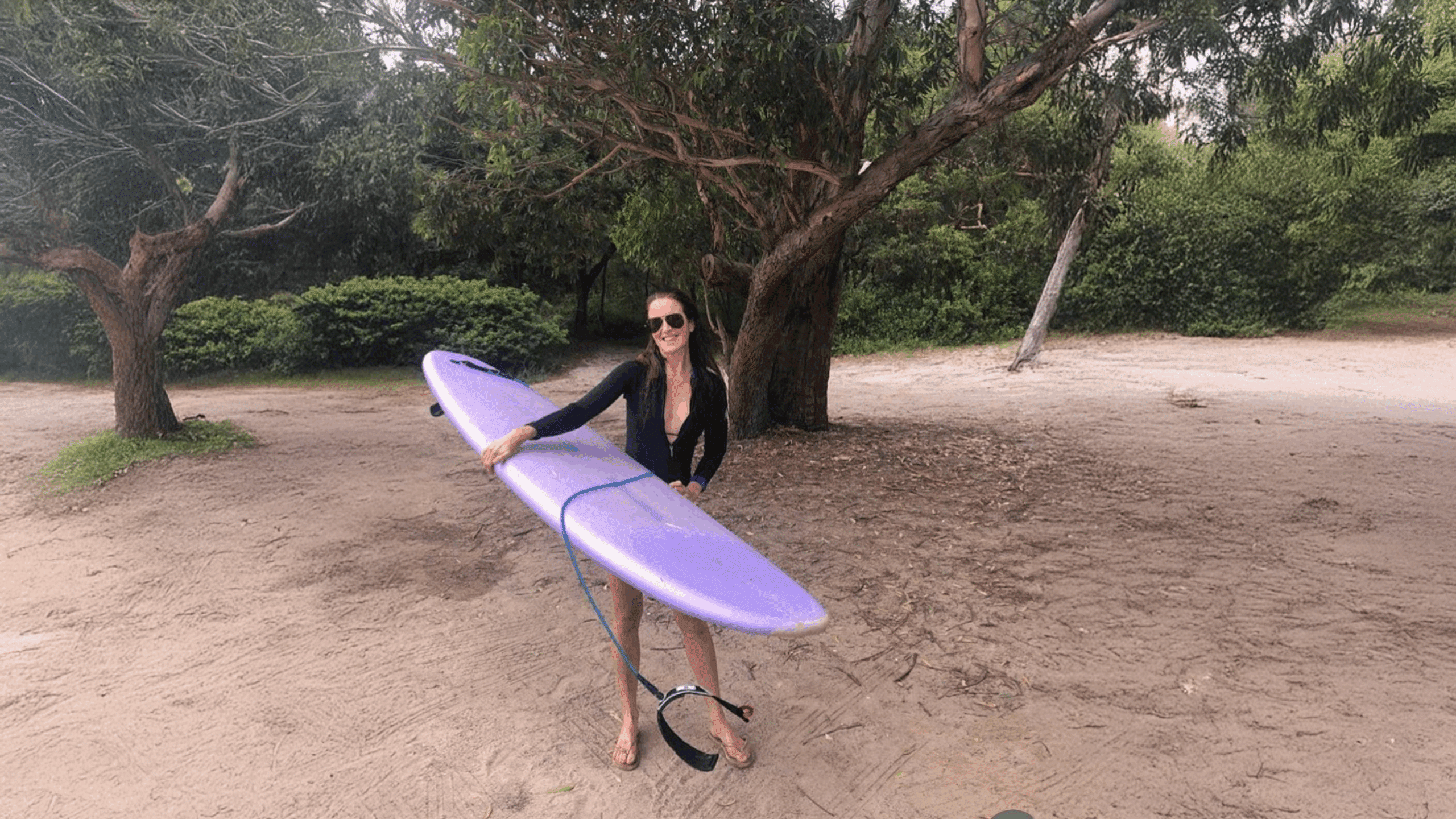
Yes. Yes. I’m on an eight foot foamy.
Yes. Do you find it comfortable? Is it easy to pop up, maneuver in the whitewash? I’m finding it really comfortable. I have an eight foot right now.
I would actually like to try a nine foot because something is drawing me more towards longboarding. So yeah, I think that I’m on the hunt for a nine foot pink foam board right now. So if you find one, let me know.
Very nice. And now you’re surfing in California, but are there any other places where you would like to surf? Oh my gosh. Anywhere where there’s surfing.
I am such a trip taker. I love taking trips. I would love to go on one of the big girls surf trips, the women’s surf trips that are just like all women.
I know they’re all levels and they just look like so much fun. I know Kyla with Surf and Fire just did one in Nicaragua and they just all look amazing. Honestly, I’ll go anywhere.
I go to Oahu on Thursday though, and I can’t wait to try and surf in warm water. Amazing. Are you going to be on the South Shore or North Shore? Um, well, I’ll be in Waikiki.
I’m staying in Waikiki. I’m actually going for the grand opening party of one of my retail partners. So it’s a women’s dive boutique.
So that’s really exciting. It’s called Bright Buoy. Um, and yeah, I’m really excited just to be there.
I, I love Oahu. So I’m excited to be surfing, but I’ll probably be Waikiki. Are you going to take a lesson? Maybe.
Yeah. I actually have a couple of friends there that surf too. And, um, again, I think that because I’ve never surfed Waikiki, I would like to go with someone so I know where to go and what to do.
Um, but yeah, maybe I’ll take a lesson. Maybe I’ll go with a friend. That’s my favorite wave, canoes, because it’s slow rolling and so much time that you’ve got to pop up.
And then you can ride for like 20, 30 seconds. Oh, yes. That sounds amazing.
And you’re going on Thursday. Yes. Actually, right now there’s a huge swell on Oahu.
So I wouldn’t probably be able to surf there right now, but maybe it’ll settle down by the time I get there. Do you think you can progress in surfing if you’re only going out surfing once a week? No, I don’t. I do not.
I actually, the first lesson that I took was probably about six weeks before the second lesson that I took. And it was like, almost everything was out the window. Again, I was comfortable in the water, but it was like, I almost had to like re-learn everything.
And, um, then after I went a couple of times in a row, I started to get it. So I do. I think that you have to go more often.
Is there anything from sailing that translates into surfing? Do you think? I do. Um, I think having to read the water, read the winds, I think all of that comes into play with surfing. Um, I went on a really windy day a couple of weeks ago and it totally changed the waves, uh, which I didn’t really realize was a thing before I started surfing.
Um, so I, yeah. And the feeling, just the feeling alone, I think is very similar to sailing. You’ve only started surfing, so nothing bad happened to you? No.
You were not sure of yet? No. The first time that I did actually stand up though, I was only in probably two feet of water and there was a stingray directly under me and it was trying to get away from me the whole time, but we were going the same direction and I was terrified I was going to fall in the stingray. Um, but yeah, I didn’t.
So it’s all good. And you are our resident hair care expert. I’ve been doing some research in preparation for this episode because we are going to talk about the ocean and the hair.
And I wanted to learn more about the history of hair care in general. And it’s a very, very long history and we’re not going bore you to death with that. But what I am curious about is, how do you feel about these more recent trends, trends, friends, trends, in hair care, specifically the no poo hair diet? I mean, I think that there is a lot to it.
I think that, um, a lot of what you’re able to do depends on your lifestyle, even like down to your diet, your, your health level, all of that, because that is the first thing to affect your hair. Um, but I do know people that are on certain diets. Um, like one lady specifically on the carnivore diet and she does not wash her hair at all.
She just rinses it and her hair looks gorgeous. So I think, I think that there’s a lot to it, but I think it depends on you and your lifestyle. This is hilarious because you brought up an actual diet and I was just talking about not using a shampoo at all as in like no poo hair diet.
What do you think about not using shampoos? Because we’re so conditioned in a way that it’s like you usually use a shampoo and then you use a conditioner. Yes. Yeah.
I mean, I think, like I said, I think it has a lot to do with like your lifestyle and if you need to wash your hair or not. And it has a lot to do with your hair texture to begin with. So I only wash my hair probably once or twice a week, but somebody with finer hair that gets a little bit greasy, a little bit heavier, faster, they might need to wash every other day.
So it’s so specific to you and like your lifestyle and your hair texture. Um, but I do think that there’s a lot to like the no poo culture, especially with curly hair. It’s that they actually do curly hair does really, really well with your natural oils and sebum.
So if you don’t, if you just like rinse your hair and scrub your scalp and you don’t use a detergent shampoo, then you’re good to go. It takes a little bit of training, but yeah, it just depends on you and your lifestyle. What about things like the apple cider vinegar rinses and rice rinses and aloe vera? I think it’s great.
Honestly, um, that the apple cider vinegar has a lot to do with your pH. Um, and whether or not it works for you again, depends on your hair type, but I do think it’s a great cleansing agent and it balances your pH just like it does in your body. Um, aloe vera is fantastic and, um, it’s actually in both of our hair products right now.
Yeah. So it’s really, really great. Um, and then, sorry, what was the other one you mentioned? Rice.
Rice. Yes. So, I mean, in Asian cultures, they’ve been rinsing with rice water since the beginning of time and it’s, it’s really great for your hair.
I cannot imagine using a solid shampoo bar. I, I, I even cannot fathom how this would necessarily work for my fine hair, but this is another trend, right? Yes. Yes.
And it’s funny you should say that I’m actually using one right now. And there are two that I really love. Um, am I allowed to talk about brands? Absolutely.
Okay, great. Um, so Flora Flora, I really love. They are all natural.
You can actually find them in Whole Foods here in California, I believe, or just online. They are local. They’re, um, San Diego company.
Uh, but they are, I, I love their shampoo bars. And as a hairstylist, I never thought that I would say that. Um, and then the other one that I really like is dip the dip shampoo bars.
They’re really awesome. And they actually do have some surf hair care products as well. Um, but yeah, I love a shampoo bar.
It lasts forever. They’re really easy to use. And I just started using them probably like six months ago.
And I, I’m a believer. I love I like them. They never used to be good, though.
So let me clarify with that. I think that the newer ones coming out, they and we’ve actually been doing research on creating our own coconut smuggler. But the ones that I’ve been trying, I’m like, I love these.
So maybe I’ll just use theirs and come up with other things that aren’t good on the market. So how do you actually use them? Do you just like wet them, create lather, and then just use it? Yep, exactly. Or I sometimes will just take the bar like directly to my head to help it.
That’s how I imagined I would be using it. I’m like, no, this is not gonna work. Yeah.
The conditioner bar, my hair is wet. And I just literally like rub it all over my strands and then rub it in. Here you go.
I’ve learned something today. Yeah. I highly recommend trying the two I recommended.
Okay. I might give it a try. What about cleansing shampoos that I keep hearing about? And I even have a couple.
Do they actually work? Are you are you referring to like the deep cleansing shampoos like clarifying shampoos? Yes. Yes. Okay.
So yes, they do work. But you do have to be careful. A lot of them will really strip out your color.
A lot of them are very, very drying. There are a few on the market that I actually really do love. Um, Davines has a really good one that’s safe for your color.
And it’s a little bit more gentle. But yeah, clarifying shampoos are great. My hesitation with somebody that’s in the saltwater a lot is you’re already taking so much out of your hair every day.
So and saltwater is a natural exfoliant. So you’re kind of already deep cleaning your hair. So I don’t it’s like, unless you’re putting something in your hair every day.
For example, if you just went for straight coconut oil or straight shea butter to put in your hair to protect it every day from the salt water, you might need a clarifying shampoo to get that out because that would build up on your hair over time. Great. I want to talk about shea butter.
And then protein is another one. Olaplex is like one of the conditioners that are masks that you’re encouraged to use by hairstylists. Yeah, Olaplex serves a specific purpose, and that is recreating synthetic bonds.
When you’re when you’re lightening your hair or using a lot of heat on your hair, or you’re in the sun and saltwater a lot every day, you’re basically breaking down those bonds in your hair. And Olaplex basically makes a synthetic bond to help hold those chain links in your hair together. So but what Olaplex does not have a lot of is moisture.
So when you’re like linking those bonds, linking those bonds, and then you aren’t moisturizing your hair, and this is the same for protein, even though Olaplex and protein treatments are different, you have to have a balance of protein and moisture. So if you have too much of one thing and not enough of another, it’s not good for your hair. So what is shea butter supposed to do for your hair? It’s supposed to be ultra moisturizing, but it can for some people it can.
So this is tricky to explain, but you still need a moisture exchange with hair and shea butter or waxes, anything like that can really create a heavy barrier on your hair that doesn’t allow for that moisture exchange anymore. So while it’s supposed to be ultra moisturizing, it can actually be long term drying your hair out. I think that’s what is happening to my husband’s hair.
Mystery solved. Yes. And curly hair is naturally drier and a little weaker.
So because it’s I mean, I think this is a voice only podcast, but basically it’s like a cylinder and flat and cylinder and flat all the way down your hair strands. So where those flat spots are is actually like a little bit weaker. So curly hair is naturally drier and weaker.
That’s why it creates so much moisture. This explains a lot. What about heat protectants? Heat protectants like UVE protectants or hot tool protectants? I think it’s like should we, living in California, being exposed to the sun constantly and hot weather sometimes, should we be using anything in our hair to protect from the sun? Yes, absolutely.
Absolutely. And there are a lot of things, especially when you’re in the salt water, like a lot of the oils that we use in our products, passion fruit oil, for example, avocado and coconut oil, they all have like that natural UVE protectant. That’s why it’s also important to not use something that’s too heavy on your hair.
Again, for the moisture exchange, you want something breathable because if you coat your hair, I’m sure you’ve heard the rumor that coconut oil will actually dry your hair out and wreck it in the sun. No. Well, it’s not.
It’s true, but not true. So what’s true about is if you take coconut oil, like straight out of the jar, cooking coconut oil, and you slather your hair in it, you’re basically making an incubator because there’s no room for the hair to breathe. There’s no moisture exchange happening.
It’s not breathable. So basically everything’s kind of getting baked on your head. Yeah.
Which you don’t want. We did a lot of research on this when I was trying to come up with our formulas because there’s a lot of formulas out there. And I just really wanted to make something that worked after listening to all of my clients.
You know, I still do hair full time. So listening to all of my clients woes and, you know, talking to them about what they’ve tried and what they’ve been using. Yeah.
It’s just, it’s very important to have a breathable product. So let’s talk about Coconut Smuggler and let’s talk about taking care of your hair. If you’re a surfer and spending a lot of time in the water, how did you start the company? So I actually started the company when I was living in Key West on my sailboat.
I was doing hair full time there and all of my clients. And I mean, all of my clients were in the water a lot. And every single one of them would ask me, how do I protect my hair in saltwater? And then I heard some of the craziest stories.
Like one woman told me that she would slather sunscreen on her hair because she felt like, yeah, like water resistant sunscreen, because she’s like, it’s the only thing that doesn’t rinse off. And I’m like, okay, but that’s not made for your hair. So I started doing some research and what I thought was just going to be a fun little project for me to give to my clients actually turned into this fun brand that I created.
But that’s how I got started is just like listening to my clients. And it was about two and a half years ago when I started working with a chemist and really doing a lot of research on it. And then we just launched like we did a soft launch last year and then really launched the beginning of this year.
I actually would like to ask you about more detail about how you go about it from the idea that you have in your head. And then how do you even find a chemist who can help you with it? And then how do you work together? Honestly, that was probably one of the hardest parts that in the sense, but we’ll get to that later. But I’m finding a chemist because this is not information that’s just like readily available online.
Like it’s it’s kind of a difficult thing to just Google. It’s a hard thing to find a chemist that works in the area of expertise that you want. There are tons of white label companies out there that have bulk products and you could just slap your label on it and call it good.
But I did not want to do that. I wanted to create my own. I wanted to listen to my clients, create my own formula and use the ingredients that I truly believed in.
So finding the chemist took a while. It took a lot of interviews with the chemist, but I finally did find one in Florida and that entire process probably took about a year from like talking to them to having an actual formula to go to a manufacturer with. And then is this like a collaboration? How do you how do you go about it? How do you decide what goes in the in the product itself? So it is sort of a collaboration.
So I went to the chemist and I said, this is the research that I’ve been doing. These are the ingredients that I want to use. And, you know, the reasons why I told them how I wanted it to feel.
And I told them, of course, the purpose that I wanted it to have. So then we went into an entire ingredient breakdown. So first, the first thought that comes to mind is conditioner, right? I want to put conditioner on my hair to protect it from whatever.
Well, that’s a conditioner is great, but it is actually water based. So water and water mix. So as soon as you hit the waves, your conditioner comes off, like it might last for a little while.
So then I went into thinking, OK, well, what works in nature? What do we know? Well, ducks stay dry under their feathers because of oils. Oils are literally what causes water to roll off a duck’s back. You know that saying water off a duck’s back.
So that happens because of their natural oils. So then we started thinking about our hair’s natural oils, our hair’s natural lipid layer, which is what protects it in nature. And we basically just took what would mimic your hair’s natural lipid layer and enhanced it.
So that’s why the feeling naughty, the pre-ocean serum, that’s that’s why it works so well, because it literally mimics your hair’s natural lipid layer. It closes down your cuticle and it’s still breathable. It still has that moisture exchange, but it’s it’s easily rinsed out and it just protects your hair the way nature intended, really.
And the chemist just goes into the lab, adds it all in, mixes it in and then you try it. So, yeah, I was living in the Keys and I would take my little dinghy off my sailboat, go into the Atlantic Ocean, I’d jump in, I’d snorkel, I would do whatever. Or I worked on snorkel boats, so I would take my test products and have people test them out.
Yeah, a bunch of tourists got to try my products before I released them. That was fun. So, yeah, just every day, like I was living it.
So I got to try them in real life conditions every single day. And then we finally found the one that I was like, yeah, this is this is the one. This is the one that is working the best.
We tried like more solid products. We tried a little bit more conditioner based, but really the blend that we found with the avocado, the aloe vera, all of it, that’s that’s what worked the best. And then you worked on the scent.
Then we worked on the scent. Yes. And the scent was so difficult.
We probably I mean, I probably went through 20 scents, especially because I wanted it to be more natural, non-toxic, you know, the things that make a scent last, anything like that. That’s where that’s where the toxins come in. So finding something that was more natural and non-toxic was a journey, but we did it.
So was it working with the same chemist on the scent? No, there’s there are several different scent houses. There’s probably a lot of different scent houses, but there’s just several big scent houses that basically control like all the world scents, which is really interesting and something that we can get into another time. But yeah, so I told them exactly what I wanted it to smell like.
I actually sent them samples of scents that I liked. I even sent them a bottle of sunscreen because I don’t I’m sure you can tell like I wanted it to have that nostalgic beach smell. Every time somebody smells our product, they say this smells like my childhood.
It smells like beach days. It’s like that nostalgic scent and that’s exactly what I wanted it to have. So I sent in sunscreen.
I sent in coconut essential oils. I sent in so many different things to this company and we finally landed on one that I loved. And it’s probably one of the most centering things on my product line is how it smells.
To me, it smells like Hawaii. I mean, actually, it smells like the inside of Juke’s bar in Outrigger. Yeah, it’s very, very specific.
I’m gonna go. I’m gonna go on Friday. Go and smell it.
How did you decide on the name? Did you do a little bit of a branding exercise or did you have something in mind already? So the keys have a big history of smuggling. They have like a big smuggling history. And I wanted it to feel like old island vibes.
I like my packaging is very retro, has kind of like the old Florida look to it, which I love. So I just wanted something that was kind of cheeky, kind of funny that would stick with you. And I want you to smell like you’re smuggling coconuts everywhere you go.
So yeah, so I guess a branding exercise, but really it was just let’s tie in this old island lifestyle with yeah, smuggling coconuts. Did you work with a branding person or with a designer? Yes, I did work with a branding person. We have actually completely changed our branding since then, but she was wonderful in helping me find our voice, find our brand pillars, everything.
She was really great. She actually lives in Hawaii now and has a new baby. So she’s doing great.
So tell us more about the products that you make because you’re making three different products. Yes. So the first one I’ll talk about is just the scent because the scent is probably like the pillar of the brand that kind of brings it in all together.
Everybody loved the scent of the products that I made so much that I actually just ended up bottling it in a little purse size roller. So people have it in their car, they have it in their purses, they have it everywhere. It’s just like a great everyday sense.
I get compliments everywhere I go. It’s just, it’s so good. The number one product and how this brand actually started was Feeling Naughty.
Naughty like nautical. So I have Feeling Naughty, everything ocean, and then Land Lover, everything land. It’s very easy to remember.
So Feeling Naughty is our pre-ocean serum. You just spray it in your hair, which I love. I also wanted something that was like super easy, no sticky hands.
You just like spray it and go. It’s so easy for your beach bag. So Feeling Naughty is probably our pillar, our number one product.
And it’s just designed for women and men that are always in the water. Just keeping your hair healthy, something super easy to use. Yeah.
I love that product. So do I. You do? Good. What do you like about it? Well, I love the scent.
And I also have very, very fine hair. So I find that it’s any product that I put in my hair, it just weighs it down. Yes.
For the first time when I used the spray, the pre-surf spray, and I went out surfing, um, I could actually comb through my hair because usually it looks like, you know, I just came out with this massive bird’s nest. Yes. Yes.
Because it’s shorter hair. It just goes everywhere when whenever white water hits. But I could actually comb through it with my little brush and I didn’t wash my hair and I just left it.
And it looks super surfy. And I’m like, oh, my God, I’ve got surf hair for the first time. And that’s what I what I love about it.
Oh, that is so awesome to hear. That’s exactly how I designed it to feel. So thank you.
And then I use just a teeny, teeny, tiny bit of Landluber after I’ve washed my hair. Because again, if I put any more, like if I spray it on my hair, it’s going to weigh it down. But if I spray it on my hands and just touch it gently.
Again, it just looks, it smells, looks good, smells good. Oh, I love that. Yes.
Yes. What’s not to like? Yeah, exactly. There are so many products out there that are now targeting surfers and divers.
I’m guessing most of them, if not all of them are reef safe. And we’ll talk about it in a second. But I’m curious what sets yours apart.
And I think you already touched upon it because you were talking about you trying to mimic the oils that naturally occur in your hair. So I think what really sets mine apart is just the real life relatability. I mean, I live and breathe hair every single day.
And I listen to my clients and my surfing clients and my diving clients, more surfing here, more diving in the Florida Keys. And just really listen to what products were working for them or what products were not working for them and why. So I think that’s literally what sets us apart is that I just literally live and breathe hair.
So our products are definitely like salon quality products. I made sure of that. But I am very low maintenance as a hairstylist.
I encourage my clients to be a little bit more low maintenance. And I tend to be a little bit more natural. So all of the products that I have that I work with are low tox or no tox.
And I wanted my products to be that way as well. So we use as much nature in our products as we possibly could. So I think that’s what sets it apart.
Also the fact that we just like really dug in with the chemist and researching different products, the breathability, the, I just completely lost it, the breathability, your hair’s natural oils, all of that stuff. It just really all comes into play when you are wanting to do everyday protection. Now I’m sure that there are heavier products that work great.
If you’re going to be in the water for, you know, eight hours at a time, I’m sure that there are products that work really great. But if you’re just going out for your morning surf, you’re going out for a quick snorkel, you’re just enjoying a beach day. You don’t want all of that heavy stuff on your hair.
You want something that’s going to be breathable and it’s going to feel good no matter what. The important thing for me when creating this product, well, first of all, I worked on sailboats. So I would go out for multiple days at a time and take clients out and we’d go snorkeling and do all of that.
Well, we’re conserving water on a sailboat. I wanted something that would just rinse out of my hair. I can’t take a cleansing shampoo to my hair every day when I’m literally living on a sailboat for a week, you know? So I needed something that was going to rinse out really clean without a lot of effort and just make your hair feel good afterwards.
So anything that was extra heavy, like I have a lot of hair, I have very thick hair, but coconut oil, straight coconut oil is too heavy on my hair. I would have to completely shampoo it out. That’s just not always an option.
So I think that sets our product apart too. What do you have to do to be Reef Certified? So Reef Certified, there’s a bunch of different companies that offer Reef Safe certifications. Basically, there’s a couple companies that test your products.
There’s a couple companies that just look at your ingredients and your certifications that will give you a Reef Safe certification. So Reef Safe isn’t really worldly recognized in the same way. So really, a lot of different products could be considered Reef Safe.
We didn’t have to get a Reef Safe certification, and maybe it doesn’t mean a lot in the grand scheme of things, but what I wanted to do was make sure that I was doing the best that I knew how at the time. So when I have a Reef Safe certification with a company, if anything new pops up, they email me. They keep in communication.
So that was the big thing for me, is we’re always going to do the best at the time that we know how and always strive to do better. So I went the extra mile for the Reef Safe certification. Some companies don’t, and I respect that because they’re like, it’s a gimmick, you know, and it could be, maybe, but I wanted to make sure that I went that extra mile and that I’m always getting the information fed to me.
I was thinking about it because we as surfers, we don’t think about it every single day. We wash our hair and we put products in our hair and then we go out surfing, right? But it would be nice to know that we are not polluting the ocean. So whenever I see that something is Reef Safe, it gives me that peace of mind.
Absolutely. Well, and everything that we, you know, rinse down our drains or anything like that, like it could end up in the ocean. So we do have to just be careful in everyday life too.
We talked a lot about products, things that you have to buy. I just want to check something with you that I heard that it works. If you don’t want to put any products in your hair, but you still want to protect it, is it enough just to use fresh water and basically moisturize it before you go into the ocean? Yeah.
So if you don’t want to use any product, it is still important to wet your hair with fresh water. When you wet your hair with fresh water, you’re basically filling it with that fresh water. So it makes it harder for salt water or even pool water to penetrate.
It’s extra important in the pool because you really don’t want that chlorine in your hair, especially you as a blondie. But yeah, if you don’t want to do anything else, just rinse your hair with fresh water. It’ll make a big difference.
Yeah, I am not a natural blonde. So let’s talk about bleaching. None of us are.
What is worse for your hair? Is it a week of surfing or a week of bleaching your hair? Okay, I love this question. Okay, so let’s see. I would say that a week of bleaching would be like burning your entire house down.
But a week of surfing is like leaving your windows open during a storm. Okay. So bleaching is way worse, yes.
But unprotected salt water is still not ideal. I’ve got a question. I just need to think of a way of formulating it.
And I don’t know, this is just popped into my head. Okay. But does ocean water strip the color? Yes.
Yeah, it does. Yeah. So salt water is a natural exfoliant.
So think of like salt scrubs for your skin. It’s just like scrubbing all that dead skin and everything off or the first layer of your skin. Basically, salt water does the same thing.
It’s a natural exfoliant. But does it also mean that ocean water cleans your hair? Sort of, but it’s the same thing. It’s like you’re using a salt scrub on your skin, but you’re not actually, you know, cleaning your bits.
What is your pre-surf and post-surf routine? Because you talked about not washing your hair. Like I have to wash it every other day, at least. But you can go on for much, much longer.
What does your week look like if you go out? Well, I’ve mentioned before, I’m a very natural, low-maintenance girl. I actually am very lucky where I have a pretty nice natural wave in my hair. So actually, when I use the Feeling Naughty and go surfing or go snorkeling, diving, whatever I’m doing, and then I just do a freshwater rinse after, my hair is great.
Yeah, so I really don’t have to do a lot. I think I can probably go three more days. I am so jealous.
You can’t really anyway, right? Salt water or not, your hair has a finer texture. Is there anything I can do to prevent the whole bird’s nest kind of situation in the surf? This is probably less about the products, but just like how to secure your hair. Yeah, so the bird’s nest is a lot about friction in the salt water.
And when you don’t use a protectant, like Feeling Naughty or whatever you’re using, so your strand, your cuticle is made up of fish scales. So it just looks like little fish scales going down your cuticle. And when you don’t use anything to kind of smooth those out and keep salt water from going in there and lifting those up and swelling your cuticle, the friction is what causes the tangles.
And then you add like the fact that it’s stripping moisture out of your hair. And that’s how you get the bird’s nest. So is there anything you can do to completely prevent your hair from getting tangles? Not really.
There are a couple different products that I am experimenting with right now. One of them is Sassy Wraps. So somebody with short hair might not benefit as much from it, but somebody with long hair, it’s basically two ties that go all the way down your ponytail.
Another similar one is Rip Tie. So that keeps all of your hair like intact together. Another thing that I have been curious about and I’ve used for diving is a headscarf.
And that really keeps all of my hair in place for diving. And it prevents my mask from like harming my hair. So those are two things that I would like to incorporate into surfing that I have used diving.
And I’ll let you know what I find out because I don’t know how well a headscarf would stay on my head surfing. But I’m curious to try because that would prevent your hair from swishing all over the place. But if you do use like an oil based product, like you said earlier, your hair was able to be brushed out really, really easily.
There’s not really much you can do to completely have your hair tangle free because it’s more about friction. But there are things that you can do like applying the oils or using a Sassy Wrap or a headscarf to keep it from flying all over the place and with the friction. So you’ve got three products right now.
I am curious what you’re going to develop next. So there’s a couple things already in the works. We are actually creating kind of more of a, well, this is all gender neutral, but we’re making it a little bit more gender neutral.
We’re going to make the scent a little bit more woodsy and appealing to men, even though men really do love the scent that we currently have. They’re a little less likely to use it. So we’re using, we’re going to use our products now, but also make a whole new scented line.
So that is in the works. That’ll be coming soon. I’m also developing a post surf or post dive deep conditioner.
Interesting. Yes. Do you think there is a difference in the products that a diver would need and a surfer would need? There are not, not really.
I think it depends on the type of surfing and diving that you’re doing. Again, if you are in the water all day long diving, you might need to like reapply the feeling naughty once or twice. But no, I think that, I think that they’re very similar.
When you’re underwater, you’re like being wished and washed around a lot and your hair is all over the place. So I think it’s a lot of the same thing in diving. I think the only thing that is different is the UV protection.
Oh, yes. Because you’re in the water. You’re in the water.
Yeah, yeah, exactly. So, yeah. But with us, our avocado, our passion fruit oil that has you covered as far as UV goes and it’s ultra nourishing too.
Is there anything in the haircare industry that is coming out that we, you know, consumers haven’t heard about yet, but you might already know about new things, new trends? That’s a great question. The only thing that I can think of off the top of my head really has nothing to do with surfing or diving, but there is, there are like new pills or supplements that you can take that supposedly take your gray hair away. No, really? Yeah.
So, I mean, gray runs in my family. So if I decide to try it, I’ll let you know. Um, but yeah, that’s a new interesting thing that I’m like, how does that work? But also I’ve heard multiple things like copper affects your gray levels, B vitamins affect your gray levels, you know, all of the different things like that.
So maybe, maybe it works. I can’t see that anything would take your gray completely away, but maybe it’ll delay it. I don’t know.
Sounds fun. It does. It does.
I hope it works. Right. Let’s end on a fun note.
I am very, very curious. What is now the most requested haircut of 2025? Haircut. It’s lots and lots of layers.
People are, you know, last couple of years were all about the blunt cut. And right now people are bringing back the classic Jennifer Aniston layers. A lot of shag haircuts are back.
Um, they’re calling it different things now, of things like that, but basically it’s a shag. Um, yeah, so lots of layers, lots of body is coming back where I feel like before it was very blunt, very, and that’s still a thing. I think the cool thing about the beauty industry or the fashion industry as a whole right now is that you can do whatever you want.
You know, there’s no like trend that everybody has to follow. It’s what works for you. And I love that.
I love it too.
And that’s all for today. Check out The Wipeout Weekly for our free newsletter, more stories and ways to connect with us. Thanks for listening. See you tomorrow for more of The Wipeout Weekly.