
Now Reading: Rincon: Malibu’s little, colder sister
-
01
Rincon: Malibu’s little, colder sister
Rincon: Malibu’s little, colder sister
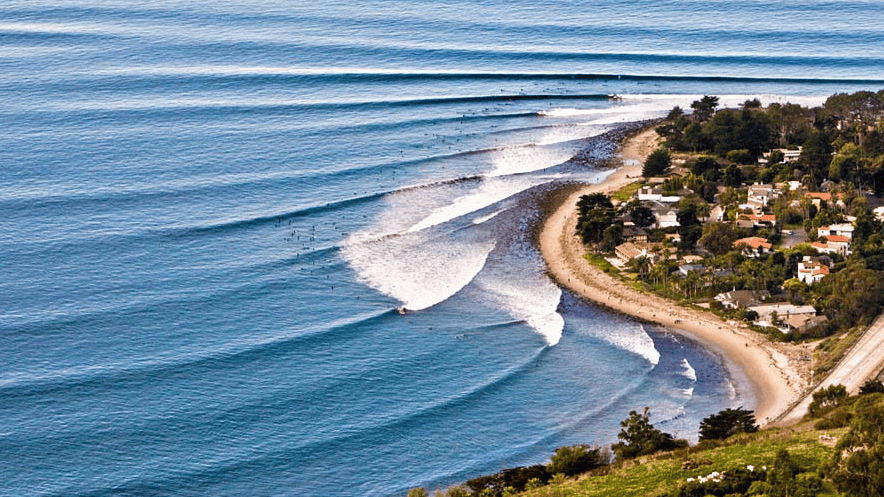
Did you know Malibu had a sister? She’s called Rincon, and you may know it as that surf spot where dolphins frolic with surfers. But despite having three points just like Malibu, these spots have a different surfing vibe. Malibu is warm and sun-washed, Rincon is on the chiller side, in the low to upper 50s. So not twin sisters then.
Rincon is often dubbed the “Queen of the Coast” and is widely regarded as one of the most iconic surf breaks in the U.S., beloved for its long right‑hand point waves. You can find it in Southern California—specifically, Rincon Point inhabits the borderline between Santa Barbara County and Ventura County.
Three for the price of one
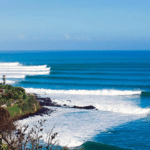
And you get three for the price of one, because Rincon enjoys a three‑section setup that offers distinct surf zones:
Indicator is the outermost section—it’s exposed and often the biggest when swell is strong. A thicker wave that often runs for 75 yards before hitting a section in front of the Rincon Creek rivermouth.
The Rivermouth (or Second Point) is the middle section—often more accessible but still powerful. It breaks for about 50 yards.
The Cove is the innermost section and most famous for long peeling rights that run down the point for up to 300 yards. Matt Warshaw calls it “so perfectly tapered as to be nearly hypnotic” in the Encyclopedia of Surfing.
When conditions align—right swell direction, period, tide, wind—all three sections can link into one long ride. According to Matt Warshaw, Rincon “is best from four to eight foot; it can get up to 12 foot, but waves of that size are often stormy or weather-beaten. Five-hundred-yard-long, 90-second rides from the Indicator through to the Cove are rare but possible on bigger swells.”
️ Best time to go
If you want to try it, now’s the time—because Rincon season starts in late fall and runs through spring. For the best waves, you’ll need a west to northwest swell that wraps correctly into the point. Low‑to‑mid tide is often preferred. And let’s not forget offshore wind. Don’t we all like a bit of offshore.
Rincon is iconic, so obviously it gets nutso busy when it works. But if you know what you’re doing, it’s worth the stress.
Surf history throwback
The first person to surf Rincon is universally recognized as Santa Barbara County lifeguard Gates Foss in either 1938 or 1939, according to the Encyclopedia of Surfing. He called the break “Three Mile,” as it was located three miles below the town of Carpinteria.
In the late ’40s, Malibu surfers descended onto Rincon—including Bob Simmons, Joe Quigg, and Matt Kivlin. Super fun fact: apparently Joe Quigg designed what many people regard as the first specialized big-wave surfboard in 1948, after waking from a dream in which he had connected a wave from the Rivermouth into the Cove.
A wave so perfect, it’s rude to move
“At times the wave is so close to perfection,” surf journalist Bill Cleary wrote of Rincon del Mar (Little Corner of the Sea) in 1966, “that maneuvering—nose rides, turning and cutbacks—seems inappropriate, an insult to the dignity of the wave.”
So close to perfection… but according to the Encyclopedia of Surfing, sewage runoff has traditionally been a problem over the years. The Rincon surf was declared off-limits 84 times by county officials between 1996 and 1998 due to high fecal bacteria counts.
Not entirely sure how much better it’s gotten in recent years, but nearby Goleta Beach experienced a massive sewage spill in early 2024. What’s worse—they forgot to tell everyone and didn’t close the beaches for about six days.
Still, Rincon was included in Surfing magazine’s 1981 list of the “Ten Best Waves in the World.” In Surfer magazine’s “100 Best Waves in the World” article, Rincon polled at #19.
In short: if you can surf it, do.