Now Reading: On how surf forecasts could suck less with Gavin Bechtold
-
01
On how surf forecasts could suck less with Gavin Bechtold
On how surf forecasts could suck less with Gavin Bechtold
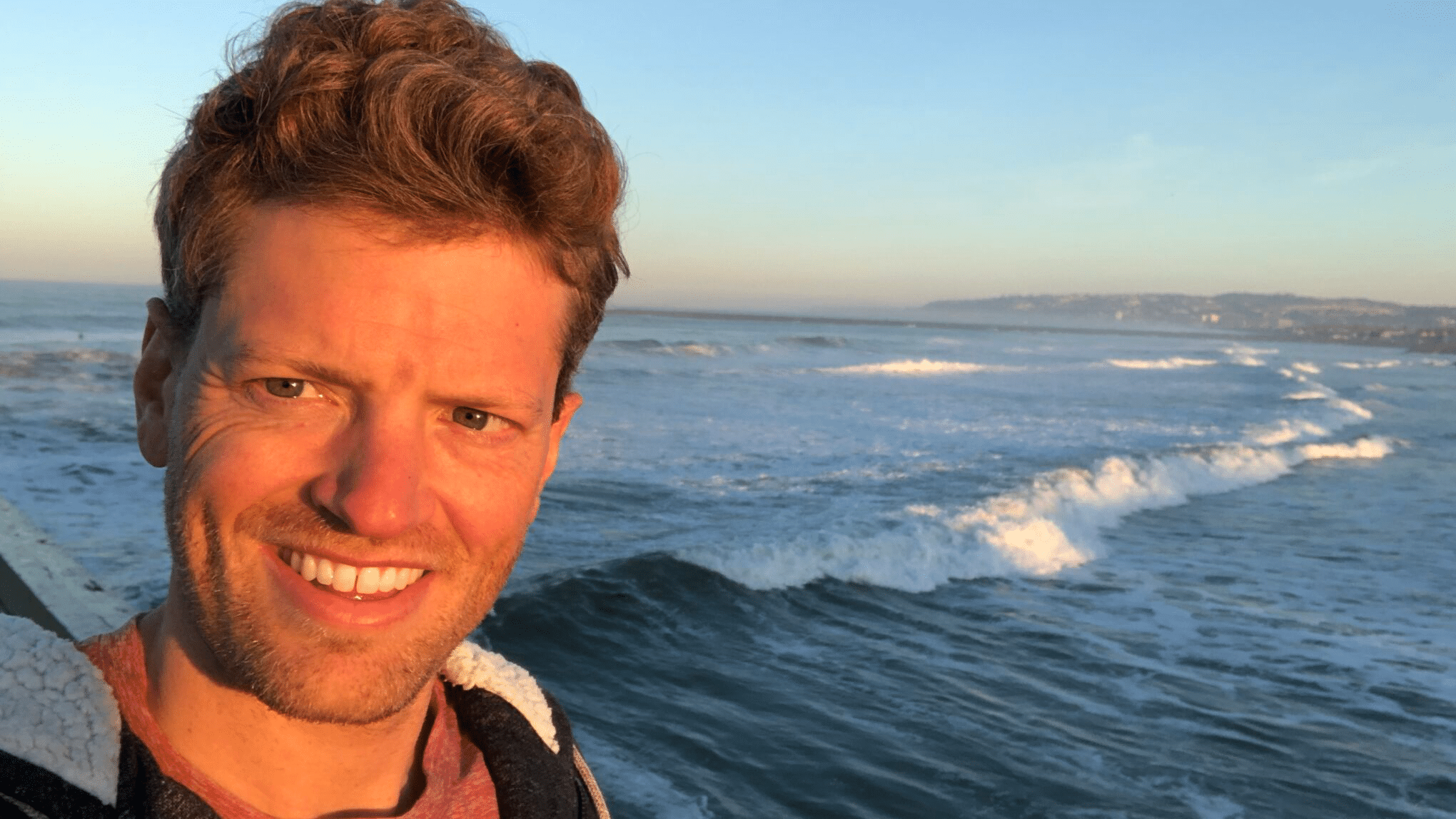
You can listen to The Wipeout Weekly episode with Gavin Bechtold, San Diego surfer and the man behind Go Surfing San Diego and The Sunday Stoke surf newsletter below or on your fav pod platform.
This Wipeout Weekly podcast episode transcript was abbreviated to a blog post format by my good friend Chad (ChatGPT). He takes liberties, you know.
You will find the full transcript below it. Host: Zuz Wilson | Guest: Gavin Bechtold
Gavin: I grew up in Connecticut—no surf there, obviously—but I was into snowboarding and wakeboarding. When I moved to Pacific Beach in San Diego, I was like, “Okay, time to learn.” Bought a big foamy and just started paddling out.
Zuz: No lesson?
Gavin: Nope! Just me and my friend who surfed. He gave me some tips, but it was mostly DIY.
Zuz: Do you remember your first session?
Gavin: I might’ve popped up for a second… maybe. What I do remember is the first time I rode a wave for real—fully hooked after that.
Zuz: Did anything surprise you, being a good swimmer already?
Gavin: Totally. The ocean changes all the time. Wind, wave shapes, directions—it’s chaotic when you’re new. Learning to read waves took a while.
Zuz: How’d you figure it out?
Gavin: Just time in the water. Watching waves, talking to friends, YouTube maybe. But the biggest thing? I surfed every single day for about three months when I first moved here. No job. Just waves.
Zuz: Surf dream life. Do you think that daily consistency made the biggest difference?
Gavin: 100%. If I had a full-time job right away, no chance I’d have progressed like I did. Most people learning once a week? Progress is slow.
Zuz: What’s your magic number for surf frequency?
Gavin: At least twice a week. Enough to build on what you learned without forgetting it.
Zuz: What about surf trips? You learn on vacation, then take a month off. Is that progress wasted?
Gavin: Yeah… it’s like trying to learn golf and only playing once every few weeks. You lose momentum.
Zuz: What about etiquette? Did you pick that up on your own?
Gavin: Some from friends, some from getting yelled at (laughs). I definitely made mistakes early on—dropping in, paddling wrong. But you learn fast when someone’s shouting at you.
Zuz: Where did you mostly surf back then?
Gavin: Crystal Pier and Tourmaline in PB. Tourmaline especially—slow, mellow, perfect for learning.
Zuz: And board-wise? Did you size down quickly?
Gavin: Too quickly. Started on a 7’6″ foamy, then jumped to a 6’0” fiberglass shortboard. Not ideal—made it harder to stand up. Eventually went back up in size before gradually stepping down again. Now I’ve got about five boards: shortboards, grovelers, fishes, and a longboard I still take out.
Zuz: Have you surfed outside San Diego?
Gavin: Yep. Baja, Cabo, Nicaragua (which was epic), and Hawaii. I even surfed Pipeline… on a 2–3 ft day. So, yeah, technically counts! (laughs)
Zuz: Let’s talk Sunday Stoke. Your surf forecast is so easy to understand—what made you start it?
Gavin: I was already reviewing surf spots on GoSurfSanDiego. The newsletter was a natural next step. Every Sunday night, I break down the week’s forecast for San Diego. Simple language. No paywall. Helpful for folks who don’t want to decode Surfline.
Zuz: Okay, I’m opening Surfline for Venice. It says 2–3 ft… then 3–4 ft observed. What’s that?
Gavin: The first number is from Surfline’s offshore buoys. The “observed” is a human checking the waves on-site. Not every beach has that.
Zuz: I also see primary and secondary swell. What’s the difference?
Gavin: Primary swell is the main energy in the water—like the dominant wave direction. Secondary swell is extra energy coming from a different direction. In summer, Southern California gets south/southwest swells, so you want a beach facing south—like Encinitas or Trestles. Winter? North swells. Think La Jolla, Blacks.
Zuz: What about swell period? I heard “longer is better.”
Gavin: Yup. Period is the time between sets, not individual waves. Longer period = more space between sets, better form, cleaner conditions. Shorter period = more chaotic, harder to paddle back out.
Zuz: Wind?
Gavin: You want low wind—under 5 knots for clean conditions. Offshore wind is great, it holds the wave up. Onshore wind makes everything sloppy.
Zuz: My favorite forecast stat is wave energy. If it’s over 250 kilojoules, I feel like I’m going to die (laughs). Do you use that?
Gavin: Not really. It’s new. Combines height, period, wind, etc., into one number. But yeah—it’s just another way to tell how powerful the surf is.
Zuz: A lot of people complain that Surfline is never accurate.
Gavin: The ocean’s just unpredictable. Surfline does its best. Sometimes they undercall it. Sometimes they say “poor” and it ends up being epic. And yeah, “fair” always means way more people in the water.
Zuz: Do you watch the cams?
Gavin: All the time. Probably more than I read the forecast. It’s like seeing it for real. Wait for a set, check wind texture, you’ll get a better sense than just numbers.
Zuz: Is there anything missing from forecasts you’d want added?
Gavin: Not more—less. A simpler version. Like Surfline Lite™ for people like us. Too many numbers can be overwhelming.
Zuz: Maybe they’ll hear this. Surfline, if you’re listening…
Gavin: Give us a no-frills forecast!
Full transcript
If you don’t pay for Surfline, or if you want kind of a more easily broken down, digestible way to get the surf forecast in San Diego, not just the waves, but the wind conditions and all that good stuff, then I release that every Sunday night. Today, we’re chatting with Gavin Bechtold of Go Surfing San Diego and the Sunday Stoke Surf Forecast Newsletter. One thing is certain, Gavin and I may have different opinions on the importance of wave energy, but we’re both very keen to simplify surf forecasts.
Welcome to the Wipeout Weekly, the daily podcast for beginners, wannabe surfers, and seasoned Wipeout enthusiasts. No hype, no filler, just the highs, lows, and honest truth about learning to surf and finding your place in surf culture. I’m your host, Zuz Wilson. Let’s go out.
I grew up in the Northeast. So in Connecticut, we don’t really have access to an ocean directly, but I grew up snowboarding, and wakeboarding on lakes and that kind of thing.
So I was always comfortable on a board. And when I moved to San Diego, I was right in Pacific Beach, about three blocks from the ocean. And I was like, if I’m going to live in San Diego, I need to learn how to surf.
So the first week I was there, I went out and I got myself a big, big foamy longboard. And the rest was history. So you didn’t take a lesson.
You just rented a board and went out by yourself. Yeah, I didn’t take a lesson. I don’t even know if I rented one.
I think I just went ahead and bought one, a used one. And I was, my friend I was living with at the time, he had already been living and surfing in San Diego for a couple years. So I went out with him and he gave me some tips, but I never had a formal lesson or anything like that.
Do you remember that first time you went out? Whether you actually felt like you knew what you were doing, whether you popped up? How did you feel in the ocean? Yeah, well, I’ve always been pretty comfortable in the ocean and a good swimmer. So that was, that was all fine and natural. But standing up for the first time was definitely a struggle and keeping my balance on the board.
I’m trying to remember if I stood up the first time I went out or not. I probably did, maybe for a second. But I do know that the first time I actually stood up for longer than a few seconds and rode the wave, then that was when I was immediately hooked.
Was there anything that surprised you? Because you mentioned that you were a good swimmer, you were comfortable in the ocean, and then you went out surfing. Was there anything different, anything that you didn’t expect? Yeah, I think one of the biggest differences, and this is also I think for anyone learning, because I do teach lessons as well, but there’s so much variability in surfing, the wind, the weather, the waves. And I think one of the hardest things is being able to read and understand the waves, especially when you’re first learning.
You just have no idea. You have waves coming at you from every direction, different shapes, different sizes. So just knowing what looks like a good wave that I actually want to try to paddle into and take off on.
So I think that was probably the thing that surprised me the most. How did you learn that? How did you learn how to read waves so you could progress? Yeah, I think that just comes with experience. There’s not really like a playbook to look for this thing or that kind of thing.
There’s basics like, yeah, you can look for the peak of the wave and try to find it sloping down in one direction. And that would be better than like a wave that’s totally walled out. So it’s just coming at you from all directions.
But I think it’s just experience and being out there and seeing more waves come at you and knowing what looks like a good wave and what doesn’t. Unfortunately, I think that’s the really the only way, but that’s the way I figured it out. So was that the only thing that you were doing? You were just in the ocean, observing the waves, learning your own way? Yeah, I mean, I probably talked to my friend or my friends a little bit.
Now that I think about it, I’m sure that I or I know that I did do some some stuff on YouTube, some some basic stuff about, you know, standing out riding the wave, probably how to read the wave too. But it’s been so long. I don’t know exactly what what I was reading.
But But yeah, I mean, a lot of it was just just kind of self taught. And I would maybe watch a video or get a tip from a friend and then I would go out the next day and put it to practice. And I think that was the other big thing.
When I first moved to San Diego, I didn’t have a I didn’t have a job for the first few months. So that gave me the opportunity to go out and I went out surfing literally every day and be able to go out every day and just like build on what I learned and practice and be consistent with it was probably the thing that helped me the most. Wow, that sounds like a dream.
So for the first one, three, four, six months, you were going out every single day. Yeah, at least three months. Yeah, it was a it was a good time.
A good era of my, my, my life. Do you think you would have progressed as much if you didn’t have these three months going out every day? Definitely not. I mean, if I if I came to San Diego, and I already had a job and I was working full time.
And I just had other commitments. I wouldn’t have gone out as nearly as much. And I wouldn’t have progressed as nearly as quickly.
And I know I would have stuck with it. But But I’m sure like for people who are learning, if they’re only going once a week or once a month, and they’re not making a lot of progress, I could see you you giving up because, because of that. What would you say is that magical number of the times that you should go out per week, in order to make progress in surfing? Yeah, I think you really want to target at least two days a week.
And that’s, I think, pretty, pretty achievable number for most people if they’re working Monday through Friday, and they can’t get out before or after work, but try to get out on weekends or one day during the weekend and one day during the week. But that way you can kind of kind of refine your technique without too big of a gap in between. Do you think it’s possible to become a better surfer if for instance, you start surfing on your vacation, you go to a surf camp, you’re there for one to two weeks? Yeah, I mean, I think, I think when you’re learning, you need that, that consistent progression.
I mean, maybe if you’ve been surfing for a few months or a year, and you, and then you, you’ve gotten to a point where you’re pretty good and pretty comfortable, then maybe it’s like they say, right, like riding a bicycle, then you can get back on and you’re fine kind of start where you left off. But yeah, I think like anything, when you’re starting out, if you do it for a week or two, and then take a month off and then do it for a week or two, it’s just gonna, gonna slow down your progress. I mean, like, something I’m, I’m trying to learn more now is, is golf.
And it’s kind of the same thing. If you don’t get out there and play more consistently, the next time you go out, it’s, it’s not, it’s not as fun as it could be. How did you learn about the surf etiquette? Were you also observing people in the lineup? Did you learn it from your friends? Or maybe you just didn’t learn it at all.
Well, I learned it at some point on there along my journey. But, but yeah, I think it was from my friend. And I think a lot of observation in the lineup.
And yeah, it was definitely, I’m sure I got some, or I know I got some bad looks or yelled at a few times when I was learning because I dropped in on someone or, or cut somebody off, or was paddling in the wrong place. Um, well, yeah, after kind of experiencing that enough, I just learned it. Might’ve watched the video or two as well.
Um, but, uh, but yeah, now I know what to look for and what to look out for. Did you always surf at the same beach or did you try different spots? Yeah, well, when I was learning, um, so, so now I live in North County, San Diego and Encinitas. Um, but when I was learning at the time I was down in, in Pacific beach.
Um, so in that area, there was one break right off the pier called crystal pier that I went a lot. That was the closest walking distance to my, to where I was living. And then there was another break a little further down the beach called tourmaline, which is a really great long boarding wave.
It was super slow and mellow. So that was actually perfect for, for learning because it, it kind of gave me that extra time to, to stand up and get on my feet compared to a faster breaking wave, like a beach break. Um, so those were kind of the two places that I alternated between when I was first learning.
How quickly did you downsize to your next board? Yeah, I think I downsized pretty quickly and I, and I don’t think I did it in a way that I would recommend most people to do it, but I started with, I think it was a seven and a half foot foam board. Um, and then from there I went out cause I really wanted my goal is to shortboard. So I actually, my next board was another used board from offer up for Craigslist or something, but it was this six foot six shaped like a shortboard, you know, fiberglass, all that.
So it was pretty thin. And when I made that step down and made standing up harder again, because there was way less buoyancy on a smaller board. And I think, and I, and I use that for a few months and I progressed fine.
But, but after that, I ended up getting a larger board that had more buoyancy. So I kind of went down and went back up before going down again to a smaller board. But yeah, that was kind of my first step down board from my, my learning board.
And now I bet you, you’ve got quite a few boards in your quiver. I do. I have a few.
Um, so I have, I had, I think I probably have a total of at least five or six boards, but the two of them are like a traditional shortboard or waves when they’re anywhere from shoulder high to above one of them, is it one of them I think is six, six feet. The other one is six, two. So when it’s a little bit larger, but then I also have some fishes and kind of groveler type boards, which are really useful in San Diego when you get kind of varied conditions and average surf a lot of the time.
So I have two of those. And then I also have a, still have a long board, which I take out occasionally. Um, so yeah, I would say about, about five right now.
And you’ve been surfing, I’m guessing mostly around San Diego. Is there anywhere else in the world that you managed to surf by now? Yeah, mostly in San Diego, but I’ve done a couple international trips. Uh, one was down to Mexico.
Uh, well, I’ve been driving across the to surf Baja, but also I’ve flown down to Cabo and surf down there. Um, and then the other trip that I did, which is probably the best one was I flew to Nicaragua. Um, and the surf there was awesome.
I went in, it was July when I went, not this July, but a few years ago. And that’s usually when the swell is good down in Central America and Nicaragua is known for having offshore winds. Most or all of the day, just the way the geography is down there.
So that made the trip really amazing. And just being able to surf in good offshore conditions pretty much all day. I heard that about Nicaragua.
I would love to try it. Is there anywhere else that you would like to go? Somewhere that I would like to go is there’s a wave down in Peru called Chacama. I don’t know.
It’s supposed to be a, one of the longest point breaks. I believe it’s a left breaking wave. Um, so for me that would be, well, I surf regular, so that would be a backside wave for me.
But, um, but yeah, if you look at videos of it, you can like literally surf that wave for probably minutes. I think my longest ride was 20 seconds to date and it was in Waikiki, Hawaii. So nice.
It was a, it was a tiny, tiny, tiny wave. Yeah. Yeah.
I’ve surfed in Hawaii too. Did you go to the North shore or did you serve the South shore? Yeah, I served both. I was actually just there in April.
So it’s kind of the in between season for at least for the North shore pipeline, the famous wave up there. And I can claim that I did surf pipeline, but it was on a very small day, like two to three feet. So there was no, there was no big barrels breaking over the reef or anything like that, but I can say I surfed it.
So if you were a surfing influencer, that would be like all over your social media. Let’s talk about your website or actually let’s talk about your newsletter because that is quite unique. Yeah.
It’s called, so my website is called GoSurfingSanDiego. I started that first. And that was the main idea there was just reviewing different surf spots in San Diego, but doing it with a lot of detail.
And then I started a newsletter, which is called the Sunday Stoke. And that releases a surf report or a surf forecast for San Diego weekly on Sunday evenings. So I wanted to do a newsletter, but I was thinking about what topic can I easily write about weekly, especially if I’ve already written reviews on most of the different waves in San Diego.
So yeah, I know there’s surf line out there, but if you don’t pay for surf line, or if you want kind of a more easily broken down digestible way to get the surf forecast in San Diego, not just the waves, but the wind conditions and all that good stuff, then I release that every Sunday night. So you can read through that. And then I also share some information about things happening at the beach in San Diego, things like And the Sunday Stoke is breaking down effectively what we usually look at on surf line.
So I thought what maybe would be useful for us, if I just asked you questions about reading forecasts, and if you could explain it to me, like I’m a five year old, I’m just going to bring up surf line for Venice breakwater. Surf line used to report on the surf height in feet. Now we’re seeing it, let’s say, as a two to three feet in one place.
And in another place we’re seeing is at three to four in brackets observed. Surf line has offshore buoys that they use to gather and predict swell size. And that’s sounds like the first reading that you mentioned.
And then anytime it says observed, that means one of their actual human forecasters went to the beach and they gave that report. And I get not all beaches on surf line have an observation by a human. So that’s why they rely on on those offshore buoys.
Probably a lot of them in LA do have someone checking them out. But I mean, especially if you go to somewhere more remote or if you go international, like some of the places I mentioned before, then you’re not going to be having a human observed. And then I’m seeing primary swell and secondary swell.
I don’t know what the difference between these two is. Yeah, well, well, swell direction is a pretty big thing. And I think it’s helpful to understand that as well.
So swell direction is where the swell is coming from. And I can kind of share what that means and how that translates to the break that you’re choosing. But so right now we’re we’re in summer, right? Yeah.
So summer, at least in in San Diego and Southern California, it’s more common to get swells from the south. So south southwest. And that just means that the swell is coming from places like like Hawaii.
It’s coming from far offshore and then it’s landing on on the coast of San Diego or L.A. And when you have a south swell, typically you want to break. That is. South facing, so it’s facing that direction.
So in San Diego, what that looks like is. Any of the beaches in our north county, so anything from Swamis and Encinitas to Oceanside and then, of course, trestles, trestles always fires during the summer. But those are really good for south swells because the the beach is facing more or less towards Hawaii.
But then on the flip side, a north swell, those are more common during the winter here in Southern California. And those are coming from places like Alaska. And you want a beach break that is is facing northerly to pick up most of that swell direction.
So in San Diego, that looks like. Even though it’s a north swell, it’s actually beaches in the south that are kind of facing north, and some of those breaks would be blacks, which is a really well-known wave, or the reefs in in La Jolla are also good for that. What about the period period of the primary swell and secondary swell? What I remember from learning about the forecast is the longer the period, the better the wave.
I guess that would probably mean a better wave, but long period, in short period, the period just means the the timing in between sets. So long period would mean that there’s going to be, you know, if the set comes in, you catch a wave, you’re going to have more time until the next set arrives, which is good if you’re surfing because you have more time to paddle out and get ready. But that also usually means that the conditions will be cleaner because the the swell kind of windows are further apart.
Whereas short period means the the next set is going to be coming much more quickly. So because of that, the seas might be a little bit more choppy or rough. And then if you catch a wave in, you might catch another set when you’re paddling back out.
So you’re talking about the set. So it’s not the period between the waves, but between the sets of waves. That’s right.
Yeah. What does the secondary swell mean? And why, when I’m looking at this, the the period is so much shorter. Yeah, so you have primary swell and secondary swell.
So so primary just that’s where the yeah, it’s like where the majority of swell is coming from. So it’s coming from from the south, then that’s going to be the dominant swell. The secondary would be there’s also swell coming from another direction in the water, but it’s not as is dominant as the primary swell.
So you see, I think I have Venice open now. You have a south southwest and then a west southwest as the secondary. And then we’ve got wind.
What would you say is that cutoff when it becomes too windy to surf? Well, the wind speed will tell you a lot about how how calm or clean the conditions will be. So, you know, if you’re on surf line and you’re reading it, they actually measure wind and you’ll see it’s in knots instead of miles per hour, which is also confusing. But yeah, knots are something that they use on the on the sea or the open ocean.
But I mean, I would say in terms of like good, clean conditions, when it’s calm or onshore, then you want five knots or less, then you’re usually going to have good conditions, basically. Right now, it looks like it says nine knots, which definitely still very surfable, but there’s going to be more kind of ripple and the water is going to be a little bit more jumbled out there. Anytime you get to, I would say, 15 or 20 plus, then you probably don’t want to be out surfing because it’s going to be too windy and blown out.
But if it’s offshore wave, or excuse me, if it’s offshore wind, then you know, it could be blowing offshore 10 knots plus and it would still be really good because offshore wind is holding up that rest of the wave rather than onshore. So the wind is behind it and kind of pushing the wave over, but offshore wind is holding the wave up. And that makes for better surfing and doesn’t happen all the time in Southern California, but usually in like September, October, we tend to get those kinds of conditions more often.
I want to talk about my favorite value here on the forecast, which is wave energy, which I have not looked at forever until somebody mentioned when we went out surfing. And that’s probably because maybe initially when I started looking at these forecasts many, many years ago, it wasn’t even there. But now I am obsessed because the lower wave energy here in Venice, the more comfortable I am going out.
So if it goes to like 250 kilojoules, I’m like, I’m going to die. But I want to know about your take on wave energy and what it means to you. To be honest, I don’t read the wave energy too often.
I know it’s a new metric they put on there. And if you scroll down past like the basic stuff, even though it wasn’t that basic, the stuff that we covered, they have all this different stuff down there that gets super detailed. So if you really want to nerd out on it, you can.
But I mean, I think if I were to break it down as simply as I can, wave energy is just like an indication of how powerful that wave is going to be. I don’t know what would be like a high, I think they measure it in kilojoules. I just looked it up on Surfline.
I don’t know what would be considered like a very powerful wave. But yeah, it says it’s a metric that indicates the power of the surf by combining swell height and period, swell direction, wave height and wind. That’ll give you a pretty good idea of what’s going on out there.
One thing that I encounter a lot is people complaining about how inaccurate forecasts are. But I don’t necessarily think this is the fault of Surfline or any other company that is providing them. It’s just that it is hard in general to create the models and then follow them.
And ocean is unpredictable. What do you think? Yeah, I think it is super unpredictable. So you kind of never know.
Well, the forecasts will give you the best bet. But yeah, I mean, a lot of times you go out in Surfline, they overpredict, they say it’s going to be bigger than it is. Or on the flip side, they say it’s going to be smaller than it is.
Maybe they don’t say as good as it is when it actually is good to keep people out of the water so they can have it to themselves. I don’t know. I do notice that whenever it says fair, there’s so many more people in the water, even though the conditions don’t look any different or are any different than the way a day before when it was poor to fair.
So it’s interesting how much surfers now rely on Surfline and similar services instead of just getting to the beach. I’ve gone out plenty of times when it says poor to fair, and it’s still a great session. But yeah, sometimes you just got to go and check it yourself sometimes.
Do you ever look at the cams? I would say I probably look at the cams as much as if not more than reading the report. Because that’ll really give me an idea on what does it really look like. It’s kind of like, if you went to the beach, but you can read the metric for the wind.
But watching the video, you can see, okay, it still looks like it’s very calm and glassy out there. Or it doesn’t. The wind says it’s low, but it’s already looking kind of choppy out there.
So the video can tell you that. And if you’re patient enough to wait for a set to come through, that might give you an idea on the size and that kind of thing. And it might get you hyped to go out or it might not.
Is there anything you wish Surfline would show you that is currently missing from the forecast? Or do you think it’s just a question of getting used to reading the forecast, going out, comparing the conditions that were in the forecast versus what you saw in the ocean, and then sort of constructing your own model for what are the best conditions for you to go out at all times? Yeah, that’s a good question. I’m trying to think of, I don’t know if there’s anything else that I would include. I’d have to think about that a little bit more.
But I think if anything, just kind of like what we’ve been talking about today, because there’s so much there’s so much data on there, and so many different numbers and things like that, if they could just simplify it down a little bit. Or maybe they have, because everything’s kind of on one page, but if they had a report that was like the simplified one for people like you and me, right? Or they can have the all this other advanced stuff on another page. I think we’re in agreement.
I think what we want is less stuff than more stuff. I agree. It seems like every upgrade they do, they add something new.
And yeah, I mean, some people might like that. But yeah, I think kind of a simple version of that would be useful as well. Well, hopefully I can get somebody from Surfline onto the podcast at some point.
Hopefully they’re listening to this one and they get our feedback and make some changes. Hopefully.