
Now Reading: Nazis, I hate these guys
-
01
Nazis, I hate these guys
Nazis, I hate these guys
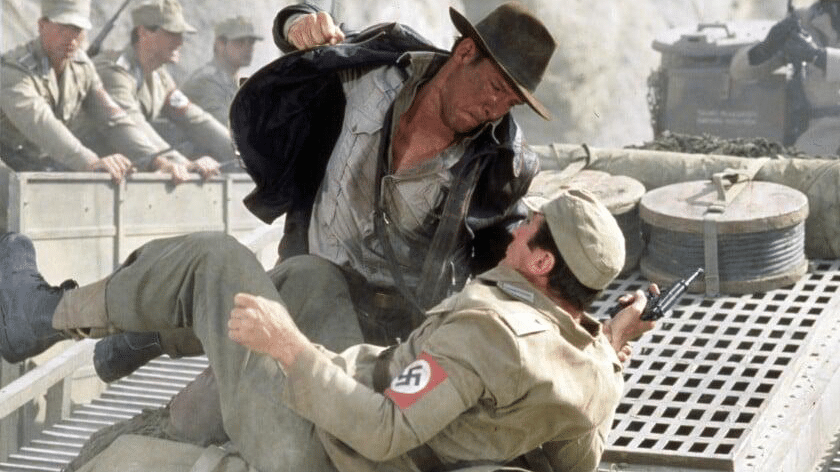
Nazis, I hate these guys. Let’s talk about Nazi symbolism in surfing. This is going to cheer you up, not.
I’m allergic to Nazi symbolism in surfing—and in general. It may have something to do with the Second World War, being Polish, a grandfather who survived a labor camp, and a grandmother who gave birth in Nazi-occupied Warsaw. You know. Just the usual Eastern European hangups. Can’t be helped.
I’m also severely averse to racism, xenophobia, homophobia, misogyny—just to name a few of the what-the-fuck-is-wrong-with-this-world isms and phobias. I believe experience can cure stupidity, but some people are plainly incurable.
I am also truly madly deeply in love with surfing. Just a bit of background, so you know where I’m coming from.
nazi-blindness via big wave worship
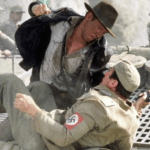
The first time I watched the scene in Riding Giants (the very reason why I got into surfing) where young surfers get out of a car dressed in Nazi uniforms, holding rifles—it didn’t even register.
Greg Noll narrated: “Some guy’s dad had gotten back from the war, and he had a closet full of Nazi stuff that he brought back. And then they went over and took flexies and rode down a storm drain for a mile underneath the town of Windansea. And that was just, you know, having a good time, but people see it, and they go: Ooh, what’s this all about?”
Perhaps because I assumed it must’ve been harmless, and because of what Steve Pezman said next: “That kind of behavior was not mean-spirited. It was playful. It was like turning a hearse into a surfmobile. Instead of dead bodies, it was all about living life to the fullest.”
context is not the same as excuse
There was a time—before being adopted by the Nationalsozialistische Deutsche Arbeiterpartei and Hitler’s rise to power—when the swastika represented a symbol of divinity and spirituality across Eurasia. So you can, with enough historical distance, contextualize the fact that in the early 1930s Pacific System Homes in Los Angeles sold the Swastika surfboard model—the first commercially available surfboard. It was soon renamed “Waikiki.”
The Riding Giants scene is from the 1950s, when Greg Noll and the crew, in addition to dressing up as Nazis, marched along the beachfront holding Nazi flags for Greg’s upcoming surf movie, Search for Surf. Because, you know, he wanted to be “outrageous.” As Greg later put it: “You paint a swastika on your car, and it would piss people off. So what do you do? You paint on two swastikas.”
I like to think of Greg Noll from that period as young, pig-headed, and plain stupid. Like really stupid—ignorant, with no reference point.
this wasn’t always ignorance
Unlike the infamous Miki Dora (born in Hungary of all places) and his Malibu surf crew, who, upon learning that the inspiration behind Gidget—Kathy Kohner and her family—were Jewish, spray-painted a swastika on their driveway.
Miki Dora was a very special type of egotistical surfing arsehole, and a notable racist. Yet all was forgiven because he surfed very well.
I’m going to lift this verbatim from the Encyclopedia of Surfing:
“He was inducted into the International Surfing Hall of Fame in 1966, and the Huntington Beach Surfing Walk of Fame in 2002; in 1999 he was cited as one of the ‘25 Most Influential Surfers of the Century’ by Surfer; in 2009, the magazine listed Dora at #14 in its ‘50 Greatest Surfers of All Time’ feature. The Inertia website, in 2013, named Dora the second-most influential surfer of all time, behind Duke Kahanamoku, and just ahead of Kelly Slater.”
If you’re thinking “oh well that’s ok,” I recommend reading Daniel Duane’s New York Times article on California’s surf Nazis, which includes a few quotes about Dora that are genuinely nauseating.
symbols don’t stay neutral forever
Moving on. In the mid-60s, swastikas were out and Iron Crosses were in, with the arrival of Surfer’s Cross decals and pendants introduced by Ed “Big Daddy” Roth, modeled after the German Iron Cross military award. The surf press wasn’t impressed.
Nazi symbolism resurfaced a few more times with the arrival of “surf nazis” (see: grammar nazis), then the 1987 Surf Nazis Must Die movie, and later in the early ’90s when Australian pro surfer Matt Hoy airbrushed an Iron Cross onto the decks of his boards. What a douche.
why this still matters now
You might be thinking: why is she on about something that happened decades ago? I don’t know—maybe because over the past year or two, Nazi symbolism has become more prevalent than ever in our society.
And surfing doesn’t get a special exemption from history just because it’s “fun” or “counterculture.” Nazi symbolism isn’t “aesthetic” or “a prank”—it is read as intimidation, and in some cases, ideology.
You don’t have to be European these days to get it. There’s a reason Nazi symbols and gestures are banned by law in many countries. Stupidity and youth can no longer be an excuse.
To be clear, I don’t believe Nazi symbolism will ever return to surfing. I’m actually very optimistic about the evolution of surf culture, however slow it is. We smart now.