Now Reading: From pointe shoes to paddling out: Crystal’s most unconventional shortboarding journey
-
01
From pointe shoes to paddling out: Crystal’s most unconventional shortboarding journey
From pointe shoes to paddling out: Crystal’s most unconventional shortboarding journey
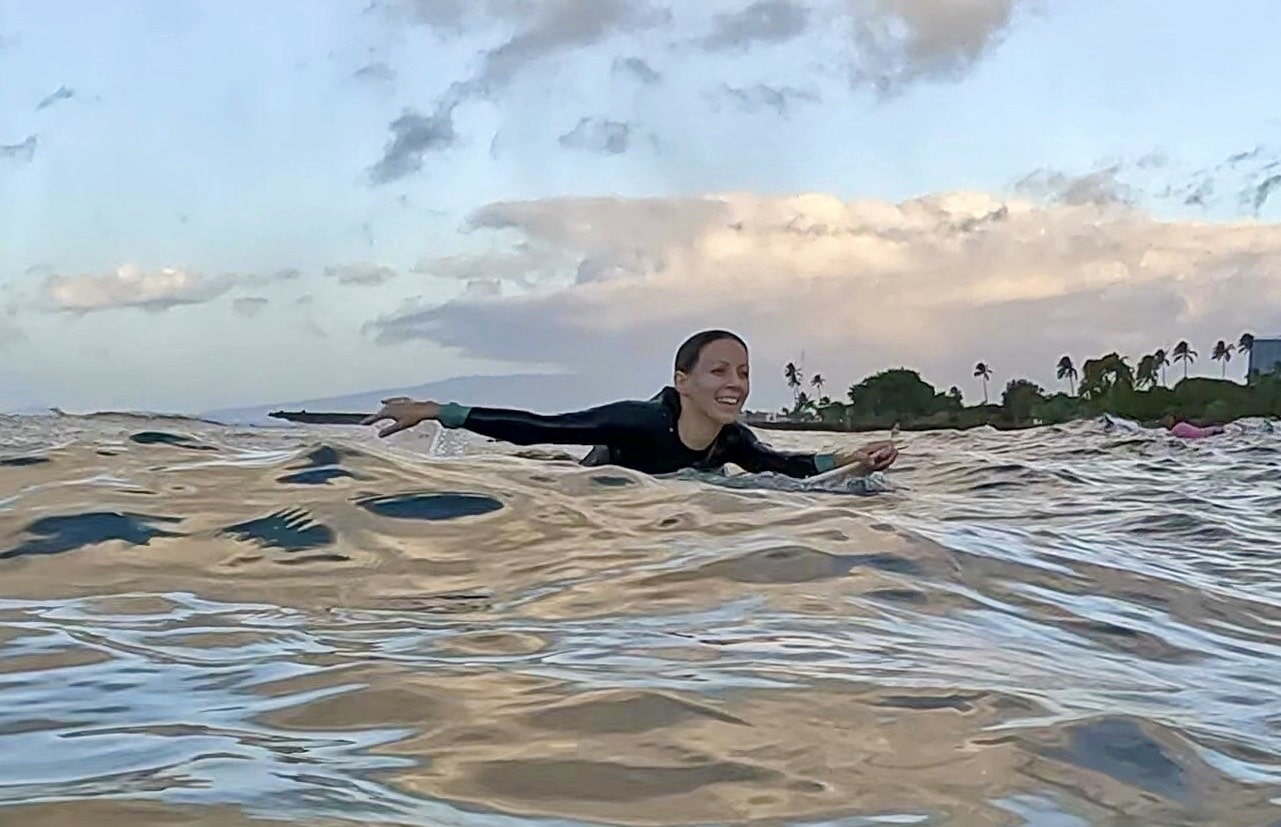
You can listen to The Wipeout Weekly episode with Crystal Dombrow, the beginner shortboarder extraordinaire below or on your fav pod platform.
This Wipeout Weekly podcast episode transcript was abbreviated to a blog post format by my good friend Chad (ChatGPT). He takes liberties, you know.
You will find the full transcript below it. Host: Zuz Wilson | Guest: Crystal Dombrow
Crystal’s story: A shortboarder’s unconventional path
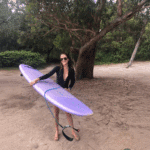
Crystal didn’t grow up in a place most people would associate with surfing. She spent her childhood in northeastern New Jersey, tagging along with her dad on fishing trips to the Jersey Shore, Florida, and the Caribbean. She remembers always being sticky with salt and her family freezer overflowing with vacuum-sealed fish her dad had caught.
Her path to surfing was anything but linear. Before she ever set foot on a board, she was a dancer—18 years of classical ballet, plus competitive dance and samba. She was also a skateboarder, skimboarder, snow skater, and eventually a freediver and got lifeguard certified. All of this—decades of building balance, body awareness, and mental discipline—became the foundation for her approach to surfing.
Crystal first tried surfing about nine years ago, but it wasn’t until three years ago that she committed to it fully. She started the way most of us don’t—body surfing and bodyboarding to learn how waves work, before finally grabbing a surfboard and teaching herself through YouTube videos, community tips, and relentless trial and error.
She never followed the “classic” progression from a big foamie to a mini-mal to a shortboard. Instead, she learned on a 7’0” fishy funboard and quickly moved to a shortboard—something she doesn’t necessarily recommend, but which made sense for her petite frame (5’0”, 92lbs) and her background in board sports.
Her learning process was meticulous. She started surfing one day a week, then added a second day of paddling practice in a flat bay, then a third, and eventually worked up to surfing 5-6 days a week. She kept her sessions short at first, tracked her progress, and adjusted her strength training until her body could handle more.
Though she’s now a dedicated shortboarder, she emphasizes that it wasn’t easy. Fear of injury, low confidence from years of perfectionist dance training, and physical exhaustion were constant hurdles. She worked with a surf-specialized psychologist to find a balance between her drive to progress and the joy that made her love surfing in the first place.
Crystal prefers to surf alone, heading out at dawn to beat the crowds, but she has built friendships in the lineup and learned to respect the pecking order. She believes the lineup is an essential teaching tool—and that patience is part of the deal.
Today, 3 years into consistent surfing, Crystal is still learning. Her dream is simply to keep improving safely, rip harder, get really barreled, and one day surf Indonesia or Jeffrey’s Bay. But she knows that every session—even the ones where she’s scared or plateauing—counts toward something bigger.
Full transcript
(0:00 – 1:25)
I’m not fully self-taught. I am community-taught. I’m community-taught and I’m YouTube-taught.
I didn’t just go out and figure it out on my own. I have a lot of tips from people. I have a lot of friends who surf.
I made a lot of friends through surfing. They take you out and give you mini lessons.
Welcome to the Wipeout Weekly, the daily podcast for beginners, wannabe surfers, and seasoned Wipeout enthusiasts.
No hype, no filler, just the highs, lows, and honest truth about learning to surf and finding your place in surf culture. I’m your host, Zuz Wilson. Let’s go out.
You started surfing three years ago and you are not into longboarding at all. What is wrong with you? Okay. There’s an asterisk there.
I started surfing consistently three years ago. The first time I got on a surfboard was nine or 10 years ago. The other asterisk is that I have a board sports background.
I grew up skateboarding with my brother. I grew up snow skating with my brother, which is like a little skateboard deck. Skateboard without the wheels.
It’s built for the snow. We would take it down little hills and we would build ramps out of the snow at the bottom of the hills. I did that when I was growing up and skateboarding.
(1:26 – 3:05)
Me following him around, I got into skimboarding when I was 20. I had that whole background leading into surfing. That’s how I started surfing.
I started surfing knowing how to balance on a board. The third asterisk is that I was a dancer growing up. I did classical ballet for 18 years.
I did other types of competitive dance, too. My balance is impeccable. I would love to see what happens with other dancers if they got into board sports or surfing specifically, because we have to, especially in pointe shoes, you have to be so in tune with your body.
If you’re dancing with a partner, you have to really be in tune with your partner’s body as they’re moving. Maybe they’re supposed to hold you up, but they have a muscle twitch. You have to rebalance.
You have to have that body awareness and response. It’s just a muscle memory. I think I just have advantages.
I’d love to look at it as this really cool, amazing thing I’ve been able to do. I have 25, 30 years of body training, athletic experience that has led up to this point and is completely reliant. This point that I’m in right now is surfing.
I can’t say that it was all this miracle. That being said, I got into surfing consistently three years ago. Nine years ago when I first tried, I was skimboarding all the time.
(3:06 – 5:40)
Surfers are always coming out of the water and saying, you need to surf, you need to surf. I was too scared of sharks to surf. Oddly enough, getting into what I do for work now, I was too afraid of sharks.
Finally, one day, the surfer came out and said, that’s it, you’re catching your first waves. We did. I was on a shoreboard.
I could barely lift my head out of the water or paddle. He had to actually hold the board stable for me as we’re going out. He pushed me into my first waves.
I rode one into shore and the rest is history. There was a very long period, lots of time between then and then. A few months later, a friend saw me with my skimboard and gave me my first surfboard.
It was a fun board. It’s fishnose, a lot of rocker, pretty rounded, narrow tail. It’s a thruster.
All of those elements together is just primed to set you up for more high-performance surfing with maneuvers. He said, it’s going to be really hard to figure out, but then once you do, you will become an intermediate surfer on this board. I was like, okay, cool.
This is quite a few months after the first time I caught a wave. Then I took the board out, tried to learn as much as I could, try to figure out as much as I could for four months, got really injured a few times. We can talk about that later.
I was also still dancing at the time. I was training for ballet. I was doing ballet.
I was performing samba, I think, or just training samba. My life was dance. It’s not just showing up and taking classes.
I was cross-training. I was stretching. I was working with nutritionists.
I was working with different coaches for all those things. I just didn’t have the time to devote to two athletic activities because I’m working full-time too. I’m not sponsored.
I’m working full-time while I’m doing all of this. Then I just knew that the muscle groups I was training and working with dance were not the same as I’d be using for surfing. There would be some crossover, but really, it’s not I could just go to dance and then jump in the water and get a benefit from my surfing magically get better.
No, I knew I had to completely devote myself to surfing. I wasn’t ready to do that financially yet. Emotionally, I wasn’t ready to do it because there was a part of me that still loved dance.
(5:40 – 6:18)
I wasn’t ready to give it up yet or step away from it, I should say. I knew I was going to. I knew it would happen one day.
I was like, not yet. Then I just didn’t have access to the resources to be able to learn properly yet. That was nine years ago.
I had that four-month period. Maybe I surfed a handful of times, maybe one or two dozen times between then and three years ago. And then three years ago, I had been, you know, I just this whole time, I’d had this bug, like, gotta surf, I gotta do it.
I want to figure it out. I want to learn. I want to get good at it.
(6:19 – 7:32)
And I was really scared of those huge wipeouts and injuries that I had. So I was kind of afraid of the waves. I was like, what do I do? Where do I start? And I feel like there was something out there.
Like maybe it was the ocean. Maybe it was like the power in the ocean that was just kind of guiding me along in this really cool and magical way. So I, my friend and I were going to this beach, this little soft beach break.
And they told me how to body surf. So that’s what I did next was I started body surfing and learning body surfing in this tiny little wave. My feet could touch the bottom.
It was a sand bottom. I could push off with my feet, like easy as it can go. When that got a little boring.
I went to bodyboarding. So then I started learning the waves that way using a board and having a piece of equipment with me and I got really injured there. But this time it didn’t deter me.
I was just okay, we’re gonna heal and we’re well actually didn’t wait to heal. I was like, we’re just you know, gonna rest it as long as is maybe necessary and then go back out. So there’s bodyboarding and then my girlfriend and I who had been doing this together for three months, we looked at each other like, we really want to serve.
(7:33 – 9:50)
So she had that same itch as me to just get into surfing. So that’s what we did. We just found a really beginner break.
This was three years ago, three years ago, I think this weekend, which is so cool. I know. It’s my three year surf anniversary.
So we just started going out every single week, once a week to this tiny gentle reef break. That’s honestly, I think it’s gentler than canoes and Waikiki is that gentle. And we started figure trying things, trying to put the pieces together.
And at that time, there are now resources that are free, available in the form of YouTube videos. So I every time I had a question would go to YouTube videos. Thank you pandemic.
It’s since around the time of the pandemic that all of a sudden, we’ve these amazing channels online that are teaching everybody everything that you could possibly want to know. There were six videos total when I tried to learn how to surf nine years ago. Now there are hundreds, there are dozens of channels that are committed to it.
It’s wonderful. And can only take me so far, but they are really helpful tips and tricks. So I was really reliant on those videos.
We went once a week, I got consistent with it. And I was like, we’re doing it now. I’m going to start building up the muscle strength and stamina by being really consistent with whatever I can physically do.
And we’re just going to do it. And then I was slowly over the course of a year able to transition away from dance and then fill in the blanks of my cross training and strength training regimen with surf specific exercises that really worked for my body. I also started getting injured, but because I was no longer dancing.
So I have this hyper mobility, hyper flexibility, but I no longer I’m working the muscles to protect those joints and keep them in place. So I started getting so many pains, like my knee, both my knees, I thought I tore my meniscus again, happened once and my hips and I went to a physical therapist and we transitioned me. So that’s the, and then, um, I was on my fun board for eight months.
(9:51 – 10:38)
And then, you know, this is that magic of the ocean again. I was like, but I really want to learn a shortboard. And my dentist, I saw a new dentist and she there, you had to write down what your hobbies are.
And she said, Oh, you serve, I serve, she serves like the, the dental assistant serves like, what do you want to do with surfing? I was like, I want a shortboard. And they’re like, you should do it. And I was like, cool.
How, what? No, that is so farfetched, you know, but it just like, I think it just put the idea out there. And then that dental assistant actually told me, okay, when you do it, I did it. I did it as an adult.
When you do it, it is going to take six months for it to click. Just be prepared for that. It’s going to take six months.
It’s like, okay, cool. I’m prepared mentally. How? And she was like, make sure you go four times a week.
(10:38 – 12:06)
I was like, Oh, that’s a lot of exercise. I don’t know if I can handle that yet. Okay, cool.
Let’s do it. I was just mentally prepared. And then the board, once again, fell from the sky, a friend who used to compete, who was my surfing when she was growing up.
She was my closest friend at work. And she was like, you know, I have a shortboard for you if you ever want to figure it out. You can listeners, you can’t see our faces right now because we’re on video and you’re only hearing the audio, but both of our jaws just dropped.
And because that’s so cool and generous and kind. So now that’s two surfboards that I just had people approach me and say, you should do this. It’s going to, it’s going to be hard.
Just do it. And I was like, okay. And again, I don’t think that would have been possible without my athletic background.
So I can’t say it’s just like some magical thing that happened. I mean, I’d feel like in a way I’ve been prepared to be in this moment for my whole life. And it’s a lot of work.
It’s a lot of maintenance and it’s a lot of heartbreak. So yes, now, now I have been shortboarding for two years, almost a little over two years. And it did, it took six months for it to start clicking.
And we’re just going step by step. And I will be taking my first lesson ever still wasn’t able to afford a lesson until recently. So I’ll be taking my first ever surf lesson, not even really a lesson to surf coach.
(12:06 – 12:29)
I’m working with a coach who used to compete and I’m so stoked. We’re going to work together in a few weeks after I moved to my new apartment. So yay.
It’s a really long answer. I can talk story. So you jump in or cut me off like whenever you need, I can just go and go and go and go and go.
(12:29 – 12:39)
Let’s talk about your secret sauce, your biggest advantage, meaning your height. That I’m child size. Exactly.
(12:41 – 14:13)
I don’t know if that’s secret sauce though. I think it’s secret sauce for shortboarding. Maybe.
I mean, I’ll say as someone who’s learning probably when I get really good at it one day, if I, if I get there, then it’s going to be a significant disadvantage with larger waves. So I hear the pros talk about it with their size specifically, and that you really do want to have body weight to help get you down the face and larger waves, the, the water’s drawing up the face. And then if there’s any wind at all at that wave size, even one or two or three mile an hour wind can lift your board up and keep you out of the wave.
That’s something that I’ve had to figure out how to work with. I guess my secret sauce actually for learning is more that I go out in any conditions whatsoever and learn whatever the ocean wants to teach me that day. So let’s say the waves are shitty.
Actually, are waves ever shitty in Hawaii? Um, they’re difficult. A lot of people say they would never surf them. We do, we get bad days.
We get days where, you know, I show up at the beach and I’m all stoked because I just want to get in the water and it’s not flat. I’ll tell you that much. Or if it is, you can go somewhere where it’s not that that’s, what’s great about being on this island.
(14:16 – 15:00)
Uh, yeah, but most people look at it and they’re like, I’m not going out in that. And like, well, I am it’s breaking, like, let’s go. But it’s, I’m noticing that it’s teaching me how to surf any type of condition.
And that’s just following my joy. Like I want to catch a wave. I want to work on what I’m working on.
Do you know how awesome it is when nobody’s out? Oh, I do. Nobody’s out when it’s bad. I love it when it says poor to fair or just poor, because then I know that in like Venice break water, there’s going to be nobody.
That’s marvelous. That’s so wonderful. You get that too.
(15:01 – 15:13)
I know. I hope for everyone that they experience that joy. And then when I’ve experienced it, I’m like, oh, I understand why people do contests now just to be out with only a few people.
(15:14 – 15:26)
I think it’s either that. So it’s just like really bad conditions or it’s a secret spot. These are the only two ways that you can get in the water and there’s nobody there.
(15:27 – 16:58)
Really dedicated and committed. And no matter what the forecast says, go anyway, just what I do. And then you score unexpectedly.
And I just feel like that’s a gift every time it happens. It’ll be this like half hour window and all of a sudden it’s perfect. And it wasn’t supposed to be, it was supposed to be terrible and small.
And it’s awesome. There are some windows of time, like when I, as I’ve learned specific spots and I go at pretty much the same time to those spots consistently, no matter what, then I start to learn that despite what the forecast says, despite what the condition should be, what those magical spots are like, is it, you know, two hours after sunrise, the sun is making the wind do something as it’s heating up the land that you just get these perfect conditions for a half an hour. It happens.
It’s so cool. It’s not necessarily two hours after that’s just, you know, I’m not going to tell you, you got to go figure it out for yourself, but sorry to keep a little bit, but maybe not because, you know, I feel like I just get rewarded sometimes for putting in the time and putting in the effort. How often do you go out every week? It depends on how many waves there are.
(16:58 – 17:41)
So right now where I live there, it’s just not peak season and I have to drive a little further to be able to get good waves or decent waves at all. So probably right now, four times a week when it’s good, I don’t stop. I would say eight days a week.
No, I try to, I think this winter, I tried to take one rest day, which is important for my body as I’m learning. I don’t want to overstress a muscle group in particular and make sure that I’m getting the muscle recovery because that’s where you actually build muscles in the recovery phase. I’m just frothing too hard.
(17:41 – 24:17)
I can’t help. It’s funny that you said, was it your dental assistant or whoever that they said that you should go out four times a week because I heard it from other people. It’s always this four times that it’s mentioned.
I wonder if it’s like a magic number. I actually think three is the magic number. I don’t know for surfing, but it was for dance and it was, I did, I had a two year stint where I did aerial acrobatics, which is really fun.
Yeah. I mean, again, just learning as a beginner, building up the muscle group. I’m sure that foundation really helped when I got into surfing.
Cause it was all upper body strength and gosh, it took me like eight months to be able to do a dead hang pull up. We used to say like for ballet, it had to, my teachers would always say three times a week, you have to go three days a week in order to improve. And you know, with surfing, I wasn’t able to do that in the beginning necessarily.
I just didn’t have the strength or the capacity or the time I hadn’t figured out my schedule so that I could make it compliment what my work schedule was. I don’t miss work to surf, which is really cool that I’ve been able to figure it out that way. It means I miss a lot of night activities with friends.
I won’t even go out past 6 PM because that is too late because I need to go to sleep so I can dawn patrol every day so that I can surf before work. You know, that’s how I made it happen was figuring out how I could fit it into my schedule. And I, yeah, I definitely, you know, I started just being consistent with that one day a week.
I think I did one day a week for a month. And then when I wasn’t so tired and sore for several days after anymore, that’s when I added the second day, but I added the second day as paddling in a flat bay just to fire up my muscles. Yeah.
And then I was really consistent with that until that my body adjusted that felt easy. Maybe it was another month or so. And then I added, I turned that second day of paddling into a second surf day instead.
And then when that felt comfortable, same thing with my body. Then I added the third day and then the third day was just a paddling day. So I was doing two full surf sessions plus one paddling day.
And I did the same thing until I got up to four days until I got up to five days until I moved to where I live now and I cannot stop. You’re so organized because even when you were, you know, just when you started, you went from body surfing to body boarding, then to surfing, and you are a self-taught surfer. So I wonder, what were the biggest obstacles for you when you were learning? A few caveats in there.
I’m not fully self-taught. I am community taught. I’m community taught and I’m YouTube taught.
I didn’t just go out and figure it out on my own. I have a lot of tips from people. I have a lot of friends who surf.
I made a lot of friends through surfing. They take you out and give you mini lessons. They’ll give you helpful corrections, not condescending.
Oh, you should get a bigger board. Like, no, no, no, no. Like, which by the way, only happens when I’m doing really well.
Actually, I only get the put downs when I’m doing really well and I know I’m doing really well. And when I say really well, I mean highest word count of everybody. Taking scraps so I’m not stealing them from anyone.
Nobody else wants them. And I know I just got a good one. The only time.
For any other people who might experience those comments that kind of make you feel a little put down in the water. Okay. So that’s one thing.
I’m community taught. The second is that I actually did. So after I tried surfing nine years ago, I then switched into free diving.
So that’s the other piece of my ocean experience puzzle. Like I started on top of the water, like growing up with my dad fishing, we’re on boats constantly. I knew how to do that.
I loved kayaking. He used to take a kayak in our pool when I was growing up. He should not have been raising children.
He was a large child and he used to take our kayak and put it in the pool and he would strap us in and then he would do the flips on the kayak in the pool. My poor mother. I also grew up with swim lessons.
She had, she was like, we have a pool. You’re going to learn to swim. I grew up with swim lessons every single summer.
Hated it. Very grateful for it now. Thanks mom.
I did thank her by the way. I called her and thanked her one day. I genuinely am appreciative because it’s easy.
And then, yeah. So then I got into skimboarding. So I was on the surface of the water and knew how to balance a board, knew how to work a tiny board, knew how to pump, knew how to jump, knew how to Ollie, like those very basic skills.
And then, you know, took it into the ocean later on. But first I started free diving. So I was just snorkeling, thought it was fun, started going a little deeper.
My friends say, Hey, you should free dive, take a course. This is not something you can learn just through friends. You have to learn safety.
I did. I did that. And then my friend and I started taking kayaks and stand up paddle boards offshore.
So we could free dive. And an uncle said, you need to get lifeguard certified for your safety and for everybody else’s safety. So last year I got lifeguard certified.
So it’s a lot of pieces that come together whereby I am able to shortboard. I didn’t just start surfing one day, go down to a shortboard eight months later. So to answer my question, you basically had no obstacles whatsoever to surfing.
Oh, sorry. I forgot your question. I did.
I did actually have, uh, I felt like the obstacles that I had were the physical challenges of being able to build up the muscle strength. Um, I also had the obstacle of fear because I did get hurt. I went out, I tried really hard to figure out surfing.
I listened to people’s tips. I was definitely too broke to take even a beginner’s lesson. So I didn’t.
And I just went for overhead waves right away, head high overhead right away. It did not work out. And I got really hurt.
I actually, the most hurt that I got was in knee high wave. So yeah, that was an obstacle that became fear. That was another obstacle.
(24:18 – 26:04)
So, and then I had the obstacle of low self-confidence and being really hard on myself because of dance. You know, I learned dance back in the day where everything was competition. I got 25 years total of dancing.
I got two compliments ever. What? That’s how it works. I think it’s a lot kinder now.
It was tough when I was growing up. I love it. It shaped me and who I am.
I found really good teachers who were encouraging later on and much softer, just not so hard that it broke you mentally. Um, and I think a lot of dancers and athletes will have that same experience of just there’s sometimes with certain styles of training, there is a point where it just breaks you mentally. So I carried that into the water with me.
And it was a huge obstacle in serving because it prevented me from having fun. The whole point of surfing is that we’re having fun. Not that we have performance goals and we get really good, but it’s to enjoy what we’re doing and to connect with the water and to take that joy.
You know what that joy does for other people in your life. And so the person who cuts you off on the road, when you leave the parking lot and you’re just like, it’s okay, you must be having a hard day. Like that’s my first thought.
Instead of giving them the finger, it just like that joy just fills your well. And then other people like you can share from that well. So it’s, there’s that.
And then the other obstacles I think was just feeling really frustrated that I, that it wasn’t clicking faster. Like I really wanted it to click. And yeah, I guess those are the biggest obstacles.
(26:04 – 26:43)
I wish I could say it was people yelling at me. I’m naturally very shy and I keep to myself and I just wanted to work on the, whatever I could, because I knew that I didn’t know. So I have a tendency to surf scraps, the inside, the shoulder, the corner, whatever nobody wants and where there aren’t other people.
So I could get a lot of repetition in because I knew that the ocean could teach me something every single day, no matter what kind of a day it was, there’s always something to work on. Sometimes I just go out and work on turtle rolls when I was with my fun board, literally, that’s all I would do. And then I knew it’s getting a good paddling workout.
(26:44 – 30:08)
So yeah, there’s some obstacles. Definitely. I worked with a surf specializing psychologist last year, right.
And started overcoming some of those mental barriers and found, was able to find a balance between joy and surfing and also working on my performance goals at the same time. So what’s your ultimate goal? Do you want to get really, really good at shoreboarding? Do you want to surf a specific height of wave? Do you have that in mind right now or just want to have fun and progress? I would say I have dreams. I can’t call them goals because they’re so far away and I don’t, I only want to get as skilled as is safe and comfortable.
I don’t want to push too far, too fast. I’ve already experienced the consequences of that is that you can get really hurt. And I’m so fortunate that nobody else was in my path while I was getting really hurt.
I didn’t hurt anybody else. I’ve only hit one person with the board once and it was, you know, just a little like tap from the nose. It wasn’t, it wasn’t bad.
So I try, I think that’s also why I’m so cautious is I just want to get really proficient and developing proficiency takes a lot of time and a lot of attention. So, you know, I don’t know. I’m, I mean, I’m in my late thirties.
I don’t know how far I can take this. So my goal is really just whatever the next step is, let’s get better at it. You were talking about community surfing.
You were talking about what waves you surf and, you know, surfing scraps. I wonder, how do you feel in the lineup? Do you feel confident when you’re on your own or do you need to have somebody there with you? So to answer the second question first, do I need to go alone or do I need to go with friends? I prefer to go alone. Actually.
I know the reason was because it just got so stressful and complicated for me to coordinate with people all the time. I also just wanted to go, you know, 5 36 in the morning before, so I could surf before I sign into work at 8 AM. So that just logistically didn’t make for a lot of community surf sessions.
Yeah. But also it just became a little bit easier for me to be able to be flexible about timing and the days that I go out and if I felt like it or not, because I am trying to be so careful with learning the skill and building that confidence. I mean, I could wake up and I had a really hard day and something completely unrelated to surfing and it just feels like it’s too much.
I’m not going to push myself unreasonably to go do it. So, and then yeah, I do. I like to, when I paddle out and I see the lineup and I see who’s out, I see how they’re surfing.
I see what the conditions are for that day. I just like to assess what’s maybe a little beyond my comfort zone, but what’s still in my comfort zone. Like what do I really need for that day? It might be a smaller size, but it’s really heavy or it’s really windy or it’s really gusty, or it’s coming from a storm surf or swell, and it’s coming from a bunch of different directions.
(30:09 – 33:08)
And that’s something that even out of size, I’m really comfortable and confident in. I can’t necessarily catch that yet or feel comfortable or confident in it. So I like to also just be able to go off on my own once I get in the water and do my thing, right? I don’t like to have promised somebody, you know, we’re going to be ocean safety buddies together today.
And then I really want to go over there. Sorry. So for all those reasons, I prefer to surf alone.
And it’s also like going to the gym for me now. Like, I just want to go whatever. It’s just not a big deal.
I do prefer to surf with somebody else. If no one else is going to be out, I never surf alone, like completely alone. Like that.
I would be the only person in the water. So we have very few waves where I live right now. And sometimes there’s nobody in the water, but there’s still waves breaking.
And normally I would go out, but because there’s nobody else in the water, I that’s when I’m coordinating now with other people. And it’s getting me out of my shell a little bit, you know, be a little social about it, not such a ballet dancer, just like, I’m going to work on this today and nothing else matters. Safety first.
So you surfed on the East coast, you surf in Hawaii right now. Did you surf anywhere else? Or do you want to surf anywhere else? Any, any destinations that you would like to explore? I definitely want to go to some other spots. There’s a bunch of classic shore border answer.
I want to go to Indonesia. Come on. There’s so many waves in Indonesia that I watch like, oh, wow.
And my friends say who shortboard there and go there for four to six months out of the year, actually. Yeah. They built their lives around it.
It’s very admirable. And part of me wants to do that, but you know, we’ll see where life takes me. I have a lot of responsibilities here.
I don’t know if I will want to do that for that long, but regardless the waves, they’re just gorgeous size softer than what I’m used to surfing longer open faces and get a lot of turns. I like ripping. That’s what my goal is.
I just, I want to rip so hard. Um, I did get my first baby Pharaoh this year. No one pushed me into it.
It was, it was all me. Um, well, you know what? I can’t take full credit with the ocean. She just gave it to me out of nowhere.
So definitely Indonesia. It seems like it would be a great way to step up my surfing when I’m ready for it. When I have the skill to comfortably be able to manage it.
And I really want to surf Jeffrey’s Bay in South Africa. It’s a gorgeous open feet again. I like ripping.
It feels so good. My view from the skateboarding and snow skating and skimboarding. I just love whipping around a small board under my feet.
(33:08 – 37:27)
It’s so much fun, especially when you play off the water with it. So yeah, I definitely, I want to surf in those spots. I didn’t answer your question about the lineups.
Do you want me to circle back to that? Yeah, go ahead. Okay. So how do I feel about the lineup? I controversial opinion.
I feel like the lineup is necessary and I have a lot of respect for it. So every day, my strategy for surfing is that pretty much marry a spot and I go there all the time. Almost no matter what.
It’s very rare that I will not choose to go to my spot. Part of that is it’s easy. It’s a routine for me.
I don’t have to think about it. Just go deal with what the ocean gives you learn to be a better surfer in all conditions. Great.
So I do that. And it’s also been really fun to get to know people. I just put my head down, do my thing in my spot.
People end up giving you waves if they know you. It’s really cool. And then I noticed too, that when I sit on the side and it’s a gnarlier day, and maybe I just totally sit out on the shoulder and observe really, and then figure out how to paddle out safely.
And then of course I’ve got a paddle line, which is a little embarrassing because I can’t take it. Maybe it’s too big, but I’ll come in safely shoulder channel, you know, Pipo board people is the Hawaiian, you know, kind of like we call bodyboarding now is like that, but a hard board, maybe a little bit bigger. So we joke that, you know, if you don’t stand up your Pipo boarding, so maybe Pipo it in.
I, when I’m just sitting on the side on those bigger days, I’m really observing a masterclass in surfing. And I feel like I learned so much. And then people will start to chat and want to become friends almost just say hi, or be like, Hey, that was a good one.
Or, you know, I’ve been taken on, I’ve been invited to the peak a few times now. And it’s really special to have somebody teach what that is and how to do it and where to line up, how to manage the conditions, watch you on a few, tell you what to do, what you need to do. So I actually kind of think the lineup is a great teaching tool is also necessary for ocean safety.
And that’s where the respect comes into play. Right. I know a lot of people get yelled at.
I don’t have that problem because I keep to myself unless I’m invited, really. And I take it as there’s probably like, we don’t know what we don’t know. There’s probably something that I don’t understand yet.
I’m very new to this. I will be new to this for a long time. No matter what, according to people I’ve talked with who surfed all their lives and the internet and chat GPT, it takes 10 years of consistently surfing at minimum to become good.
And that’s what they say. And I knew that to be true of dance. Ballet didn’t start clicking for me until I’d done it for a very long time.
It was the same with dancing on stage. It was the same with acting. It was the same with everything.
It just, it takes a while. And with surfing, you know, we’re riding these boards, we can fall off and there are people around that takes a while to learn the nuances of how to manage water safety for yourself and other people. And I just trust that if people are asking me to not be in a spot, they see what I can do, or maybe they don’t know me at all.
And they don’t know what I’m capable of positively or negatively. Right. They don’t know if I have the proficiency yet to be able to be in that lineup with them and keep them safe and not be a hazard to them.
I trust that completely. And oftentimes it just takes longer than I wish it would. But it’s okay.
Like patience is part of it. There’s every time I’m like, I wish I could sit at the peak today. And I wish I could get those waves.
Like you’ve gotten your waves, be humble, put your head down, go get your workout in somewhere. You’re like, you’ll still learn something. We don’t get the cherries all the time.
(37:27 – 37:57)
No, nobody does, you know, even really crowded spots, heavy lineup, like pipeline, all those guys, they’re not taking wave after wave after wave, they meet their turn too. They give to other people, you know, can’t I’ve never been out there. That’s just what I observe and what I understand of, of the lineups because I’ve been a part of that sometimes.
And it’s really cool. And then everyone will step aside and let you paddle for a wave. That’s special.
(37:57 – 39:51)
Do you know how much those waves mean? Yeah. So I, I think it’s necessary. I think anytime I get a little grumpy about it in my head, it’s just a reminder that I’m learning and that there’s a lot more to learn.
And I, I take it as that and that’s it. And also too, I would so much rather be at least on decent terms with people than piss people off in the water. I want to be there and I want to learn.
And if it takes a little while to build that trust in other people to have those relationships, even if it’s just saying, hi, I’m okay with that. You know, you are so positive. Do you ever get into a surf funk? Yeah, I’ve plateaued a few times and it was really frustrating and I, I kind of lost my zest for surfing a few times too, just because I wasn’t progressing at the rate that I thought I should be.
And then, you know, this is the benefit of making friends in the lineup. Someone came up to me and I see every day, you know, it’s, it’s different. It’s making an assumption about where you’re at.
And it’s like, Hey, we’ve seen you catch. We’ve seen you trying to go for bigger and you’re scared. I want you on a slightly larger board.
Trust me. And I was like, okay. So, you know, I went from teeny tiny shortboard to what’s called a step up shortboard.
So it’s just slightly, maybe more foam, maybe a little wider, maybe at least a few inches longer, six inches longer, I think is the standard. And it did, it got me into waves really fast. And then they’re like, Oh, we didn’t know you could surf.
I’m like, yeah, I guess so. It’s pretty cool. What’s the biggest wave you’ve ever surfed? It was a few feet overhead.
(39:52 – 40:03)
So that’s what in feet? So that would be seven to eight foot face, I would say. Yeah. On a shortboard.
(40:05 – 40:43)
Yeah. Did you trim down the face? Did you do any tricks? No, I didn’t. I was too scared.
I was, and I could feel it too, how much power was behind the wave. So it was just too nervous to make a mistake. So I didn’t try to lean heavy into my rails to go into turns.
I just set a line, kept it. And I focused on shifting my weight a little bit forward and pumping a little so that I could get out of the whitewater. I took it.
It had just started breaking. So I got it in a little bit of whitewater. And then all of a sudden I was on it.
(40:44 – 41:47)
And I looked and I saw how far up I had to look to find the lip. And I felt how powerful it was. And I was just like, okay, you know what to do.
You I had this little inner coach club, you know what to do. Just go, just go, just get out of harm’s way, which would be falling in the whitewater. So I just kept writing it.
Yeah, it was, it was, um, it was interesting. And that that’s a really good time to mention. I read this awesome surf safety book that my physical therapist had recommended.
It’s called surf survival. It’s written by three physicians who are also surfers are all short borders. They really seem to know what they’re talking about.
They talk about big wave surfing in there too, a little bit. And they say in there that a wave that is twice the size has four times the power. So as we size up, it’s really important to keep that in mind.
(41:47 – 42:57)
And I know that’s why it felt like so much should be surfing something that was twice as big as I had ever surfed before. I just wasn’t used to the force that was behind it. And I wasn’t confident enough in my technique and skills yet that I thought I could manage it.
I did. And I just, you know, the ocean humbling me again, got so much to learn. You’re a very unique surfer because you’re so into shortboarding and you never effectively went through this progression path from a longboard to then let’s say a minimal fun board to then a shortboard.
What is a piece of advice that you could give to people who are starting now and they really, really want to just be on the shortboard one day? I’d say take some lessons, actually, because I don’t know. I again, I have all of this background and athletic experience that just set me up to be able to try to learn. I have no idea what somebody starting from scratch should be able to do.
(42:57 – 43:23)
I could only recommend what I did, just, I don’t know, get into ballet for 18 years, make sure you’re doing Pilates the whole time as cross training. And then I don’t know, grow up on boats and then maybe make sure you’re skateboarding the whole time. Like you can do an ollie by the time you’re 14, even though no one skateboards around you except like Bam Margera and Johnny Knoxville and you’re watching movies because they just don’t do that.
(43:24 – 45:19)
Yeah, I didn’t grow up in a culture that supported any of this or I had people to look up to as me and my brother watching MTV and just be like, we want to try that, you know? So I have no idea what they would do, but I know it helped and I know it’s helping now. So I’d say just work with somebody, get on a program and listen to what they tell you and just be really consistent with it. There’s so much to learn and so much to work on.
I don’t know what somebody without that background would be able to do to get to shortboarding faster. I feel like I actually feel like I went too fast with it. Now, my friend and I did the same thing as me.
She was a professional body boarder for 15 years and we’re the same size. And she’s like, we’re laughing because now we’re actually going back to fun boards sometimes so that we could dial in and learn technique that would have set us up really well for shortboarding if we weren’t so stubborn to listen. And I just bought my first mini gun, which is like a much, I know, from her.
She’s really generous about it. And I have that now so that I can get into bigger waves. Like just trying to size up on a shortboard has been really tough.
So you have to take off late. It is a very powerful wave. It requires very precise military purchasing technique.
So what I got from your answer is basically watch MTV. Watch old MTV. MTV of the early 2000s.
And that’s all for today. Check out The Wipeout Weekly for our free newsletter, more stories and ways to connect with us. Thanks for listening.
See you tomorrow for more of The Wipeout Weekly.