
Now Reading: Hawaiian Surfboard—the $15,000 surf book find
-
01
Hawaiian Surfboard—the $15,000 surf book find
Hawaiian Surfboard—the $15,000 surf book find
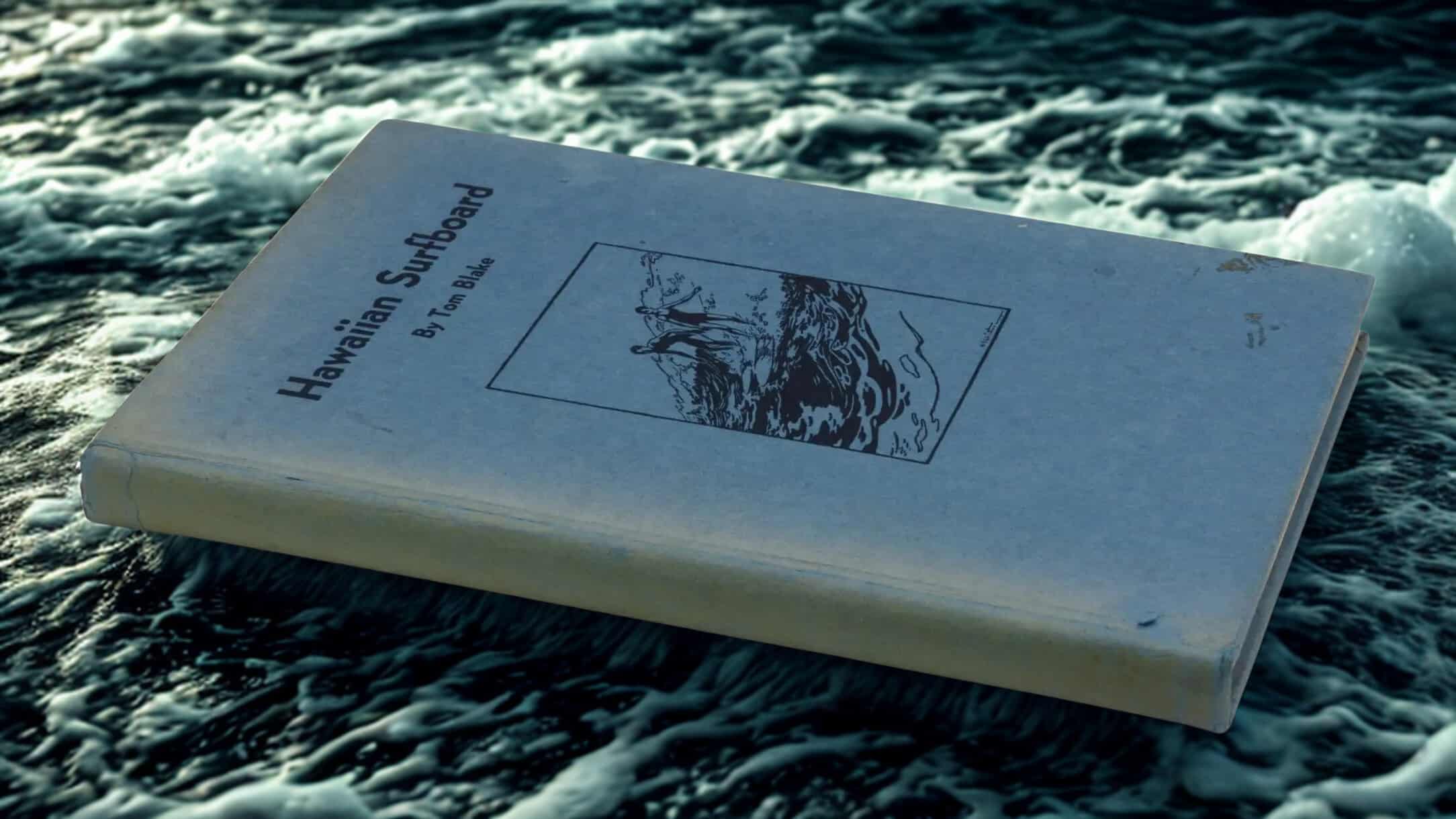
As I’ve been ordering some second-hand surfing books from AbeBooks, I came across a listing so ridiculously expensive that I felt we needed to do an episode on it. Namely: Hawaiian Surfboard.
The listing I spotted was for a $15,000 first-print edition of Hawaiian Surfboard by Tom Blake.
It is signed by Tom Blake and inscribed in the year of publication: “with sincere appreciation of a master craftsman, from Tom Blake 1935.” In 200 Years of Surfing Literature: An Annotated Bibliography by Timothy DeLaVega, the author states: “There is one (known) softbound cover, blue with text only.”
not quite one of a kind
You may be forgiven for thinking the price is driven by the book’s total uniqueness—but there’s another first-edition listing at $12,500. It’s also signed by Tom Blake and inscribed on the front free endpaper: “Mr. Joseph Farrington—may your children some day ride the waves at Waikiki.”
Farrington was a journalist who later served as the delegate to the U.S. House of Representatives from Hawaii Territory’s at-large district from 1943 until his sudden death in 1954. He followed in the footsteps of his father, Wallace Rider Farrington, who was also a journalist before turning to politics and serving as Territorial Governor of Hawaii from 1921–1929.
why is it so expensive?
Okay—but why so much money? What’s with this book?
Two things. First—the author. Tom Blake is widely considered one of the most influential surfers in the history of the sport. He invented the surfboard fin, the hollow surfboard, and a water-resistant camera housing for surf photography—and he was the first person to surf Malibu. We’ll talk about Tom Blake again soon, I’m sure.
Second—the book itself. It’s considered “the most important publication in the surfing canon,” according to Timothy DeLaVega, and described by The Surfer’s Journal as a “seminal volume of surf literature [and] the sport’s single most important document.”
what makes the book special
The book is ninety-five pages long and was written by Blake in 1935. Only 500 copies were printed at the time.
Before Hawaiian Surfboard, there were surf articles and essays—but not a proper standalone book. According to the Encyclopedia of Surfing, it’s “part surf history and part instruction manual.”
Hawaiian Surfboard was illustrated with nearly 50 black-and-white photos, most taken by Blake, and Duke Kahanamoku wrote the introduction. The book is divided into four sections: “Ancient Hawaiian Legends of Surfriding,” “Early Hawaiian Historical Period, Surfriding,” “Modern Surfriding,” and “How to Use the New Hollow Surfboard.”
According to EOS, “Blake’s prose is dry, often clumsy, and occasionally pedantic, but he does convey the power and beauty of surfing in Hawaii.” And unfortunately, the book could’ve also used a better editor—if it was edited at all.
a sample of blake’s prose
It sounds like this:
“The water is so warm one is not conscious of it. The view of the palm trees on shore, the [Waikiki] hotels, the mountains and clouds is marvelous and to me it is part of the pleasure of surfing. The hour before sunset is best of all, for then the mountains take on all the shades of green imaginable, while the clouds near them assume all shades of white and gray. Rainbows are often seen in the far-off valleys.”
if you don’t have $15,000 handy
In 1983, the book was reissued as Hawaiian Surfriders 1935. You can buy used copies on Amazon for under $800.