
Now Reading: Fin and games: how one invention changed surfing
-
01
Fin and games: how one invention changed surfing
Fin and games: how one invention changed surfing
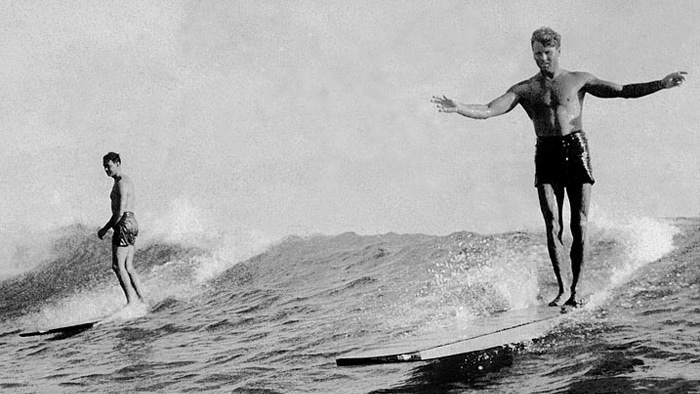
I’m in awe of ancient Hawaiians who surfed big waves – no wax, no grip, no fins. But personally, I’m glad we’re past that. Because there’s no hope in hell of me riding a wave finless and gripless. In today’s episode, we’re talking about surfboard fins—where they came from, why they matter, and who to thank for them.
Ancient finless surfing
If you’ve been listening to our podcast, you may remember from our history of wax episode that ancient Hawaiian rode boards like the Alaia, Paipo, and Olo that were flat, wide, and beautifully carved from native woods, completely finless.
How on earth you may ask? Well, it involved a ridiculous amount of skill and it was the shape of the board that did most of the turning work.
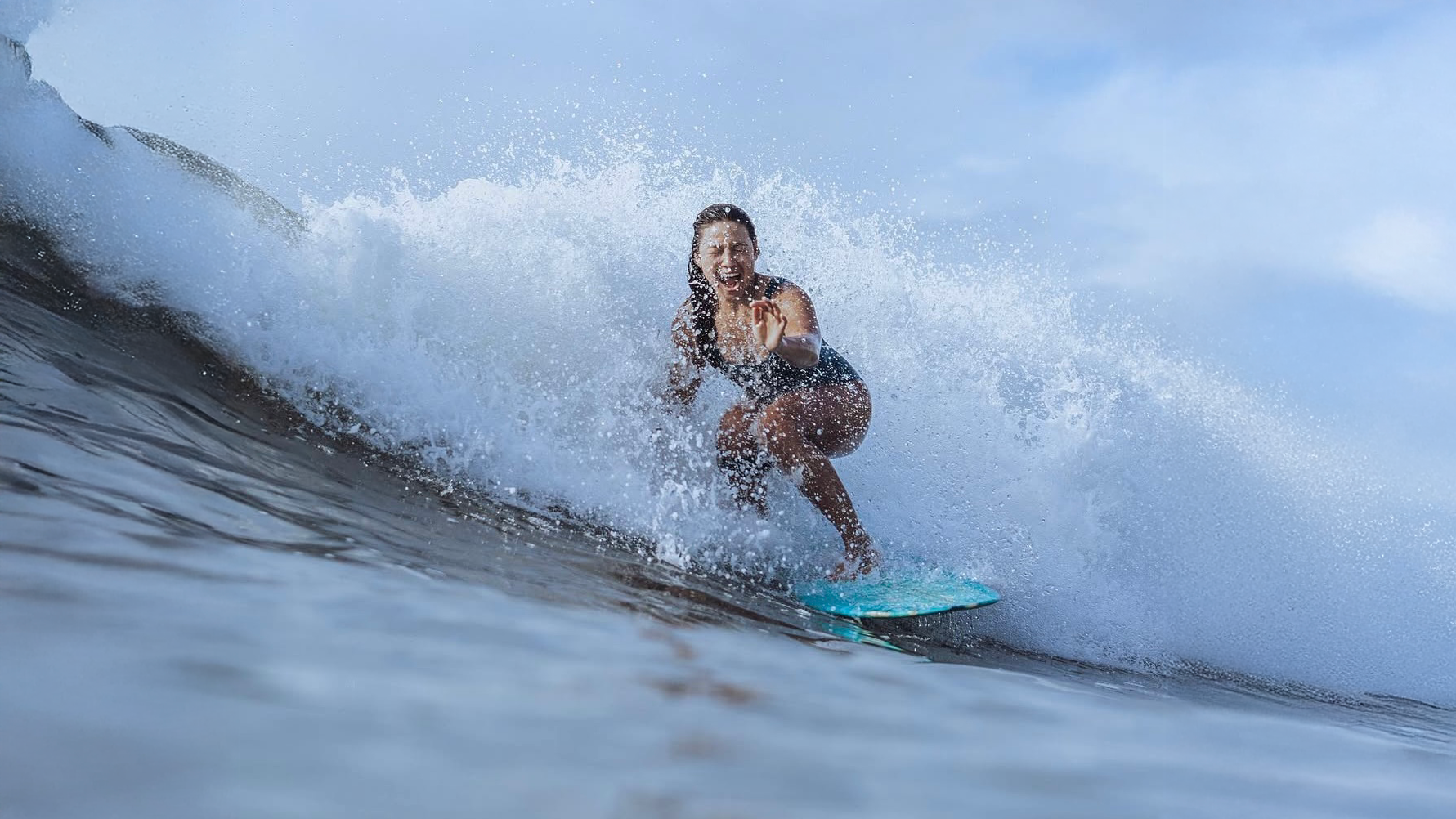
And this is what ancient Hawaiians and us beginner surfers had in common. They also rode mostly straight, but perhaps not all the way to the beach yelling woohoo as I do. Any carving was “stylish” but far from the sharp turns we can see today.
⚙️ Why fins matter: the physics bit
Physics is not my strong suit, so I’ve been trying to understand why a fin even matters?
It comes down to skidding versus having control of your board. Without a fin, the tail of your surfboard has nothing to anchor it in the water, so it can easily spin out under pressure.
And there’s a lot of pressure in the ocean. Once you stick a fin on your board it acts like a rudder and helps the board hold its line on the face of a wave. It cuts through the water and resists moving from side to side. There—physics.
The Tom Blake breakthrough
What surprises me is that it took so long for someone to add a fin to a surfboard. We’ve had rudders on boats since the 12th century (I’ve checked. If you want to be nitpicky – 1st century BC in China).
That someone was Tom Blake. And we’re going to forgive Tom for only figuring it out in 1935, because have you ever seen a photo of young Tom Blake? Oh yeah. He was a stunt double for Clark Gable!
At this point, I’d like to quote my fellow sociologist, Kristin Lawler to give you an idea of the magnitude of Tom Blake’s contribution to surfing.
“Tom Blake is considered the founder of California surf culture. He personally innovated most of what’s associated with surfers to this day: he was the first to experiment with making better surfboards, revolutionizing board design in the process with lightweight materials and the fin; he was the first to build a waterproof camera housing and inaugurated the tradition of surfers documenting themselves and their friends; and he was the first among countless surfers to come to write a book on the history and pleasures of surfing. In addition, his personal style became the prototypical beachcomber look, still in effect today.”
What she said – Legend.
From hollow boards through skegs to hulls to…fins?
Tom Blake was a tinkerer. First, he studied the Olos (remember: long as f and heavy as f ancient surfcraft), drilled holes in his surfboards and covered them with a thin outer layer, and finally came up with a totally new design—a hollow board with T shape bracing. He received a patent for it in 1932.
But it wasn’t until 1935 that he tore the keel off an old speedboat and attached it to the bottom of a surfboard.
You don’t know what a keel is? Well neither did I. It’s that long, central ridge running along the bottom of a boat’s hull.
But dude, what’s a hull? We’re going to be at it all week. A hull is the main body of a boat, the part that floats on the water. Anyway…
He didn’t like it at first. Blake said:
“The board had an entirely different feeling with the skeg on it. It wasn’t entirely a likable feeling…”
Well, a skeg is not entirely a likeable word, which is probably we call it a fin now.
From singles to quads (and back to none?)
The rest is history. Once you go fin-full, there is no going back.
We got our single fins for flowy longboarding, twins for that skating feeling, and thrusters and quads.
Did I say there’s no going back? Ha.
According to Surfer Magazine (which The Wipeout Weekly aspires to be—but for beginner surfers, and pre-National Enquirer days), finless surfing has been gaining traction in the last decade.
Former pro surfer Derek Hynd re-pioneered finless surfing—or pioneered modern finless surfing—and showed it was possible to surf with both style and power without fins. He claims that finless surfing is making him age in reverse. Now I kinda want to try that.
And of course, there are the Wegener guys who make the Alaias and Paipos—because if it worked for 1,000 years, then why not now?
Why I’m still team fin
As much as I love the ancient Hawaiian way, I’m sticking with my fins. Cause I gotta be in control. I love what Tom Blake said about his fin contribution.
“It gives me a lot of pleasure when I see the kids drive by in their cars with a fin on their board.”