Now Reading: Cross-stepping into surf sisterhood with Laura Day
-
01
Cross-stepping into surf sisterhood with Laura Day
Cross-stepping into surf sisterhood with Laura Day
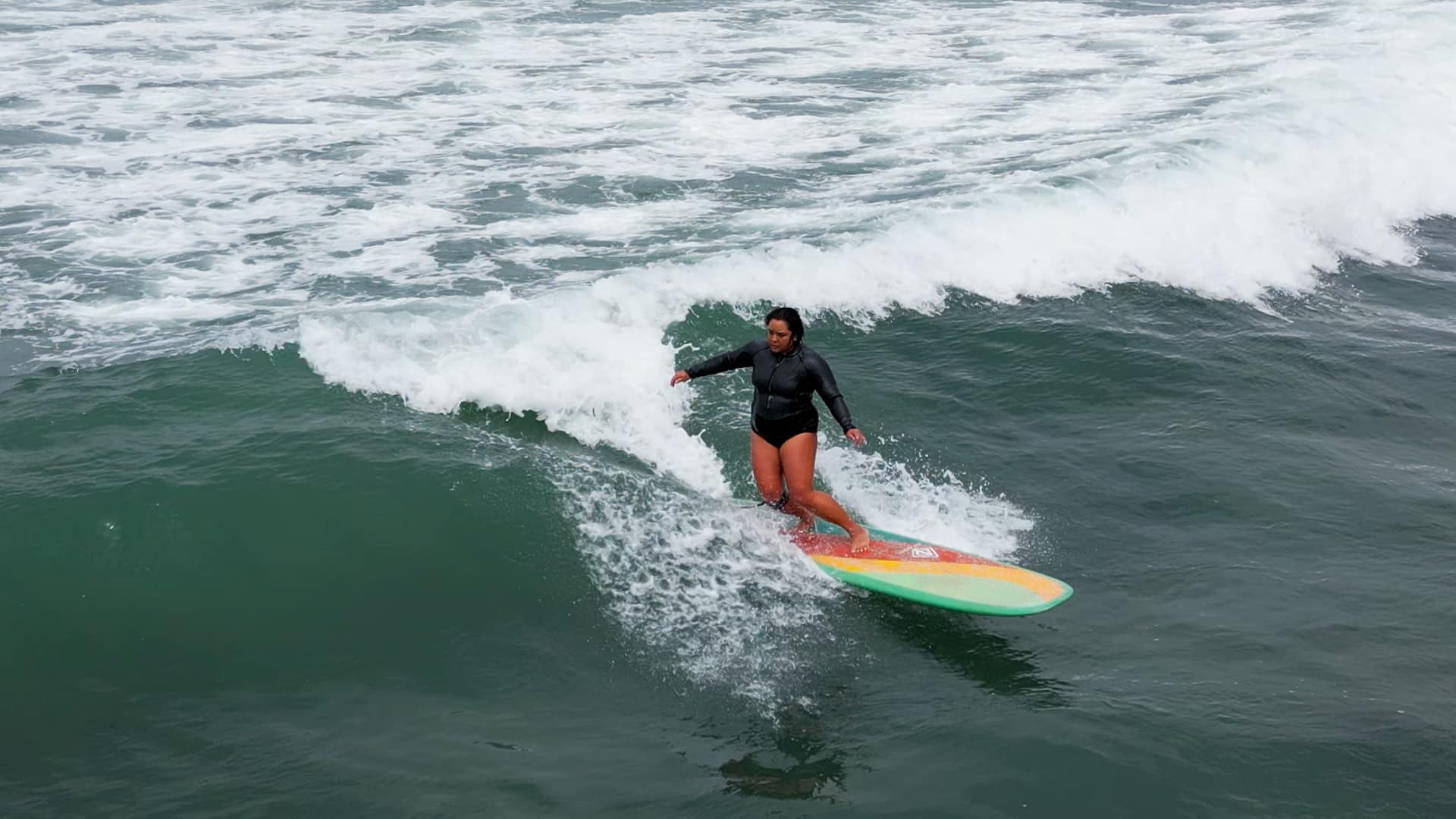
You can listen to The Wipeout Weekly episode with Laura Day, San Diego surfer and founder of The Surf Société below or on your fav pod platform.
This Wipeout Weekly podcast episode transcript was abbreviated to a blog post format by my good friend Chad (ChatGPT). He takes liberties, you know.
You will find the full transcript below it. Host: Zuz Wilson | Guest: Laura Day
Zuz: You’ve been surfing longer than 10 years now, but I’m curious—what made you start in the first place?
Laura: It’s funny, I was just texting someone the other day about this. I don’t think I chose surfing—the surf life kind of chose me. I was always drawn to water. My parents loved to travel and we camped a lot. But I didn’t know anyone who surfed until I moved to San Diego. A girl in my architecture class had a boyfriend who was a surf instructor, and they took us out. That was the start.
Zuz: Were you hooked right away?
Laura: Oh, yeah. Even before that, when I was going to Glendale College, I had these huge breaks between classes. I’d drive to Manhattan Beach, just to sit there. Gas was cheap, so I’d go by myself and soak it in. It wasn’t until I moved to San Diego that I really got the chance to start.
Zuz: And your friend’s boyfriend was your first lesson?
Laura: Sort of. He and my friend took me and another classmate to a beginner-friendly spot near Swamis. Nothing broke that day, but they gave us all the basics. I didn’t catch anything, but it was a beautiful day.
Zuz: So how did you really get into it?
Laura: My cousin was moving to Germany and gave me her 8-foot board. I started just going out on my own or with classmates. It wasn’t crowded back then. We had no idea what we were doing.
Zuz: How did you progress without instruction?
Laura: YouTube! At the time, there were these Surf Simply whiteboard videos. I’d watch them, replay waves in my head, write it all down. Then in 2012, I met a guy at my gym who surfed. He took me out more, helped me buy my first board—an 8’6″ Native. I eventually joined a women’s surf club because I couldn’t keep up with the boys.
Zuz: Was it helpful to surf with guys who were more advanced?
Laura: At first, yes. They got me in the water. But they didn’t really give tips—they’d paddle off and leave me behind. It helped me get started, but I felt disconnected. Joining the surf club was huge—older women felt like big sisters, and it was so encouraging.
Zuz: How often were you surfing at that point?
Laura: Two to three times a week. Sometimes more. If you can go that often, you really progress.
Zuz: Do you surf alone now?
Laura: Sometimes. But I also check in with friends. Weekends I like to surf with a crew.
Zuz: What boards are you riding these days?
Laura: Mostly longboards. My go-to is a 9′ Paragon nose rider—super trusty. I also have a 9’6″ Hobie Harmony model, which is beautiful but heavy. I’m trying to downsize a bit. I borrowed a 7’10” Almond Beach Chicken and loved it. Looking for something similar.
Zuz: Ever tried a shortboard?
Laura: Not really. My goal from the start was nose riding. But now I’m looking to downsize because it’s tough to paddle a big board when the swell picks up. I get stuck on the inside for 20 minutes turtle-rolling.
Zuz: How far along are you on the nose ride journey?
Laura: I know the setup and can do a mid-face turn and take a few steps. My brain still resists going all the way to the nose. So my friend and I joke—just die on the five! Step up and wipe out if you have to. I’m hoping to consistently tap five by the end of this year.
Zuz: Hang ten next year?
Laura: Maybe! I’ve been told if you can hang five, you can hang ten. It depends on how you’re weighting your feet.
Zuz: Let’s talk Surf Society.
Laura: It started from my podcast, Confessions of a Surf Lady. In 2020, I ran a virtual surf retreat during COVID with Clarissa from The Ocean is Female. That became the foundation. Surf Society is now an online community where women learn together. We bring in mentors and run themed challenges—right now we’re doing the Nose Ride Blueprint.
Zuz: What do the challenges look like?
Laura: We meet on Zoom, break down skills into digestible parts, and do workshops. We have fun challenges too—core fitness, visualizations, even prizes like surfboards. It makes Instagram surf clips inspiring instead of FOMO-inducing.
Zuz: Do you plan to expand?
Laura: Yes, I’d love in-person events and chapters in different cities. Zoom gives access, but local meetups add connection.
Zuz: What’s the most rewarding part of running a women’s surf community?
Laura: The conversations. Everyone is curious and hungry to learn. It makes surfing more fulfilling and keeps me thinking about it constantly.
Zuz: Has your relationship with surfing changed over time?
Laura: Definitely. At first, you’re just obsessed. The podcast brought cultural awareness. The community deepened everything—surfing has no right answers, and the ocean constantly surprises you.
Zuz: Why do you think there are no men’s surf communities?
Laura: I don’t know! Maybe they don’t realize they need it. My friend and I joked about starting a group where guys hug after every session. We need emotional healing out there!
Zuz: Do you see common themes in your podcast interviews?
Laura: Everyone knows there’s still gender inequity. Equal pay is progress, but we’re not there yet. That comes up a lot.
Zuz: Has the lineup changed post-COVID?
Laura: 100%. I have photos from 2012 where there’s no one in the background. Now it’s packed, even on bad days. And yes, more aggro young guys. But you can avoid the chaos by choosing the right spots.
Zuz: Has it become more dangerous?
Laura: Yes. Some people show up without understanding etiquette or ocean safety. Social media makes it worse—you see videos of people pushing limits for content. There’s a lack of respect for Mother Ocean.
Zuz: Who are your surf heroes?
Laura: Josie Prendergast—beautiful technique. Auntie Megs—powerful, shapes her own boards. Daisy from the Philippines. I love seeing women who look like me shredding.
Zuz: Speaking of Instagram, you’re filming your surf sessions?
Laura: Yeah, GoPro footage! I have to rig it so it doesn’t block my nose rides. It’s tricky, especially with a longboard, but I’m working on a boom setup.
Zuz: You also have a clothing brand?
Laura: Yes, Aira Surf. Started in 2016 with rash guards and bikinis that actually stay put. Designed them myself. Still have inventory. It’s vintage now!
Zuz: And Surf Nasty?
Laura: That’s just for fun. It’s for when you’re surfing multiple times a day and don’t bother showering. Less so now that I’m older and love my clean sheets.
Zuz: Where do you dream of surfing?
Laura: Saladita. Long lefts, warm water. A surf society member told me if I go for a week, I’d be on the nose by day three.
Zuz: Final question: What would you be doing if surfing didn’t exist?
Laura: Don’t make me imagine that! Maybe more CrossFit, maybe climbing. I need to move. But surfing is everything. It ties into my business, my creativity, my community. It chose me. I’m just along for the ride.
Full transcript
Laura: I think everyone is fully aware that women aren’t like, we don’t have like the equity totally yet. And even when you talk to the pros, it’s like, it’s really great that we have equal pay. We still have a long way to go.
Zuz: That was Laura Day, San Diego based nose writer, podcast host of Confessions of a Surf Lady and founder of the Surf Society, which brings the sisterhood together on the journey to becoming more accomplished surfers. Laura and I agree on a lot in this episode, but perhaps most importantly, ain’t no deck that good, especially when it comes to surfing in Malibu.
Welcome to the Wipeout Weekly, the daily podcast for beginners, wannabe surfers and seasoned Wipeout enthusiasts.
No hype, no filler, just the highs, lows and honest truth about learning to surf and finding your place in surf culture. I’m your host, Suze Wilson. Let’s go out.
Zuz: You’ve been surfing longer now than 10 years, but I am really curious, what made you do it in the first place? Oh, I feel like, you know, it’s funny, I was just texting someone the other day, I was like, I don’t think I chose the surf life. I think the surf life chose me. I’ve always been drawn to the beach.
Laura: My parents love to travel. So every summer they’d take us camping, traveling. That was always a big thing.
So water, being drawn to water was like a big thing. I didn’t know anyone that surfed, though, as I was growing up until I moved to San Diego. And then there was a girl in my class that her boyfriend was a surf instructor.
And so they took us out. But it’s always been like in my back of my head, vision board. And when I was in community college, when I lived in L.A., I grew up in La Crescenta, so right by Glendale.
I went to Glendale College. Yeah, I would have a morning class. I remember that and that 1030 English biology would start at 4 p.m. I would leave from Glendale at 1030 and go to Manhattan Beach.
I would leave from Manhattan Beach at 230 and come back to Glendale College by 4 p.m. for biology class. I would just try to squeeze in the beach like just by myself. I would just sit there.
It didn’t matter. And mind you, back then gas was like, I don’t know, 99 cents or something. So, yeah, that was I was just so drawn and never had the opportunity till I moved here.
So did you go out with your friend’s boyfriend who was a surf instructor? Yeah, so they were from Sweden and I went to architecture school. She was in my class. She took me and another classmate out to not Swamys, but right next to Swamys, because, you know, you’re not going to bring a newbie to Swamys and nothing broke that day.
But, you know, they gave us all like the lessons of like how to hold the board. Don’t put the fin this way because that’s not cool. You do it the other way.
Got to carry your own equipment. No one’s going to help you. Like all those little things, which was really cool.
They ran it like a lesson, tried to push us in. And I don’t think we caught anything that day. And they were basically like, oh, you know, there’s no waves today, you know.
But it was a beautiful day out. And I had a cousin that lived here that was moving to Germany. I went to visit her.
She had a surfboard and like her little dog run on the side yard. And she’s like, oh, I, you know, she’s not going to take it. She’s like, you just have it.
And it was like eight foot from Manhattan Beach, actually play up players, surfboards or something. And she gave that to me. And then I was just like going cooking out on my own.
Well, me and like a classmate just cooking out. And back then, it really wasn’t that busy in the lineup or that or I don’t remember like getting in people’s way or something like I don’t know. But yeah, we would just go.
I had no idea what I was doing. We had no idea. We just like go out there.
So how did you progress if you didn’t have anyone teaching you? Yeah, I used to do a lot of I used to like I think at the time, the only videos on YouTube were Surf Simply. They had like a 10 series whiteboard Wednesday video series like I used to watch that. And then like I used to like replay every wave in my head.
You know, like write it all down. And then in 2012, I met a guy that I hadn’t been surfing that much anymore. And he was a member at our gym and his friends went to my school and stuff.
And like I knew that they all surfed. I was like, I really want to surf. And so they’d invite me out and I’d get tossed on the inside like they’d make it all at the back.
I couldn’t make it out the back. But I was going more often because he was surfing. And then he went with me to buy like my first surfboard, my first new board.
And then then I joined a women’s a local women’s surf club here because I was like, dude, I’m sick of like surfing with these boys. I can’t keep up with them. You know, like I can’t get to where they’re at.
Yeah. So that’s when I joined a local surf club here, found a couple of girls that were around my level. And then you get that rhythm of like being able to go without somebody.
And that’s when you start really progressing a little bit more. Right. Because you’re getting consistency.
So what you’re saying, was it detrimental for you to go out with the boys who are more experienced than yourself? So, you know, they didn’t really give me any tips or anything, they kind of just like peddled off all the way. Like, I don’t ever remember that guy that I dated him. I don’t ever remember him giving me like a single tip unless I asked or anything.
And maybe once in a while they’d be like, oh, it’s easier to paddle out here. I mean, at the time, I would say no, because they got me out there and they were the only ones that I knew that surfed and they had a garage full of boards and stuff and they were going regularly. So no, but but I did feel like disconnected at a point where I was like, well, is this like really the experience I want? Like at this point? And I was like, no, I’d really rather be around other women who are in the same or similar level as me.
So how did it change for you when you started surfing with those girls? At that time, that club, it’s changed a lot through different years and it’s actually already dissolved. But at that time, the way that club was run, the women who were like on the board, it felt very big sisterly. So I’m like in my early 20s, some 23, 24 or something.
And the women that that ran these meetups and groups that they’d been surfing for decades. And it just felt like, oh, I’m with like a big sister, a couple of big sisters who are excited to see us come out and stuff like that. And so that was encouraging.
And then we’d see them surf or we’d see videos of them surf and be like, I want to be like so and so. Yeah. So it gives you something to look up to in person, you know.
So at that point, how often do you go out during the week? At that point, like is it as big, probably at least two to three times, like that’s what I try to maintain two to three, four if I like. I mean, it just takes so much time. But if you really get into it, it’s like you can’t stop going, like going every day.
But at least three times a week, I feel like is a really good cadence if you can. How long does it take you to get to the closest break? Oh, for me, it’s like 20 minutes, under 20 minutes. No traffic.
Yeah. So we have enough options here in San Diego. So like, let’s say La Jolla, that could be 20 minutes plus with the traffic on the on the exit.
But there’s other spots, too. So. Do you go out on your own a lot now or with other girls? I do go out on my own, but I do have a couple of friends that I’ll check in with every once in a while, you know, just be like, hey, you’re surfing.
And then the weekends, there’s like a group of people like I’ll check. So be like, hey, what are you up to? Are you guys surfing? And and that’ll be pretty fun, because on the weekends, it’s a little more crowded out there anyways. Like if you’re going to be in a crowd, you’d rather be in a crowd of some of your friends.
Absolutely. And you mentioned getting your first board. What was it? Do you remember? Yes, I actually still have it up there.
I haven’t ridden it. It’s there for sentimental reasons. I think I’ve looked at it so many times.
I’m like, you know, maybe I could sell this. Then I imagine like this day I have a garage and I’m like, I have space for you. You know, so it’s it’s up there on the wall.
It is an eight six native. And I don’t get I think this little shape, it must be local native surf surf boards. And it must be more like an egg longboard shape, kind of like mini log ish.
And I walked into the shop and I’m like, I’m like five one. I’m really short. And I told them I was like, oh, I want to learn how to nose ride.
And so he had just gotten that board on consignment. And he’s like, oh, this would be perfect. It was eight six.
And he’s like, you know, it’s a little shortish because, you know, technically nine foot is recommended. It’s like you could you could do it. You might be able to do it.
And at the time, I think it was probably the right fit because I had ridden nine foot boards. And I’m like, what the do you do with all this board? Like it’s too much board. Yeah.
So at the time, I think it was the right fit. Yeah. And I haven’t let it go.
I still have it. I haven’t even ridden it for years, but I still have it. What other boards do you have now? So right now I’m a longboard girly.
I am trying to diversify the quiver, but I haven’t had luck finding what I want. So I have boards up here. I’m pointing out ahead of an over my head right now.
I’ve got a nine foot Paragon surfboards. It’s a nose rider, also single fin. And then this other board that’s up here is a Hobie.
It is nine six. So even bigger. It’s way heavier of a log.
And it is the Harmony model, which is I don’t remember her name. One of their riders, she that’s her model that that. And I really love the way she surfs.
And so this one, I do love to ride, but it is like to carry it down and bring it down. It’s like a big it’s a big journey to do that, too. Yeah.
I think you already answered my question. But which one do you love more? You know, so the Paragon is the one that like I’ve just had in my car all the time. It’s like the trusty one.
It’s it’s like durable enough where I put a GoPro thing on it. I don’t really feel like this one up there is really beautiful. It’s got a shibori inlay.
It’s blue. Like if I get it repaired, I’m getting repaired at the most expensive repair shop. You know, the Paragon, you know, I mean, where they color match the Paragon.
I’m like, whatever. Thirty dollar repair. But it’s it’s really I’ve had it for five years.
And it’s really like my friend actually ran over the tail. It’s fine. Like it’s one of the it’s one of those trusty ones where you’re just like, oh, OK, like it’s the reliable one.
But I have been borrowing boards from friends because I want I want to size down a little bit, because when it gets bigger, you can’t really take off deep with a big board and you can’t get that much speed. So I did write a friend’s seven, ten, seven, ten beach chicken by Almond. And I really like that.
It was a really good like transition from being a long boarder to like still having enough control over it to like enjoy it within the first session. So I’m looking for something similar, but I don’t want to not looking for something new that’s like, you know, seventeen hundred dollars. So I’m on a little search right now.
Were you ever tempted to downsize quite a lot and, you know, try a short board? You know, I guess maybe not so much, maybe because my goals since the beginning were really to nose ride. And so I didn’t I didn’t look to downsize that early on. Like once I was kind of like a nine footer, I was pretty comfortable there.
But now now I am looking to downsize because I have tried other boards and when it becomes winter and like, you know, winter and like early spring and you have swells are like four to five feet. It’s really hard to to. Yeah, it’s really hard to paddle back out with a nine footer.
And like the place I like to surf, a lot of the energy will collect on the inside and I’ll literally I’ll have fun. I will go out there. I’ll catch an amazing wave on a glidey long board and then I’ll get stuck inside for 20 minutes.
Just like turtle roll, turtle roll. And I was like, you know, I there’s like I can’t be I can’t be like stuck in here for 20 minutes. And then there’s a bunch of waves.
Sometimes you got to pass up because you’re too deep. And it’s like it’ll just pitch you over on a really on a log, at least for me at my skill level, whereas on something like a fish or something that’s a little smaller or has a little bit more rocker, you can beat a section and take off deep and not get totally tossed. Yeah, it would have been amazing if one could duck dive on a longboard.
It’s impossible. But wouldn’t that be just a dream? Right. Let’s talk nose riding.
Yeah. So this is a skill that takes years to develop. How far are you along that journey? So I know we’ll get to this too a little bit later.
So I have a community called the Surf Society. Right. And essentially we’ll transition to that.
But we invite on mentors to teach us different skills. And nose riding has always been on the list. So there’s a lot of knowledge that I have around it through that.
We’re actually running a nose ride challenge right now covering all of that knowledge. So the different approaches to get there, like there’s different strategies to set your board into the into the wave so that you can balance on the front. So anyone that’s listening that wants a nose ride, you’re you have to get the tail of your board into the wave.
So the wave is toppling over the tail and it’s counterbalancing your weight. Right. So there’s a bunch of strategies depending on the wave, depending on your skill level and how to make that happen so you can run up.
So I. I’m really comfortable with one setup or like one approach, which is like a mid phase turn and then a step when you’re learning how to cross that, like at least when I did, I didn’t really know that any of that existed, that you had to kind of do it a certain way. I was just like cross stepping whenever I felt like it, which is which is good because you’re starting to pick up those skills. Like I told myself, you’re not allowed to shuffle, Laura.
Don’t shuffle. So that I would never. Yeah.
So that I wouldn’t do it. And it worked. Yeah.
I just was like, you’re not allowed. And so it worked. And I never I never shuffled and I always cross stepped, even though I don’t know why I was doing it.
And so now I know that like you got to set the board. And usually if you’re going to nose ride from the takeoff, you have to cross up right away. And so a lot of people will.
And I’ve done it like you stall because you’re waiting for the safe moment and you have to train your brain to be like, no, this is I have to do this right away so I can set the board with a mid phase turn, which is like most basic setup and take the first set of steps And then recently I’ve realized that like my brain is not wired to take the second set of steps because, you know, your brain’s like that’s weird, different danger, you know? So I’ve been challenging myself to what I called with my friend, die on the five. So get all the way to the five and let yourself wipe out like it doesn’t matter, right? Because you have to override your brain that’s saying like, that’s dangerous. That’s new.
We don’t do that. So I’m getting there. I’m in between that right now.
This must be absolutely exhilarating to be able to hang five. In terms of your serve goals, how much longer do you think is going to take you to hang ten? To hang ten? Oh, I think like, OK, well, I would say that hang five. I’m not there yet.
Right. Like because I could probably get there, but die there. I’m not coming back yet.
Right. I got to train my brain to come back. I would say like my goal is by the end of this year that I’m able to tap five and come back on waves that have that opportunity.
I’ve been told by a mentor, though, they’re like, if you can hang five, you can hang ten. So it’s it’s more. Yeah, it’s more like if you’re from what she’s kind of said, it depends.
If you’re doing a cheater five, which means your back foot has all the weight and your front foot is just dangling, you’re not actually putting pressure on it. And then you can’t just transfer your front, your back foot to the front. Right.
But if you have your front foot weighted, then you can technically transfer your back foot to the front. So I don’t know. I feel closer than ever in the sense of like, you know, what we’re doing at Surf Society right now is our challenge called the Nose Ride Blueprint.
The whole idea is like, I know it seems like we don’t know where to start, but here’s your blueprint, like here’s like what it takes. And where do you fall within that? So with more of the mentorships and the other women that are also moving towards the same goals, I feel very encouraged. So I feel I feel closer than ever.
I’m going to say by the end of the year, I’m hanging five often enough. So unless I get a fish and I stop doing that for a while and hopefully by next year, I don’t know. I’ll check.
We’ll have to check in. You’ve mentioned your community, Surf Society. Is it Surf Society or Surf Society? Surf Society, either.
I like the fancy way, too, though. I like it. It’s just a lot of accents.
It’s just pain. Oh, yeah. To type it in.
Copy and paste. Copy and paste. Perfect.
Yeah. Yeah, let’s do it. How did it start? So as you know, I’m a podcast host as well.
I have a podcast called Confessions of a Surf Lady. I started that in 2020, like I said. And I think in 2021, I mean, I was just getting so many DMs from people that were interacting with the podcast.
And I was like, oh, this would be really cool to have like a woman’s community where people could connect with each other. And it backing up a little bit. Was it before the podcast? Oh, no, no, no.
Because podcast launched January 2020. So COVID March 2020 during that time. Sorry, every conversation goes back to COVID.
Well, during that time, me and Clarissa Cusel from The Ocean is Female, they used to run that account. They don’t run it anymore. We were like, oh, we should do something.
And we put together a four week virtual surf retreat called the Daydream Surf Club or the Daydream Surf Retreat. Yeah. And so it was like pretty much Monday through Friday.
We had like a cute little 20 minute talk show that had like these stupid jokes about COVID, like how bad the swell was. We had like every morning we’d have the surf report and it’d be like horrible and sharky, like just to make people feel better. Yeah, it was really stupid.
But we had this four week retreat. It was virtual. We had workshops.
We had a sound bath with Cassia. We had like she was a fitness instructor, so she did workouts. And I would say like unknowingly, that was kind of the predecessor to what Surf Society became.
So as the podcast became more popular and I had like a lot of people in my DMs about it, and I was like, oh, I wonder if I could have like a virtual community, that’d be really cool. I interviewed a lot of ladies. I’m like, what do you want out of a community like this? Everybody wants to get better at surfing.
Absolutely. Like that’s the number one thing. And so then this idea came or like, what if we work with mentors who come in and bring that knowledge and then we can all do this together? Right.
As a community. Yeah. And that’s how that’s how it started.
And it’s really rooted in like my own personal passion and love for becoming a better surfer. And I think that’s also what’s different about our platform versus like going to a platform that’s run by the instructor. Like it’s it’s run.
I’m the student. I’m the Stokes student like you. And I’m starting conversations with people who are super eager to share their knowledge with us.
So how does it work in practice? Is it online? Do you sign up? Is there like a weekly meetup? Tell us about it. Yeah. So we’ve we it’s all online.
We have a platform. It’s really beautiful. It’s hosted on a on a place called Heartbeat.
So it’s a really nice platform. Also has a mobile app. We meet on Zoom just like this.
We do quarterly themes. And so this quarter, it’s the Nose Ride Blueprint. So that’s kind of the common goal that we’re all getting at.
And we have anywhere from like two calls a month to once a week, depending on like what we’re working on. This particular one, we are having a challenge. So the challenges are really fun.
Last challenge we did was a core challenge, like a fitness challenge. The girls are competitive. So it’s fun.
Yeah. And then we did a challenge before that was a visualization challenge, which we’re probably going to bring back again next year because it’s so powerful. But yeah, there’s a challenge this time.
It’s really cool. We have a bunch of sponsors and like really good prizes, including a surfboard just for participating. So like tonight, we have a workshop that’s all about what kind of board do you need for nose riding? What kind of waves work and what kind of sections can you nose ride in? So like giving you that foundation.
And so, yeah, we’ll take like one topic, usually break it up into three or four chunks, have someone come talk about it. I have video examples from Instagram. One of my biggest goals is that you come to the Surf Society and instead of scrolling in Instagram and seeing all this FOMO, like all these like beautiful surf videos that the Surf Society turns it into your inspo, because now you get it.
You get like where they’re surfing. You get like the the the equipment, what it takes to get there. And now you’re inspired.
Not you’re not just like, oh, why can’t I be there? You know what I mean? I love that mission. How far are you going to take it? With Surf Society? Mm hmm. I’d love to start working on some in-person events here in San Diego and eventually some chapter like chapters in different places.
I think there’s so much knowledge to be shared by other people and other groups. And it’s like for me here, I mean, with me, I have access to a lot of people. But for me here in San Diego, I have access to a lot of surf culture, which is cool.
But I would love to see an event in Jacksonville that’s live streamed on our platform for people that are in California and feel more of that global tie to each other and still in that essence of learning and like rising up together. I want to ask you, what is the most rewarding thing about running a women focused community? I think I know, but I would love to hear it from you. Yeah.
In terms of for Surf Society, I think because of the way it’s structured, like I’m a big learner, I’m a big curious learner. Like, I want to know why. But this and that and I’m going to ask tons of questions.
It seems to have attracted the same types of women who ask a lot of questions and start these amazing conversations like things that I couldn’t think of. And so that’s made my personal learning like so much more fulfilling. It helps me keep surfing like at the forefront of my brain, which is what I feel like helps me get better.
It’s like I’m always thinking about it somewhere in the background. But it’s, of course, meeting meeting women who are like just as stoked, like they’re just as excited as you are about surfing. Do you think how you feel about surfing changed from the moment you started surfing, then when you started the podcast and now that you’re building this community? Yeah, absolutely.
So I think in the beginning, you’re just like chasing that like, I want to be in the water. And I don’t know, like I know for some women, I see it sometimes in forums where people are like, oh, I just want to quit. And I reflect in my head.
I’m like, there’s never a moment I’ve ever. It’s not that it’s not been hard. Definitely like surfing, especially in the beginning stage, is really difficult.
Even now it can be difficult. But I’ve never had a moment where I didn’t want to. I wanted to stop doing it.
I never wanted to stop. So I think in the beginning, you’re just like chooses you. You just get roped in and you’re going as much as you can and you’re being a part of it.
And then the podcast was really I started the podcast because I noticed that like there wasn’t as much of a collective women’s voice yet. Like it’s really the beginning of like Instagram and like having more of these online communities. And I realized that people wanted to have these conversations because as women in the water, we didn’t really feel like we had anywhere to.
It’s called Confessions of a Surf Lady. Like literally tell tell people like this guy yelled at me, you know, like why did he yell at me or just you feel so alone with all those thoughts. And then I started to realize like, oh, people want to talk about this stuff, like going to air all these confessions.
So that then introduced me more to like the cultural aspect sort of connecting me with people that like I that don’t live close to me, that I maybe knew as an acquaintance on Instagram. And it broadened my friend group in so many amazing ways. So I think I like was introduced to more of like that cultural like just like that buzz, like that blossoming of women’s surf culture that we’re all in right now and that became really special.
Right. And then with the community, like once you start really, really learning about surfing, especially for mentors that have lived it, experienced it, like been through it. There’s one thing that I always say, and it’s like there’s no right answer when it comes to surfing.
Like there’s no one way. Like if you go and instructor says like, this is the only way you can only do it. You can only you can’t pop up on your knees like stuff.
I don’t know why I hate hearing that. I’m like, no, do what you need to do. You know what I mean? But, you know, like if someone says there’s only one way to do things like they haven’t experienced the incredible nuance of what surfing is and can be, what the ocean can do, how much it can surprise you.
And so I think being and creating surf society like exploded my idea of what surfing was. There’s so many ways you can take it. And it’s just like you’re never going to master anything.
So you might as well surrender to that. Like you’re always going to be in pursuit, but you’re always going to be like interested and there’s going to be a next step. There’s going to be something.
So, yeah, that it has changed my I’ve never been asked that before. But thanks for asking. You’re very welcome.
Why do you think we don’t have any male focused communities for surfing, apart from maybe all these dudes who are on Reddit in the surfing subreddit? You know, do they just think they don’t need each other? I don’t. Oh, my friend, me and my friend Clarissa, I think it’s in a podcast episode where we talk about that. And we talk about how like, wouldn’t it be great if there was just like a male surf group where like after everybody got a hug from each other, like a free therapy session, like, you know what I mean? Like, because it’s very clear that you guys need some emotional healing.
But I mean, I know women are always we’re meant we’re very organizational wise in terms of clubs and groups and stuff. I don’t know. Yeah.
I sometimes feel that they would like it, but they don’t know how to go about it. Yeah. You busy being macho? Potentially.
But, you know, you come here to Venice Breakwater and you look at the lineup and it’s not particularly macho. Surprisingly enough. So who knows? Maybe, you know, maybe it’s going to evolve.
Well, my dream personally is to see more women in the lineup than men one day. We’re getting there. Yeah, we’re going to work on it.
We’re going to work on it. You mentioned your podcast. Yeah.
And you spoke to so many different women who are surfers. What I would love to know, do you did you notice any common themes across all these conversations, things that keep coming up over and over again? I think everyone is fully aware that women aren’t like we don’t have like the equity totally yet. And even when you talk to the pros, it’s like it’s really great that we have equal pay.
We still have a long way to go. Like that. That is probably since 2020 still a long way to go.
I would say that’s probably the biggest thing. Yeah. Just just like the the noticing that like we still should have more equity in the water.
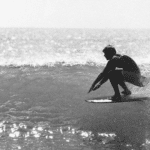
Did you notice because you you started your podcast around the pandemic and obviously that was the biggest explosion in surfing that we’ve seen for a very, very long time. Did you see the difference in what type of surfers you saw in the lineup before and after? So there’s this photograph I just I posted and it’s it’s me and I’m surfing at a local break here and I’m I’m taking a cross step. It’s taken in 2012.
There’s nobody in the background and there’s nobody in the background. And I remember in those days I would in the winter, if it was cold and it was small, I always went because nobody was there. And that day there happened to be Phil, one of the photographers.
He just happened to shoot me. And I look at that photo now and that is fucking impossible. That break, even if it’s shitty conditions like you’ll look at really bad conditions and it’ll be full of people.
I think there has been more. It’s hard to say, because sometimes I wonder if I just didn’t pay attention to some things like that back then. But I definitely felt like in the last year or two, like there’s a lot of aggro 20 year old boys that I’m like, OK, I’m not into that.
There does seem to be more times that there’s like beginners that are in the way. But I seem to figure out how to get around that by surfing in places that were more suited to my level. But yeah, definitely that one break.
Absolutely. Tons, tons of people now. Yeah.
One thing that I’ve noticed because I started surfing in 2009, 2008, 2009, is that obviously there’s more people in the water. But it’s also it seems that people don’t know what to do in the water as they’re beginning their journeys. And that’s why, you know, your platform is is a blessing because not only you’re teaching people technique, because I’m also sure you’re going to be teaching them surf etiquette.
Yeah. Do you think it’s now more dangerous in the water? I know that you’re surfing at different breaks, not beginner breaks, but just for other beginners who actually know what they’re doing. I absolutely you’re right with that.
And I think the difference is not so much. It’s like this idea that you can walk into something without questioning what’s going on around you. So for me, like I knew coming into surfing, you’re the new person and there’s a respect factor.
So like, listen, you know, ask questions. Let’s not be somebody that’s learning about the cultural. I think that was really big.
Like there was a cultural aspect to it. And like I like to say that would serve society and confessions of a surf lady where we’re challenging some of those cultural white patriarchal things about it. But you still also have to understand the surf etiquette, the knowledge, like the history to to challenge that culture.
Right. And I do think in you can see it now in social media, there’s content where there isn’t a connection to the history or the culture that was before, before they challenge that. And like you see content created where someone goes out in a break that’s way beyond their skill level and they’re getting hurt and the fins are getting smashed on their board and it’s YouTube likes.
And to me that it just tells other people that you don’t have to be aware of the ocean before you paddle out, you know. And there’s one video where the girl is like, oh, that was my fin got ripped out of my board and that was my sign to sit this one out. And I’m like, well, you could have sat on the beach, learned how to observe the way the waves broke.
And that would have been your sign to sit this one out. And that is like the respect element for the cultural, the history and mother ocean is the most important one because you will get hurt that I think I don’t know. People aren’t coming with big questions anymore.
Maybe I’m not I’m not really sure why. I it’s sad because a lot of that stuff makes surfing very fulfilling and a lot safer, too. I think you’re right.
I am absolutely obsessed with surfing history, and that’s one of the reasons why the Wipeout Weekly is out there, because we talk about ancient Hawaii and how it all started. How did we get a fin? Where did it come from? I literally just finished an article about the shoreboarding revolution, and it was completely eye opening. I had no idea that by 1970, there were 10 to 20 percent less surfers than in 1967 just because it was so much harder to go from a longer board to a shorter board.
And people were just like, no, I’m not doing it. I had no clue. I’m curious if.
We’ve got so many of these new surfers who joined in the last in the last five years, whether they’re here to stay or at some point. This is going to change again. What do you think? Oh, I think there are people that just like kind of wax and wane out of surfing and that maybe never really, you know, they want to get out to the beach and they want to get in the ocean.
And, you know, it’s like when you’re on it, you’re on a hinge account and he says he surfs and then you see the pictures and you’re like, hold on a second. I don’t think you do. Yeah, but I do think there is like a group of people that are very temporary.
And I just hope that the people that stay really see it for for more than just that time in the water, because it’s a lifestyle, cultural aspect. Right. It’s not just like this.
It I mean, it is for some people what you just do on the weekends, but there’s more to it than that. I bet you we could have an entire episode about what does it mean to be a surfer versus what does it mean to just surf? Maybe we should have that on my podcast. We should talk about it.
Another thing that I have learned quite recently was that not all surfers are created equal. So, yes, some of them care about history and culture, some not necessarily. Someone to want to rip in the lineup, someone to just commune with the ocean.
And there’s no right or wrong answer, right? Who are your surfing heroes? My surfing heroes? OK, so I would say one that like the ones that I follow a lot on Instagram, Josie Prendergast. Everybody loves Josie. Beautiful surfer.
Love to watch her technique. She I’ve watched a couple of videos like one where she talks about how she was mostly a longboarder, but then one of her friends was like, oh, you should try like this mid length or the shorter board. And so her style is just really beautiful.
I mean, she grew up. She’s half Filipino. She grew up in I think she grew up in Siargao and Byron Bay.
So amazing, amazing surfer. I always also like to look for women who resemble my body type because I want to see somebody that looks like me doing the tricks that I want to do. And I think that is still limited as far as content on Instagram.
And that’s always been one of my I guess ambitions is like I would like to show that you don’t have to be tall and thin and young to to do the nose ride and, you know, or grow up in a surfing family. So like hopefully one day I’m doing it and I can show everyone it can be done. But, you know, I’m five one.
I’m I’m like thick in terms like I’m Filipino. I’ve got thick legs, so I’m not going to be doing that light, you know, that real light, sweet dance up to the nose. But women like Auntie Meg’s.
She is powerful. She is powerful Hawaiian surfer shapes. Her own boards will ride a like a high performance like like a short board and then get up to the nose like a long board.
So really, really amazing. And then there is a Filipino surfer named Daisy. Her her and her Instagram handles Daisy Surf.
I just love watching the Filipino girls just shredding it up and doing yeah, doing these amazing tricks and like, you know, doing it in my homeland. So that’s really cool, too. I want to see more of your content on Instagram.
You can become a surfing influencer and then you can just look at yourself and inspire yourself. Thank you. I have started the surf site account, my surf diaries.
So that’s yeah, that’s GoPro footage. So the the challenge is the GoPros on the top of the nine foot board. So I have to like get up there, turn it on, come back.
And sometimes I lose a little bit of paddle time. And I’m like, oh, no, turn around. So that’s a little bit of a challenge.
But I’ve gotten some good footage. It’s a 360 max, so it gets the front of the wave in the back, even though it takes forever to start the video out because there’s a lot of data. But yeah, I started a series like that just a couple of weeks ago.
I’ll send you a clip. And I am so now that I’m trying to get to the nose, I can’t actually have the camera, even though it’s set to the side. I can’t I don’t think I can cross up to the nose with it there.
So I’m trying to figure out a setup where I can boom it, anchor it off the edge of the nose of the board. Yeah, so that’s that’s my next project so that I can still because I stopped going out with the GoPro lately because I’m telling myself like I need to get my five on the tail on the nose and I’m not able to do it. If the if the GoPro is there, my brain’s going to be like, no, we’re not stepping over a camera.
I don’t know. Would that even be physically possible with the camera on the nose? There is every once in a while someone makes a product for it, but it never lasts unusually. I’ve seen setups with a GoPro boom.
So it’s like a carbon fiber pole that you can put the you can put the sticky on the bottom of the GoPro on the surfboard. And the boom will shoot like will come off the bottom. And in the the yeah, the camera will hang off the edge.
So I haven’t tried it yet. I need to order the boom and see how it goes and see if it’s possible. But that makes the camera a lot further away.
And so then I have to test out using an Apple watch to control. It’s a whole it’s a whole system. Yeah, I’d have to test out using an Apple watch to turn on the camera because it’s it makes it really far.
And the times that I’ve run it because it’s a max. The files are so big. If I just let it run the whole time, it’s a lot.
Yeah, it’s a lot slurred through. Yeah. Dude, I am so happy you brought this up because I wrote an entire post titled I hate GoPro.
Yeah, I went to Waikiki. I got the new Hero Blackboard. It’s not so new anymore, but it’s new to me because the last one was Hero 3 for me.
So I was so excited. And I was on the nine six Robert August and the reaching to start this bloody thing. Impossible.
And I say, like, well, I am five five. I must have these little T-Rex arms because I cannot reach. And then I would leave it running.
And obviously it shoots in 4K and it just dies after an hour or, you know. God forbid you switch when you’re turning it on and turning it off. And then you only have clips of you not doing anything or or like at some point, sometimes like I finally figure out how to lock the screen because the water would wash over and change the settings.
And so I had a bunch of time lapse videos, like five second videos. I’m like, oh, there’s a lot. There’s a lot to it.
And you mentioned that you’re using your Apple watch, but I use it for the surfing workout. So it’s locked. So I cannot do anything with the camera.
So I haven’t tried it yet. That’s my that’s my thought. My thought is like, OK, if I can set up a boom, then I can use a watch to turn it on and off.
But I haven’t I have to test it out. I’ll let you know how it goes. I hope there is an app for the boom, because there’s no app for GoPro on the watch.
Oh, really? They used to have it and they discontinued it. I thought about third party, third party ones. Well, we’re going to yeah, we’re going to solve this.
If we can’t solve this, we’re going to make our own camera company for women surfers. I want to talk about your clothing brand, because this is something that it’s kind of like a little bit buried on your Surf Society website. But I’m super curious about it because there’s so much cool stuff and it’s so colorful.
And I looked you up on LinkedIn, so I know where your background is. And it seems that, you know, you studied architecture design. Are you a designer? Do you design clothes now? So I started I actually started that before the podcast.
I started the Aera Surf back in 2016. So that’s the first business I started. And I I was just making clothes because bikinis are expensive.
And I had I knew how to sew like I had some machines and stuff. And so I was like, why don’t I just make stuff? You know, I wasn’t going to school during the summer. So I was just making like as many bikinis as I could.
And at that time, I was like my 20s. So bikini like these small bikinis were like, fine, I can make them. And then at some point, I had friends that were like, you should turn this into a business, like you should do this.
And kind of just like a rolling out of different support and information coming through. Yeah, I turned it into a business, found a manufacturer here in San Diego through a through a some product business class I was taking. So my teacher was like, you know, I told her I want to do this, but I can’t sew everything.
And she’s like, OK, you can get it manufactured. Then you learn how to do all of that. So we did two seasons of new runs of rash guards and bikini bottoms.
That was like the signature pieces. So the biggest thing was rash guards are usually cut very straight and narrow. And then you wear it once it rolls up like it rolls up to here.
Yeah. So that that rash guard is cut with the darted bust. So it stretches around your bust and a curved a curved hip.
So it’s not just straight. So it actually like goes around your body and stays there. And so I was doing that 2017.
I was doing pop up shops. I was selling e-commerce and stuff about 2020. I mean, I still have product and stock and T-shirts and stuff.
And when COVID happened, I picked up my collection that the manufacturer almost didn’t want to release it because we were on like we were on some kind of like don’t go anywhere. Some so I don’t remember. Yeah.
People were saying, like, stay home. And she’s like, oh, I don’t want to get a ticket. And I was like, can you please just release my collection? So I got that.
And that was the that was the start of like my second production run of and then through just a series of COVID and life. Twenty twenty one came and I decided I didn’t want to produce more because it’s like you have the stock. It’s a lot.
Had the podcast going and stuff, but we still have product. And I mean, I learned so much from that business. And I think I thank you for saying that because I don’t I don’t put it up front and center, but it is something that I forget that when I look at it, I’m like, oh, yeah, this stuff is really beautiful.
I think at the time, in the moment, you’re just like, I want to make it better. I want to make it nicer. But I look at it now and I’m like, oh, these these garments are like they’re really high quality.
They’re really well designed. So, yeah, they’re extremely distinctive, both in like the shape and and, you know, the colors. And now they’re vintage because you’re not going to make anymore.
And they’re there and the pricing is really good, guys. Yeah. So because it was my last collection, I took the price down and really it’s more about selling it and getting it out there.
So, yeah, they they are beautiful pieces. Thank you for saying that. Are you still doing anything with clothing? Because I saw your brand Surf Nasty.
Oh, yeah. Yeah. So not for for Surf Society.
It’s like just a couple of brand shirts and the Surf Nasty logo. So the difference with that, that’s all print on demand. So if you order it, it’s created and then sent to you.
Meaning like I don’t have to carry it costs more money, but I don’t have to carry like at least like I don’t make as much, but I don’t have to carry it all, which is always a lot of work. But yeah, Surf Nasty was like one of the fun, fun things. So the whole idea is, you know, when you surf multiple times in a week, especially if it’s summer or you’re on a trip and you’re going to surf like the morning, maybe the lunch and the afternoon and in the evening, you’re about to surf again in the next morning.
And so you just decide, like, I’m not going to wash my hair. I’m not going to take a shower. I think back in my 20s, I’d be like, I’m not going to shower.
I was way more Surf Nasty back then. Now, like now I’m like in my 30s, so I need the luxury of shower. But that’s where the idea of Surf Nasty came.
I would just surf with my friends like day after day after day. And like, you know, you haven’t washed your hair in like four days. I totally get it, because even here when I go out and I just put my wetsuit on, I jump in the car.
I don’t even take my wetsuit off until I get back home. And then it’s like, oh, what’s the point of taking a shower now? Yeah, I’ll take a shower before bed. OK, I’m not I’m not that nasty.
But then I go through the entire day not washed. Yeah. Yeah.
That’s where Surf Nasty comes from. Yeah. No, no, no.
I’m like now I like take a shower right before bed, no matter what. Like I could do second shower. I don’t know.
I just I love that. Like your sheets feel clean if you go and clean every single night. And you’re like, oh, I feel like so, so good.
So, yeah, I’m not as Surf Nasty anymore, but I still have like the Surf Ratchet personality. You can be Surf Nasty when you go away somewhere and you’re staying in a hotel. Yeah.
Is there anywhere you would like to surf? Oh, my God, I would like to surf on like a long point break, like a long rolling break, like Saladita or something, even though I see what the paddle out looks like, it looks insane. But it would be really nice to have a place that you can like like I’ve been told by one of the girls in Surf Society. She’s like, if you went there for a week, like you would be cross stepping, nose riding, like to the to the top of the nose, like by the third day, because you just have so much opportunity to get up there.
So that would be really cool. But also, like I was talking to my neighbor about it yesterday and we’re just talking about how spoiled we are in California. There’s a lot of good breaks here, too.
But I would warm water, warm water would be amazing, warm water year round. All I’m going to say that you guys are more spoiled than we are. We are.
Yeah, because we got to go to Malibu and then we might get killed in the lineup, you know. So when I was living back over there during COVID, I would go to Malibu and I would ask myself, why do I surf? I’m like, that was so dangerous. Yeah, I would say I would go and I’m like, why do I for the first like 30 minutes of the session? I’m like, why do I do this? And then you catch like one wave.
You’re like, oh, this is why I do this, because it’s like this beautiful, amazing wave. But yeah, that is that place is a struggle. Definitely.
That’s the only place I’ve ever heard. Get off my wave or I’ll kill you. Somebody shouted not to me, but I do remember it till this very day.
So it’s definitely I actually did a podcast episode about it. And I was watching Bling Empire a lot at the time. And there’s there’s one of the women cast members.
Her name is Anna. And she talks to one of the other girls who’s dating this guy who treats her like shit. And she always goes, you know, dick that good.
And so for Malibu, I’d always be like, you know, dick that good. Do I really want to go there and create this incredibly toxic relationship I have with surfing because these people are crazy? And maybe there’s other times. I know there’s other times that people get it good.
And I know people have their strategies on it, too. But yeah, do I really want to go there and do that and then drive home in two hours in L.A. traffic and then be like, what did I just do today? So, yeah, that was my take on that when I was there. And we’re spoiled down here.
I got to come and visit. Yes, you do. Is there anything that surfing taught you that you took to building your business as an entrepreneur? I think in surf society, one of the biggest things, most invaluable skills that we’ve learned every year this this next year, 2026, will be our third time hosting it.
We did a visualization challenge. So all about how to take this goal that you have in surfing, create a meditation around it to train your brain and your body, how to execute those maneuvers. Right.
And since I’m a podcaster, like one of our assignments was to actually write a visualization and I’m a podcaster. So I just recorded it and I put in all these like music layered things. And you know what I mean? All this.
I just made it fun for myself. Why not? Extra project. And I would just go to sleep with it in my ear at night.
Yeah. And that’s when you asked me about the nose ride, like me learning how to do the first setup and step, like getting your brain to do it automatically. It’s because of that.
I was going on a trip to Baja and I wrote this whole nose ride visualization and I just listened to it every night. I knew the way there. I knew that I could do it on that wave.
And so then I started utilizing that in different parts of like my business and in my life, like visualizing and imagining like what you want out of something. And you’ll notice that like something like wood surfing to get better at it. There’s this process where you’re walking into something like you don’t even know.
You don’t know what you don’t know. Right. And you just kind of have to go with it.
Even when I’m trying to work on getting to that second cross step or there one thing I’ve had in my head a lot is like people always say like she draws the most beautiful lines. She chooses these beautiful lines. And so sometimes I’m like, I don’t quite know exactly what that means.
I get it. But in practice, like how is she choosing that line? What does that mean? So when I’m in the water, like I just kind of try. I don’t know what that means.
I’m going to give my best shot. Same thing with business. I have this idea.
You just kind of try it. Just see like see if it sticks. I don’t know.
And sometimes I think that too would serve society. Like when you’re in business, you always kind of over project. It’s really easy to over project like where you’re going to be at.
And sometimes what serves society, I’m like, oh, I thought we’d be like a little more stable by now, a little bit bigger by now, like have more resources. But then you step back and look and you think like, wait, this didn’t exist like three years ago. This is completely something that was created.
And I feel like that’s the same with surfing, right? It’s like you step back and feel like, wait, remember the time that I had no idea what I was just telling myself, don’t shuffle, don’t shuffle. And now I’m intentionally cross stepping. So absolutely.
It’s so it’s so tied together. From our conversation, it’s very clear that for you, surfing is life. If there was no surfing.
Oh, no, don’t ask me this. What would you be doing? So there was no surfing. Oh, gosh.
As far as like physical activity type stuff, like I’ve always liked being athletic. I used to be a CrossFit coach. So I love that stuff.
Not I don’t love CrossFit as it is now, but I love CrossFit as it is back then. If you guys know about CrossFit, you’ll see like there’s an evolution. So probably a lot more of that.
But I also like even when I was in CrossFit, I had this kind of idea of like, why are you being fit just to be fitter, like lifting weights so you could lift heavier? Like, no, you shouldn’t be lifting weights. So you could like go surf or maybe get me more into climbing. That could be a thing.
I’m really into music. So maybe more of that. But that is a tough one.
We don’t want to even think about it. No, don’t dream of that. I mean, do you have an answer to that? I’ll be riding horses.
OK, OK, that’s a good one. Yeah, I used to climb. Maybe I would go back to climbing.
I would cycle a lot. I would be very, very sad if there was no surfing. Agree.
I think I could only survive if surfing was never invented. Yes. You wouldn’t know what you’re missing.
Right. I agree. And that’s all for today.
Check out The Wipeout Weekly for our free newsletter, more stories and ways to connect with us. Thanks for listening. See you tomorrow for more of The Wipeout Weekly.