Now Reading: The big kid surf formula with Lou Harris
-
01
The big kid surf formula with Lou Harris
The big kid surf formula with Lou Harris
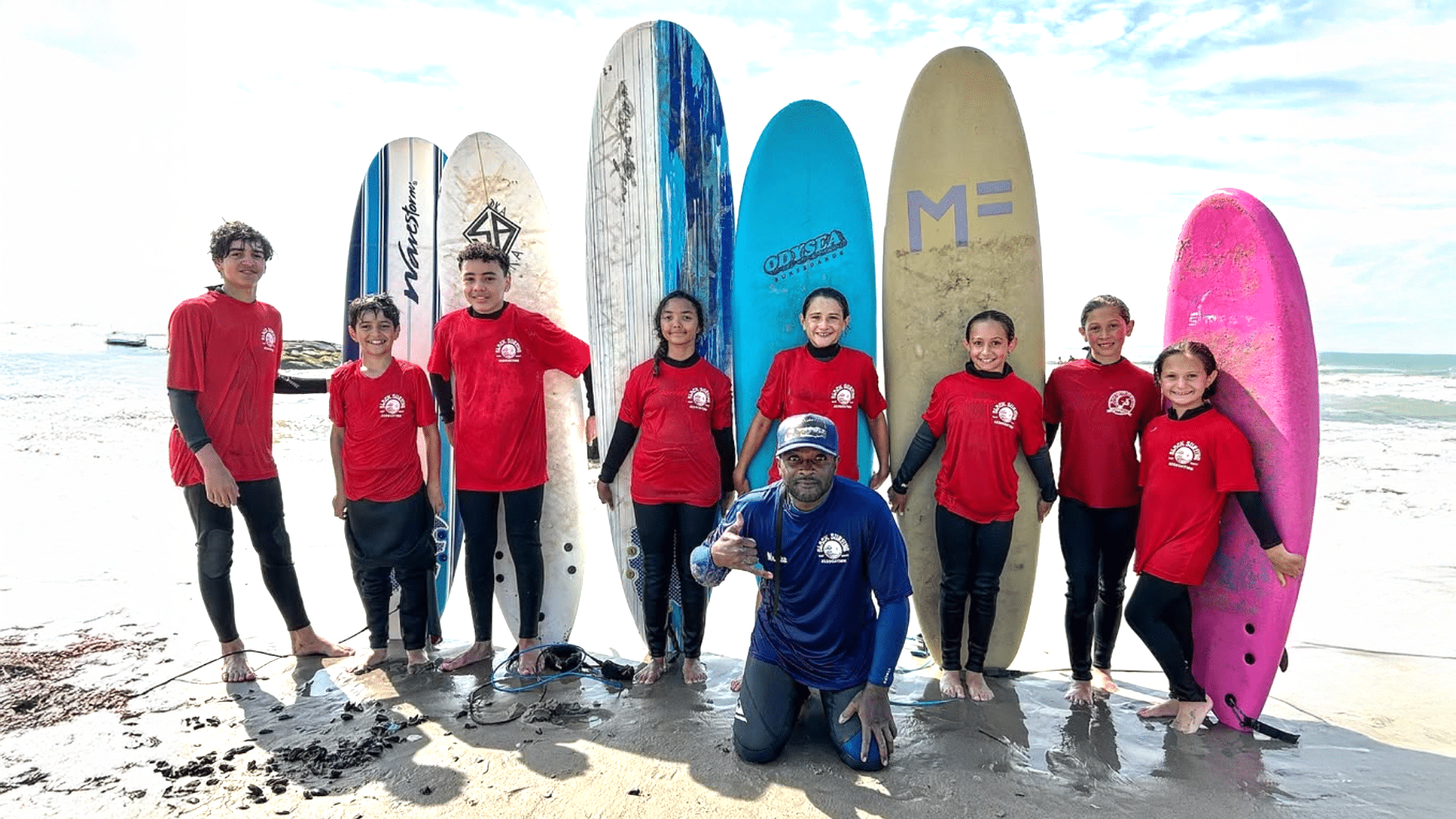
You can listen to The Wipeout Weekly episode with Lou Harris below or where you get your pods.
This Wipeout Weekly podcast episode transcript was abbreviated by my good friend Chad (ChatGPT). He takes liberties, you know. A lot of liberties. He preserves the gist.
You will find the full transcript below it. Host: Zuz Wilson | Guest: Lou Harris of Black Surfing Association
🎙️ zuz & mr lou — the big kid surf method
ZUZ:
You’ve taught hundreds of kids in Rockaway. One parent said you’re a really positive male role model. What’s your secret?
LOU:
When you’re dealing with kids, you’ve got to be a big kid yourself. You can’t yell. One dad told me, “Mr Lou, you can yell at my daughter.” I said, “Nope. Once you yell, it goes in one ear and out the other. And now I’m Mr Yelling Lou.”
I’m not trying to be Mr Yelling Lou.
ZUZ:
So what do you do instead?
LOU:
I talk to them like I’m one of them. I still play video games. I tell fart jokes. Especially when they’re nervous—that’s when the jokes come out heavy.
You can get your point across without yelling.
ZUZ:
And they listen?
LOU:
Oh yeah. One mom told me, “My kid listens to you more than me.” I said, “That’s because you yell.”
You’ve got to remember what it felt like to be a kid. Did you like someone screaming in your face? No.
how mr lou became a surfer
ZUZ:
You didn’t grow up surfing. How did this even start?
LOU:
Long Island. Born in Queens. My parents bought a house with a pool because my father grew up when Black families didn’t always have access to swimming. He wanted his sons to learn.
I skateboarded for 25 years. Then I saw people surfing in Rockaway and thought, “Wait… you can surf in New York?”
I told my girlfriend I was going to take a lesson. She said, “No you’re not. You skateboarded for 25 years. Teach yourself.”
So I did.
I used my sick days from work, sat on the boardwalk with a notebook at 3:45am, and wrote down what everyone did. Didn’t paddle out. Just watched. Asked questions. The older locals respected that.
When I finally caught waves, I grabbed a seashell, wrote the date and time on it, and took it home like a trophy.
rockaway energy
ZUZ:
What’s Rockaway like?
LOU:
Beach 90th is packed. But the same wave exists two jetties down. That’s what I tell people.
Rockaway’s special because it’s diverse. Black, white, Muslim, gay, straight, trans—it’s New York. And it’s the only place you can surf in the morning and be at a Broadway show 45 minutes later.
You can’t do that anywhere else.
the mission
ZUZ: When did you start teaching kids?
LOU:
2016. There was a tragedy in New York—a 13-year-old kid started a fire because he was bored. That stuck with me.
I saw an article about the Black Surfing Association, reached out, and started a chapter on the East Coast.
At first? No insurance. No structure. Just lessons here and there.
Then donations started. Vans. Jonah Hill bought eight surfboards. Red Bull gave us $8,000 for kids.
But here’s the thing: every dollar goes back into the community. I never forgot the surf shop owner who trusted me when I only had $15.
why kids stick with it
ZUZ:
Surfing is frustrating. Why do your kids stick with it?
LOU:
Because they feel safe.
If they don’t get it the first day, I pull them aside. I say, “Rome wasn’t built in a day.”
The other kids cheer when someone stands up. High fives. Hooping and hollering.
It becomes community.
And yeah… I bribe them sometimes. Candy. Vans. I’m not above it.
But mostly? I don’t shame them.
hard lessons
ZUZ:
What humbled you the most?
LOU:
Puerto Rico.
Thought I was good. Got out there. Couldn’t even make it to the lineup. Meanwhile, a nine-year-old kid who had just been refilling my water glass was doing airs.
That was a moment.
his teaching philosophy
ZUZ:
So what really makes you different?
LOU:
I don’t yell.
I treat them the way my father treated me.
I tell them: You don’t have to get an A. Did you try? Did you study? Did you pass? That’s what matters.
Ego? Check it at the door.
And remember—surfing is supposed to be fun.
Full transcript
LOU: Well, one thing I realized is that when you’re dealing with kids, you got to be a big kid yourself. You can’t yell. I always tell the kids, this one father said to me, he’s like, Mr. Lou, you know, you could yell at my daughter.
I said, I’m not yelling at your daughter. Once you yell at her, it goes in this ear and out that one. And now, now I’m Mr. Yelling Lou.
You know, I talk to the kids like a big kid myself. I, you know, and they know that I tell far jokes. I still play video games.
Like we say, we tell a lot of fart jokes, especially when the kids are nervous. That’s when I tell a lot of jokes.
ZUZ: This was Louis Harris or Mr. Lou as the surfers of Rockaway Queens call him.
Lou Harris began giving free surf lessons to New York kids more than a decade ago. He’s the founder of the Black Surfing Association on the East Coast on a mission to make the sport of surfing more inclusive. The New York Times wrote about him.
Kelly Clarkson interviewed him. And now he’s speaking with us about how he got into surfing, what makes Rockaway Beach so special, and his secrets to getting kids to stick with the most frustrating sport known to humankind.
Welcome to the Wipeout Weekly, the daily podcast for beginners, wannabe surfers and seasoned Wipeout enthusiasts.
No hype, no filler, just the highs, lows and honest truth about learning to surf and finding your place in surf culture. I’m your host, Zuz Wilson. Let’s go out.
LOU: I grew up on Long Island. I’m actually home here in my childhood home in my old room because I came home here to take care of my mother. She had a hip replacement on a Friday.
So I’m in my old room. And and this is where I keep a lot of my donations that I get. Like, I don’t know if you can see the vans back here.
Yeah, that’s a lot of a new board donation. So I keep a lot of my expensive donations here. But anyways, I grew up here.
We moved here in 1982. I’m American. I’m born in Queens and raised here in Dix Hills, Long Island.
And my parents bought this specific house because it had a pool in it. Right. So because my mother and father grew up, my father grew up in Queens.
My mother grew up in Harlem. So this is back in the 40s and 50s and 60s where black people, you know, didn’t swim, didn’t have the opportunity as white people. So my father was an advertiser.
I mean, he was very successful. I mean, back in the 80s, he was making 150, 200 thousand dollars. So he said that he wants to get a house with a pool in the backyard so his sons could do what he couldn’t do.
So 1977 in Amityville, Long Island, right when the movie Jaws came out, we were five years old. My twin brother and I terrified in the ocean water and we learned how to swim. Learned how to swim when we were five years old.
So and I’m a Pisces. I’ve always been a water person. I mean, I don’t know if you can see my surf wave there.
I think you see it’s dark. I have a wave there. You can’t see it. I can actually see it. Yeah. Wait, hold on, I’ll do it again. Let me see. You see the wave? Yeah, I can. Yeah. So I fell in love with the water at a young age, right? So I started skateboarding in like the late 80s, early 90s, and I skateboarded for a good 25, 30 years. I kind of stopped in 99, 2000. Right.
And that’s when I, you know, and like in between that, I was in Canada with a girlfriend, California, you know, in the city, Upper East Side. Like I’ve been everywhere. So fast forward to I’m in Harlem now. And this is like 2004. No, I’m sorry. So no, no, no.
2000. Right before Obama got elected and I was living with my ex-girlfriend at the time. And oh, yeah.
And back in the 70s, I used to come out to Rockaway. My mother would bring us out here during the summer. You know, my father would say, you want to go to camp? You want to hang out with your mother? We hung out with our mother.
We would go to Rockaway. So my ex-girlfriend at the time, we she’s like, we should go to the beach. And we’re in Harlem.
Like, like what beach? And she’s like, we should let’s go. You know, my friend said, let’s go to Rockaway. So from Harlem to Rockaway, that’s a two and a half hour trip.
Right. So when we got out there, I was having, you know, these flashbacks of being a kid out there. And then that’s when I saw people surfing because I was like, holy crap, they can surf in New York.
Whoa. This is crazy. So we leave and we just had a great day.
We didn’t want to go back. One thing we did, which sucked, was we drank alcohol on the beach and then we got sunstroke. And that’s the worst thing.
That’s the worst thing that you could possibly do. You know, so we we go back to Harlem and we’re like, let’s go back to the beach again in a couple of days. So we go back again.
And I’m fascinated seeing these guys surf. Now, remember, I just stopped skateboarding. You know, I’m getting old now.
I’m like 34, 35. So I said, I said to my ex-girlfriend, I said, you know, that’s what I’m going to start doing. I’m going to surf. I said, maybe I’ll pay for a surf lesson. And she gave me the best advice. She said, no, you’re not.
She said, you’re going to teach yourself. She said, you skateboarded for 25 years. You’re going to teach yourself. So I so I so we this was the end of summer, September 15th, September 7th. So we go back to home and we all we kept talking about was the beach, the beach, you know, the clarity. You know, it just it makes you it just you know, it’s it’s got a it’s it’s medicinal.
People don’t realize the ocean is medicinal. You know, so we so fast forward to January of 07. And we said to each other, let’s go out to Rockaway.
It’s freezing cold. We said, let’s go out to Rockaway and go find a place to stay. And back then in Rockaway, there was a newspaper.
It was called The Way. They still have it, but they had a lot more rooms and stuff. So they had rooms to rent and there was a room for rent, big, giant room, 160 bucks a week.
And we and then we said, you know what? We’re going to go out to Rockaway. We’re not going to come back to Harlem until we find a place. And that’s what we did.
And then when we we got we got went out to Rockaway, paid the guy, came back to Harlem, packed up a van and drove all the way out there. First thing I did when I got to Rockaway was made myself friendly with the surf shop there. It was called Borders, Borders Surf Shop.
The owner’s name is Steve Stathis. He’s a Rockaway local legend in his 60s, 70s. Great guy.
He runs a nonprofit called the Greybeards. So anyway, I go into his store and I see these these and I’m looking for a surfboard and I can’t surf. I don’t know what I’m looking for.
And I see these sandals. There’s a surf company called Sanuk. They make these sandals.
I saw them, these $60 sandals in there. And he saw me looking at him, looking at him. I think about it back then.
I’m like one of three black surfers there. So I stick out like a sore thumb. You know what I’m saying? So he he sees me look at the shoes.
He goes, why don’t you get him? He doesn’t even know me. He’s like, why don’t you get him? And I’m like, no, no. I said, man, I don’t get paid till Thursday.
I got 15 bucks in my pocket. He goes, you live here, right? I’m like, yeah, I live on Beach 90. He goes, take him.
I said, what do you mean? He goes, when you get your money, you come back and you pay me. I said, really? I said, why? He said, where are you going to go? And I was like, holy shit, you’re right. So that next that night I took the shoe that night.
I called my mother. I said, Mom, listen, can you just wire me $45 so I could pay this guy? And he was shocked that I went back the next day and paid him for those shoes. And then he picked out.
So I was getting to surfing. He gave me this big nine six warty surfboard beat up with the surfboard bag. And then I said to him, I said, listen, I’m just starting to surf.
You know, I said, of course, I’m black. I know people are going to be, you know, give me the business. And he said, Lou, listen, people like to surf on Beach 90th Street because that’s the legal surfing beach.
He goes, why don’t you go to 97, go to 98, go to 116th? I said, why? He goes, because the same wave on 90th Street is the same wave on 116th. The same wave on 110th. And it may not be the best break off because that jetty of 90th Street is freaking fantastic.
But again, he said, you’ll be by yourself. You could fall, bust your ass as much as you want. No one’s going to laugh at you.
No one’s going to point at you. And then he said, when you get good, then you go around, you know, to Beach 90th Street. So I was working at the time.
I was working with adults with disabilities. You know, 50, 60, 70s autism, cerebral palsy, Down syndrome. I was changing their diapers.
I was feeding them all that kind of stuff. With that job came eight sick days. Right.
So right when I bought that surfboard, called in sick. And I said, I called at 345 in the morning. That first time I said, I’m not coming in sick.
I’ve got a cold. I went to the store. Right.
I bought a beer. I brought my notebook. I got a. I got a pen and I sat there on the boardwalk and just wrote down what everybody did and just wrote it down.
And that’s so when I would see locals coming out the water, like 50, 60 year old men. And I’m thinking, man, I’m a black dude. These people are not going to be.
But they appreciated that because they were like, wow, instead of this guy getting in the water. You know, acting like a maniac, he’s asking questions. They appreciated that.
So I didn’t get into the water yet. So then called in sick the next day. Right.
I said, I’m really got a cold. I said, I’ve been on the toilet all night. It’s coming out of my butt.
My mouth stayed. And my girlfriend at the time was pissed because she’s like, how do you just get to go to sick days? And that’s when I got out there and I started to do it. And I started and didn’t catch a wave until my second time.
And I remember the day I caught that wave, I probably three days into that because I called a sick. I took up six, six days in two weeks. I said only a two left.
And and then I grabbed the seashell after that first day of catching like three waves in a row. And I wrote the date and the time of my first wave and took it home. And what happened was.
So now. Right. I go to Beach 90th Street.
Now, Beach 90th Street is a left break for people that don’t know, you know, when you let’s say the jetties here and you’re right here. The only way you can go is left. You know, people don’t realize the person on the right of you always has the right of way.
OK, because that person on the right is going left. So what I was doing was I didn’t know how to go left yet. I was a kook.
I’m going straight down. I’m just going straight. These people want to go and carve down that line.
So, again, got out the water, asked a couple of the locals. I said, yo, how do you go left? How do you go right? They said, Luke, good question. They said the human head is the heaviest part of the body.
Whatever way your head turns, that’s the way you’re going to go. You want to go right. You go right.
You want to go left. You go left. And then also what I teach the kids is I said, whatever way, whatever side you see the way breaking on, you go the opposite way.
They said, Mr. Lou, how do you know how to go left or right? I said, oh, when you see the foam on the right, you go left. You see the foam on the right, you go left. And that’s that’s pretty much like how I learned.
And and fast forward to the fire. 2016, I got my neighbor’s mail by accident. Right.
And in that mail was an article. I’m sorry, it was Surfer’s Journal. And in that magazine was an article on the Black Surfing Association.
And I’m like, holy crap. Black people surf like this. Wow.
You know, and I just this was, you know, the tragedy was the week before this. So and I in the article was Tony Corley. I’m like, wow, wow, wow.
So now my wheels are turning because, you know, at this time I’m a doorman. I work night. So now at night after all my ideas come to me.
So that’s when all people sleep and my wheels are turning. So I’m like, you know, maybe I should reach out to that guy, ask him if I could start a chapter here. And so I sat on it for a week, something and I didn’t say no.
And I came out to him and I messaged him on Facebook, friended him. And I said, listen, it was a tragedy. You know, you know, a couple weeks ago here in New York and Coney Island.
I said it was a fire was started by a 13 year old black kid, Marcel Dockery. I said the kid started the fire because he was bored in his basement. He started the fire.
And he said, oh, my God. And then he said he said, well, what do you want to do? I said, well, skateboarding lessons and, you know, surfing lessons. He’s like, sure, go for it.
Right. So start the Instagram page. And now I’m doing a lesson here.
Lesson there. I don’t have insurance yet. I have nothing.
So this guy from the Bronx named Jack Cuggy, he messaged me on Instagram and says, listen, I love what you’re doing. I love how you do it for free. You work with the kids.
He said I used to be in your position a long time ago, but I’m handicapped now. He said, I’m going to send you a five hundred dollar donation. So I’m like, oh, great.
Wow. Wow. Fine.
OK. So a week later, something said, look, go check the mail. I checked the mail. He said fifteen hundred. So I called Tony in California. I’m like, Tony, I need I need the tax ID number.
I can’t open it up because, you know, on the check, it says Black Surfing Association. I can’t. You know, so they so they trusted me.
They gave me a tax ID number, which was bogus at the time. I didn’t know. And I opened up the account and and that was my first big donation.
And I took three hundred dollars of that and went to this Spanish restaurant and bought a bunch of food. And a buddy of mine, we stood on the corner and gave out free plates of food, free plates of food. Right.
So two weeks later, you know, I go into vans in Queens in a mall to go buy a pair of skateboarding shoes because I’m not skating anymore. But I still love to wear skate shoes. I’ve worn for 30 years.
So I’m wearing my BSA shirt. Right. You know, so BSA there.
And the guy, the manager is helping me out. His name is Nace. Great guy.
And he says, what shirt is that? No, no, no, no. No. He said he said you skate.
I said, oh, I just started surf. I said I skated for 20 years and my body can’t handle it. He goes, what shirt is that, by the way? I said, oh, this is my nonprofit in Rockaway.
I teach kids free free surf lessons. He said, oh, really? He said, do you have an Instagram? I said, yeah, I gave it to him. So he disappears.
Right. He goes into the back to get my sneakers, brings them back, goes into the back to check out my Instagram. So then he comes back and goes, I just check out Instagram because you’re doing some nice stuff.
He goes, he said, do you have a taxi number? I said, yeah. He goes to the back again. He said, I think I can get you free shoes.
I’m like, yeah, right. I’ve been wearing vans since. I’ve been wearing this picture right here.
I don’t think it’s from 1978. OK, and in the picture, 1978, I’m six and a half. I’m wearing vans in the picture.
OK, so I’ve been wearing vans for 46 years. So I’m like, no, the vans, the shoes that I love. I’m a little kid.
I’m like, no, you can’t. So he said, yeah. He said, I’ll call you in a week.
Calls me up. He said, oh, we have two boxes for you. And I’m thinking boxes like the ones behind me, like two boxes.
So I think two boxes on a cash register. I go grab the two. And he goes, no.
He boxes where each box contains like 15 pairs. And that’s and then that’s how it started. Like that’s when the donations just started rolling.
Jonah Hill, when he used to have Instagram, Jonah Hill. My buddy goes, you know, Jonah Hill’s following you, right? I’m like, yeah, right. From Superbad, from Wolf of Wall Street, from Moneyball, he’s following me.
I go to his Instagram following. I’m like, holy crap. So I go to his DM.
I’m like, hey, man, if I’d known you were following me, I would have followed you back. I said, listen, whenever you want to come out to Rockaway, I’m your guy. You let me know when you want to come out to Rockaway.
And he goes, that’s the best offer I’ve had in a long time. He was filming the movie with Eddie Murphy and Julia Louise Dreyfuss at the time. I forgot the name of it.
But yeah, it was when he was marrying a black girl, Lauren London. Yeah. So so anyway, so he’s filming the movie and he goes.
Can I can I give you some boards? And I’m like, if you want to. So Jonah lost a bunch of weight at this time. So he had all these fat guy surfboards sitting in his garage.
So he went back to filming the movie and his assistant, Marie, was supposed to get in contact with me about these boards. So I didn’t want to bust his balls. I got his phone number, my phone.
I don’t. But that’s one thing celebrities don’t want. They don’t want you bothering.
That’s why a lot of celebrities, I have a bunch of phone numbers. I don’t bother you. So I didn’t bother him.
So after the movie finished, he calls me up out of the blue. Eight o’clock his time. Eleven my time.
I’m falling asleep. I’m like, you know, next to my wife, ex-wife and snoring. Hey, Lou, it’s Jonah.
Jonah who? Lou, Jonah Hill. I mean, holy crap. I wake up and then he’s like, hey, you didn’t get those boards, did you? And I’m like, no, no.
And I’m like, oh, she’s like she she she blew me off. Like I like I sent her an email. She blew me off.
He goes, why don’t you call me? I said, I don’t want to bother you. I said, you give me something for free. How am I going to bother you? So he goes, go pick out a surf shop in Rockaway and I want you to pick out eight boards.
He goes, how much did they cost? Eight. And he goes, forget about it. Just go pick them out.
So I go, guess where I go to the surf shop. The guy that took care of me with the shoes, Steve, my guy. And guess what? I don’t tell him it’s Jonah Hill.
I just said this guy, I said this guy is supposed to buy his boards. So he so I give him Jonah’s number. Actually, I’m sorry.
I gave Jonah his number and then Jonah called him and they hashed it out. And then Steve calls me. He’s like, Louis, why didn’t you fucking tell me this was Jonah Hill? I almost shit on myself.
And I’m like, he goes, why? I said, because you looked out for me that day. I said, I don’t forget that, Steve. And Jonah bought us eight surfboards, $600 a piece, like that, like that.
And that was massive. And like and that was good for Steve, because in Rockaway from November till about March, that’s your dead time. You make no money.
If anything, during the week, you sell wax or maybe a wetsuit. No one’s buying stuff because everyone’s in Puerto Rico. No one’s in Rockaway.
So. So. So fast forward a week later, Red Bull hits me up and that’s one of my biggest sponsors.
I get stuff from all the time. And they said, look, we have what was it? Oh, 11. No, no.
I’m sorry. No, we have eight thousand dollars to blow away. This was like a couple of weeks before Christmas.
And I’m like, he’s like, can you get together 11 kids? So, again, I don’t tell Steve. I just bring the kids there. And I said, Steve, I said, meet me there.
I said, I got a surprise for you. We spent eighty eight hundred dollars and forty five minutes. And he said, Lou, why? I said, because I don’t I’ve never forgot.
You sold me that cheap board and you sold you gave me those shoes. I could have walked out in stone and you trusted me. And that’s why I always we always, you know.
And and that’s how pretty much the donation started. So like, you know, went from Vans, Jonah Hill, people saw that then. And then again, it’s like people see me do a lot of these things and everything is like a stepping stone.
You know, Kelly Clarkson. That was dry. You know, GQ magazine.
That was to look on Rolling Stone magazine. That was Red Bull. So a lot of these appearances, it leads to other stuff.
And that’s my mother always says. She’s like, Louie, you don’t know who’s watching you on TV. You don’t know who’s following you.
Sometimes there are celebrities that I have no idea. Oh, my God. I didn’t know that.
So but but but that’s how it takes off. And like I’m an act like my father was an advertiser. I went to school for marketing and people don’t realize Instagram is free marketing.
It is free. You sell yourself. And and and that’s what I do.
Like like I reach out to a lot of these companies, you know, and. The worst thing to say is no. You know, it’s like it’s like being a kid when you’re 13 and you want to date a girl.
And my mother would tell me, said, Louie, the worst thing to say is no. And that’s it. And like this, this is what I do.
Right. And then and I want you to pass this on to friends of yours who who are looking for sponsorships. One of my biggest is dryrobe, you know, dryrobe, right? The jacket.
OK. They’re they’re in London. Right.
Two hundred twenty dollar jackets. You know how I approach them. I said, hey, you know, love your company, love your jackets.
I said, would you guys possibly have any defective or slightly used jackets that you might if you’re going to throw any away? Would I came at them with that angle? They were like, let’s send them. So last year they sent me 10 less in December. This past December, they sent me 12 because that’s the angle you got to come in.
Like like another one of my sponsors, it’s freestyle watches, freestyle. I said to them, I said, yeah. They said, hold on.
Stay right there. Hold on. One of my favorite watches in the world.
They sent me three. I have one of these different color. Yeah.
They sent me three. And I said to him, I said, do you have one missing straps or maybe, you know, the digital part doesn’t work. And when they see you like that, like, wow, this guy will take anything.
Now, you can’t go there like, oh, do you guys have 12, a green one, five, five in the green. No. You know, and that’s what you got to do.
You got to remember, you got to kiss ass a little bit, you know. So it’s been a fun ride. Like my mother says, she’s like, Louie, you’re laying the blueprint down.
I’m laying. And I see people copying off me all over Instagram. I see him copying all the time.
I get people hit me up all the time for advice. Look, how do I promote this? How do I do all the time? Like my mother’s like, you should start charging money now. You could offer marketing advice.
Oh, yeah. I got a friend here in Rockaway. His name is G-Day.
He’s a Nigerian model. His wife is a Nigerian. They have an African restaurant in Rockaway.
OK, the food is there, but it’s OK. But but it’s a great post surf food because it’s not heavy. So and again, two beautiful models.
And he said, man, can you offer me any advice? I said, G-Day, you’re beautiful. Your wife’s beautiful. Cook one of your beautiful meals.
Take a shot. Smile with the thing. Say this beautiful meal we offer today, three o’clock.
And this is Callaloo. Boo, boo, boo. That’s come on.
But that’s like rocket science. Come on. And so I’ll get those phone calls maybe twice a week.
ZUZ: And you started surfing was it in 2007, did you say?
LOU: 2007. Yes. Yeah.
2007.
ZUZ: And from the moment that you had your non-lesson, because you were basically learning by yourself and you were on this massive nine six board. What happened then? How you know, how quickly did you progress or like what was that journey like?
LOU: Oh, great question.
So once I started killing it on that nine six. It just got annoying after a while, because when you’re riding a long board nine six and you and you got a wave like a three, four foot wave. You’re pearling.
Yeah. And I got sick of that. So what I did was I went on Craigslist, traded that the nine six for eight.
Oh, eight. Oh, kill that board. Yes.
Oh, one of my favorite boys killed it. And then again, like I’m surfing big waves now, four to six feet, eight foot boards suck. That transition going down the face is hard to maneuver when you got a big ass board.
So got rid of that eight. Oh, went down way down to a six, six firewire advance. And what the biggest wave my life, like an eight, nine foot wave in Rockaway.
Huge. The face had to be 10 feet. And that’s what I did.
I progressed down and then I rode that six, six. And then and now I’m like, I’m like, 36, 37. I’m still, you know, but once I hit it, so so the shortest I went down to was like a five or five, two.
And then once I hit 40 and my knees started and my that’s when I started going back up to six, eight, seven. Oh, right now I’m riding a six, eight and I got a six, five. I have a six, two, which is like two years old, which I can’t ride anymore.
But it’s so fast that pop up is like, you know, so. And people always ask me, they say. When, when am I ready for that transition? When, when, when, when am I ready to, you know, to to downsize? And I’m like, you know, how’s your turning? Can you go left? Can you go right? Yeah.
Right. OK. Are you good at duck diving? Are you good at turtle rolling? And so and I think to the surf shop, I take the parents, I take the kids to the surf shop and I show, you know, in the surf shop.
They like that because a surf shop is they’re going to sell you something that you don’t need. You know what I’m saying? That’s what happened to me. First time I actually surfed before I got that nine, six.
I went to this greedy surf shop on one 16th Street and they sold me a six for $400. And I was terrible on that. I left that part out.
I’m so sorry. And then I brought that board to Steve at Borders and he goes, what the hell are you doing on this board? I got a board for here for you. The nine, six.
That’s right. I left that part out. Sorry.
And yeah, because surf, surf, surf shops, they won’t, they won’t even tell you what you need. So I took them to Steve’s and Steve is going to tell you what you need. He’s going to tell you all the way down to your boots, your gloves, everything.
And again, he’s like me, you know, he doesn’t want parents spending that money that they don’t have to have, that they don’t have to spend.
ZUZ: So along this journey, did you get any instruction from anybody else or were you just like looking at people and then trying to copy and just learning by yourself?
LOU: Pretty much learning by myself. I mean, I had one person that was giving me tips here and there, but it was pretty much by myself.
And my ex-girlfriend at the time, she was like, you know, like my biggest coach. You know, she was the one that was, you know, just she would take pictures and take video. And what I would do is I would go back.
This is before GoPro. I wasn’t, I don’t know if GoPro was out yet, but I would go back home and I would watch myself on the camera. It’s like, it’s like, you know, being in a football game and the coach after the game, they watch a game film and they say, why don’t you block here? Why don’t you cut there? And that’s what I would watch myself.
And I’m like, why did I do that? Why did I? So and that’s why, you know, and those sick days from work, they really help.
ZUZ: What’s the Rockaway like? Like the vibe and, you know, the lineup. Is it friendly? What do you expect when you go there?
LOU: It’s not.
I mean, it’s kind of friendly, but it’s Beach 90th is packed. You know, like I told you before, the same wave there, the same wave, two jetties down. So I like to be on 102nd Street.
That’s why I teach my lessons during the summer. That’s why I have my permit. That’s why I know that jetty.
I know the breaks. I know the drop offs. I know the rips.
I know all that stuff. So so that’s where I like to go. I was on Beach 90th Street.
This is when I was riding that 664 I told you about. This is the day I caught that eight foot eight nine foot wave. I think it was Hurricane Gus.
It had to be September, October, because that’s when the waves start pumping. So every September 11th, September 11th, that’s when the waves start pumping. So I’m in the water and I just caught that wave.
And my endorphins are flying out of my head and I’m going. So my buddy’s paddling next to me and he’s like, yo, I saw that. He’s like, man, I got to get out of the water, man.
He goes, he goes, I got to use the bathroom. So I said, oh, pee in your wetsuit. He goes, no, no, no, no.
He goes, I got to go number two. So I’m like, oh, because he lived he lived right across the street. So he had to go number two.
So I’m like, OK, I’ll see you when I see you. So I turn around, I paddle back out to the lineup. I caught another wave, not as big, maybe five foot, six foot.
And then I see him again. I’m like, well, that was a quick dump. And he goes.
I shit in my wetsuit. And I was like, oh, my God. I’m like, what? And that’s when I knew that surfing was that sport that people will do anything for.
They will free they’ll freeze their asses off in the snow to surf. They’ll they’ll leave their girlfriend waiting at the subway station to catch that last wave. And they’ll shit in their wetsuit.
I learned it. So it was so funny.
ZUZ: How often do you surf now that, you know, you’re teaching all the time.
So what’s the split between you surfing and.
LOU: Well, I’m 54 now, so I’m getting up there. So, you know, and like in the past four years, I’ve had three surgeries.
So I’m not the spring chicken I used to be in my late 30s, early 40s. So during the summer, you know, you know, I’m that weekend warrior. I surf during the during the week, too.
But during the winter, I’ll only surf if there’s like a hurricane as well. I just won’t be out there messing around in two, three foot waves, you know, because people don’t realize when it’s when it’s snowing or something like that. Before you even get in the water, your feet are frozen, you know, and like there’s a lot of tricks of the trade.
You know, I remember when I first started surfing in the cold weather and I would ask the locals. So what do you guys do? The number one thing a lot of people don’t realize is you put Vaseline on your cheeks. Because that stops the wind.
And then also you drink a beer. And I said, why drink a beer? And they said, oh, do do a couple of shots. I said, why? They said, oh, because that makes you pee.
And then you pee in your wetsuit and you stay warm. Yeah, because I’m like, yo, drinking surf. And they’re like, yeah, no, not getting drunk.
And it works. And also being out there with a little, you know, a head buzz from the beer. You’re catching waves that you’re not normally going to catch.
Yeah, I found myself catching like I’m going for seven foot and like I just seen it and I’m going for it. Yeah. So and that that was a great lesson because Vaseline on the cheeks that really stops that wind bite on your cheeks, too.
And then you put some some on your lips. It really stops that because that’s again, your face is covered. But that, you know, when the water is 32 degrees, you know, and the wind is I mean, and the air temp is 38.
That’s cold. And that, you know, it’s it sucks just sitting there. Your feet are already frozen before you get in the water.
Now your feet are frozen. And then I’ll be trying to pee like four or five times. I’m like, I got nothing left.
I’m out of here. You know, I’ll tell my photographers during the summer. I mean, during the winter.
I’m like, yo, get your pictures now. One or two ways. That’s it.
ZUZ: That’s hilarious. I used to do the same thing. I didn’t drink beer when I was surfing in the UK because I was driving.
But but I would I would drink a lot of coffee and then I would I would just keep myself warm by peeing into my wetsuit. It was my favorite.
LOU: Yeah.
That’s why I tell parents, like when they go on vacation somewhere, I said, never rent a wetsuit. They say, why? I said, because everyone pees in them. They said, oh, that’s right.
So I got a sponsorship deal with this company called Hyperflex. They’re a surf wetsuit company in New Jersey. And they sent me 40 wetsuits last year for the kids.
They’re going to send me another 40 in April. And, you know, when I give the parents these wetsuits, they’re appreciative because they’re new. They got tags on it, you know, and like and I always tell them, I said, never wear a used wetsuit.
So why? I said, because you’re swimming in somebody’s piss. I don’t care how many times. And nine times out of ten, when someone rents a wetsuit and they pee in it and they give it back to you, they don’t like wash it, wash it, they spray it with a hose.
And that’s it. And your pee is still there.
ZUZ: Well, I did the same thing with my wetsuit.
I just spray.
LOU: Oh, yeah. Yeah.
It’s our pee. Yeah. I don’t care.
It’s our pee. Like I’ll do that. There are times I’ll pee my wetsuit.
I don’t even spray it down. I just throw it in the rack. Yeah.
So but it’s all good. I’m making you laugh. I see your face turning red there.
ZUZ: I know. I know. I just I’m sitting in this little booth as well.
So it’s just getting warmer and warmer. But OK, so you are surfing a little bit less now, but anywhere else that you would like to surf?
LOU: I’ve surfed in Puerto Rico. That was humbling because I thought I was a good surfer.
And I went there for my 40th birthday, 2012. And my ex-girlfriend and I were at that we’re sitting at this restaurant. There’s one of the best places called Maria’s Beach.
It’s great. Right. And that and then that’s the thing.
Right. In Rockaway, everyone leaves to Puerto Rico, December, January, February. Everyone, Long Beach, everyone does.
So my buddy Simon’s like, Lou, let’s meet you and your girlfriend. Get a 12 o’clock fight at a JFK. That’s a 12 o’clock flight.
That’s weird. He said, no. He said the flight’s a two hour flight.
We land in Aguadilla. Right. We land there about two thirty, three o’clock.
We go to our condo. We sleep for two hours and then do a dawn patrol at five, which was awesome. So we surfed at five.
It wasn’t that big, but then it was a swell kick. It was eight feet. Right.
So we’re at Calypso at the bar eating lunch before I go back out. And our little bus boy, his parents own the restaurant. He could be more than nine or ten.
And he kept saying, mama, mama, papa, papa, I want to serve. I want to serve. And I’m saying to my girlfriend, look at this little shit.
How’s he going to get out there? So we finish our lunch and I couldn’t even make it out there. I couldn’t even get out to the break. I couldn’t even make.
I was so embarrassed, humbled. So I’m sitting on the beach with that board next to me, just feeling defeated. And guess who is out there catching waves, doing airs? That little freaking shit kid that was filling up my water glass an hour ago.
And I I got humbled that day. And I think God did that for a reason. He said, you’re not such hot shit.
You thought you were. But just remember some kid 30 years younger. And that kid was ripping.
And I and I’m glad that happened to me. Like I said, I thought I was good and I wasn’t. And watching it, not just him, but all the surfers in Puerto Rico, watching them all is like watching a live surf magazine.
Like they don’t play out there in Puerto Rico. I remember when I got out there, there’s a coral bottom rock and coral. I mean, slippery, sharp.
And I remember I said to the to the locals, I said, yo, how do you guys deal with that? And they said, pretend there’s no bottom. I said, they said, pretend there’s no bottom. I’m like, oh, my God.
But that was the best trip of my life, because, again, I got humbled. I learned, you know, that, you know, how to paddle, because a lot of breaks in Puerto Rico are seven minute paddle, you know, eight minute paddle. Yeah.
Yeah. Because you got to think about these ways of these ways of bang, crash, crash, crash, crash. You got to duck dive, turtle roll, you know.
So another thing which is great in Puerto Rico is the riptide. When you can’t get out to that break, you use that riptide takes you out there. I mean, it takes you a little off course, but you got to get back out.
But it’s not like the riptide in Rockaway. The riptide in Rockaway is deadly. The riptide in Puerto Rico is better because there’s no jetty.
And two, it’s like a straight it’s like a conveyor belt. It takes you right out.
ZUZ: Did you go anywhere else after Puerto Rico? You’re like, no, I’m just staying at Rockaway now.
LOU: Yeah. Yeah. Rockaway, Puerto Rico.
And yeah, that’s that’s yeah, that’s pretty much it. Yeah. I mean, oh, oh.
And and in Jersey, Jersey, Jersey is really racist out there. There’s no black service. My friend was called the N-word out there.
We we went to a surf expo at an Atlantic City on the boardwalk inside one of these hotels. And it was every surf company there giving you the preview of new surfboards, wetsuits. We got to, you know, because I was the manager of a surf shop at the time.
So we went out there and seeing what stuff we’re going to order for the season. And we had demo boards with us. And it was like a little swell in the water, maybe four to six.
The the the event ended at six o’clock. And my buddy’s like, let’s go surf. You know, he’s like me.
He’s a black guy, but he’s not like, yo, what’s up, man? What’s good? He’s like me. He was like, we’re nice. And so we got to the water and every white person.
Wait, wait, wait. Hold on one second. OK.
I am so sorry. My twin brother is here. OK.
All right. So what’s the question? I’m sorry. But what’s the question?
ZUZ: Oh, no. You were talking about surfing in Jersey.
LOU: Oh, yeah. So so it’s all white people there.
And that’s one thing I don’t like. I mean, not that I don’t like a lot of I like I like
ZUZ: Nobody likes a lot of white people. Trust me.
LOU: No, no, but no, no, no. But when I say that, I like that’s why I like Rockaway. Because Rockaway is black, white, Asian, Muslim, gay, straight, trans.
That’s why that’s why I love it. So we’re the only black people in the water. And like we’re getting all those stairs.
Now, mind you, you know, I grew up in a Jewish neighborhood. I used to date white girls. I still do.
I go all the time. I get stairs all the time. And that’s what they were doing, just staring.
So and I said, bro, I don’t even want to paddle out. So we paddle out and they’re staring. So I catch my first wave, carve.
My buddy catches his way. And guess what? They stop staring. They’re like, OK, these guys are surf.
They’re cool. But but but I just didn’t like that vibe there. It was just a terrible, terrible fight.
Like, you know, like with me, I’m so welcoming with people like like like, you know, because people know me in Rockaway. People come up to me and say, hey, Mr. Lewis, whatever it is like and like I don’t like I said, I’ve had trans people come up to me. Gay, whatever it is, asking for advice, questions.
I welcome everybody. You think I’m from New York. I see gay people all the time.
I see all kinds of people, all colors. That’s why I love New York so much, because it’s the kind of place where. You don’t see the same thing every two seconds.
There’s always something. That’s why a lot of these people from the Midwest and like especially a lot of young gay men, gay women, they come to New York because nobody’s going to care. Yeah.
You know, and and and that’s why, you know, I love Rockaway so much. I get asked this question a lot. They say to me, what separates Rockaway from other surf breaks? And I said, I got that easy.
I said the same thing all the time. Rockaway is the only place where you could surf. And then 45 minutes later, you could be in the city seeing a Broadway show.
You can’t do that in Jersey. You can’t do that in Montauk. You can’t do that in Jones Beach.
You can’t do that in Lido Beach. I remember it was the end of summer. Early September.
And, you know, that’s when the hurricane started. And I surfed. And now it’s a hurricane during the summer like that.
September. I surf from like 6 a.m. to like one in the afternoon. I’ll come back to the house, feed the cat, you know, pee or whatever, whatever it is.
So I surfed all day and my eyes were just bloodshot red, bloodshot red. So my ex-girlfriend’s boss, he was on the board of Washington Square Park.
Washington Square Park every September had a thing called Taste of the Village, where every restaurant in the village, they do pop ups right in Washington Square Park and they give out free samples.
Right. So here I come to meet her and her boss and the friends, you know, for the dinner in there. My eyes are just out of my face.
So her boss is like whispering to her. He’s like, what’s wrong with Lewis? And he’s like, is he stoned or something? And then she’s looking at me and I’m so she comes over to me. She’s like, she’s like, are you stoned? I’m like, not now, but I’m just sitting here.
Why? And then she’s like, well, he thinks you’re high. And I tell him I was surfing for six hours. She’s like, that’s right.
You went surfing. So she goes to him and says, yeah, he was surfing. And he’s like, where? You weren’t surfing in New York.
And I’m like, dude, Rockaway. And he had no idea that you could catch world class waves a train ride away. So that tripped me out because the kids like, again, people he thought I was, you know, smoking a big old blunt or something.
And like and he couldn’t believe I was surfing.
ZUZ: How did kids find out about you giving free lessons in New York? How does this work?
LOU: So a lot of it is from is from like magazines. A lot of it is from TV.
We were in The New York Times last year.
ZUZ: That’s how I found out about you.
LOU: Yeah, yeah.
So that was our second time in The New York Times. And right after that article came out, like we only had maybe two weeks of summer left. And I must have had about 40 new kids come.
So and then also a lot of the parents that are in my program now, they tell their friends and then they tell their friends. And then that’s how it works.
ZUZ: Do you know how many kids you’ve you’ve taught so far?
LOU: Oh, God.
In nine years, I taught. Two hundred. And I was thinking, too, like because I give out free surfboards to probably in that time, too, in the nine years, I’ve probably given out at least maybe 300 surfboards.
Like I give away so much stuff. It’s kind of thing where, like, you have to give it away because if I die tomorrow, I can’t take that stuff with me.
ZUZ: You only teach in the summer, right? Because kids, otherwise they don’t have time of school.
LOU: Well, yeah, and it’s hard teaching them after, like, September, October, because, again, now they have activities. They got basketball, they got gymnastics and it’s hard to get, you know, and then a lot of my kids’ parents, their teachers. So during the summer, they’re off during, you know, the winter months now.
It’s hard for them to, you know, to get their kid there and stuff. And a lot of the parents don’t like the kids in the cold water. Of course.
Yeah.
ZUZ: OK, so how does it work? What time do you start? How long do they do they surf for? Do you have anybody else who helps you? Do you have how many kids you have at the same time?
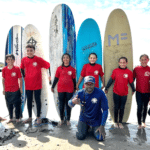
LOU: No, I have I have about. Five instructors that, you know, that one comes from Brooklyn, another one comes from Manhattan, one comes from Harlem, one comes from Jersey.
You know, and these people dedicate their time, come in and help me out. And such amazing people. And we start at eight o’clock in the morning.
We have two groups, Group A, Group B. Group A is from eight o’clock to about eight forty five. And then we have, you know, Group B from about eight forty five, nine to ten. And the kids who already had their own boards, they don’t have to get out of the war.
They can serve the whole time. Those schedules are for the new kids, you know, teaching that don’t have boards. So, yeah.
So and then we get to the beach, you know, because I’m very early, I’m very punctual. I like to be on that beach at seven fifteen. We have a board storage across the street from one or two street.
The kids get there early. You know, we put the boards on our heads. We carry the boards to the beach.
We set up. If there’s a wave out there, I’ll go start for the kids real quick. And then I like to be there early.
So so the kids, I can show the new kids the pop ups and stuff like that. And I told the parents, I said, you got to be punctual because there’s some parents that will show up at eight sixteen, eight twenty. Expect you to get out and come do the pop up.
I’m like, no, that’s it. That’s it. You got to be on time.
ZUZ: Do the kids just do one lesson or do they stick with it and they just keep coming back?
LOU: Especially like when I give you a surfboard and then also to the like I said, when parents and find out, you know, the parents that are with me, they’ll tell this set of parents and this set of parents. So now you’ve got a bunch of friends, everybody’s surfing together, you know. So like like that’s that’s that’s what make the kids stick around, too, because they’re surfing with their friends every day.
ZUZ: Do you remember your first student?
LOU: Yeah. Yeah. Yeah.
Yeah. The guy who the African model who had the restaurant. Yeah.
His little brother. Oh, really? Yeah. Yeah.
Yeah. And again, did not know what I was doing. Did not know about RIPs really good.
Did not know about the drop off. Had no insurance. Didn’t.
Yeah. Yeah. And by the grace of God, everything was good, safe.
ZUZ: How do you teach kids and adults? Like what is your method? Do you get them practicing pop ups on the beach and then you get them on the boards of the body board before?
LOU: Oh, no. We just we do the pop up. OK, first thing I ask the parents are, are your kids athletic? Do they play sports? Do they, you know.
And when when the mom say, oh, yeah, my kids do gymnastics, I’m like, oh, that’s easy. So those those are the ones when I when I when they say gymnastics or soccer or I know that pop ups going to be automatic. And when I see them do that, I’m like, OK, you’re ready.
Let’s go. I had their mother sign the waiver, sign the insurance and we’re good. It’s the kids that just sit around the house and do nothing.
I don’t get it. And then the parents always ask me, they say, Mr. Lou, how come, you know, my son’s not getting it? I said, what what activities does he do? Nothing. And he plays video games.
And I said, that’s what it is. And I said, you got to understand when he’s trying to do a pop up, his body is using muscles it’s never used before. So she goes, what can he do to improve? I said, well, in the pop up.
Doing a push up leads to the pop up. So I said every night when he goes to sleep, have him do five. Every morning when he wakes up, have him do five.
That leads to the pop up. So so and then those kind of kids, you know, a lot of them aren’t that athletic. You know, they’re a little, you know, not in the best shape.
So they use a knee to pop up, which is fine with me. I usually like for them to pop to their two feet. Those kind of kids, you know, and I tell them whatever works for you, you know, you stick with it.
ZUZ: Did you ever have any kids who got in the water and absolutely hated it?
LOU: Yeah, those are like the younger kids. That’s why I don’t go under under seven years old, because, you know, you see the kids in the water. I mean, on the beach and they see their brother or their friend and they’re like, I want to try.
And as soon as you get them out there, they’re like, OK, bye.
ZUZ: Is it a requirement for them to know how to swim or not?
LOU: And that’s a good question, because a lot of the parents, they message me to say, oh, Mr. Luke, my child can’t swim. And I explain to them how every lesson that I take the kids out.
It’s low tide. Low tide is the possibly the most shallowest part. I mean, I’m up to maybe my waist, not even if that.
And the water is maybe two feet. It’s shallow. And also I explain to them that the board is attached to their ankle, the leash.
So it acts as a flotation device. So I said they’re 100 percent safe. Yeah.
High tide is impossible to do lessons because I don’t have any footing to stand. And then the water is up to my neck, which isn’t safe. And then and then when you push them, it’s like shore breaking.
ZUZ: Have you noticed any changes in kids like after they started surfing? Like, did you know them, for instance, before? And then they started surfing. They’ve been doing it for a while. And they did you basically see the effect of surfing on their life?
LOU: Oh, yeah, definitely.
Like his one kid, Benjamin, I started he’s I was so stupid. I took him out when he was four with his dad. He’s 11 now.
He’s better than me. He I’ve given him like six, seven boards. Like I give him all the donations I get a gift to him.
And he’s better than me now. He’s like, Mr. Lowe, you got to do this. You got to do that.
But like like again, I look at him and I tell and all the kids that come, they want to be like him. And again, he’s 11. All the kids will be like him.
And then I explained to the kids. I said, you know, they said, Mr. Lowe, how? I said, well, Benjamin started with me when he was four. And I’m like, what was I thinking? But so, yeah, so I don’t go under seven years old.
Yeah, yeah. I don’t go under seven. I do seven to 18.
That’s it.
ZUZ: Benjamin was an exception.
LOU: Well, think about it.
Benjamin lives across the street from the beach. Benjamin could stand on his balcony and throw a rock and hit the boardwalk. You know, I explained that to him.
I said, I said, Benjamin, I saw you, you know. And he said, why did you took me so young? So I said, because I said, for one, I said, if you live next to a golf course, you should learn how to play golf. If you live next to a pool, you should learn how to swim.
If you live next to a baseball, you should be playing baseball. And that’s what I told him. And his father has been forever grateful.
He’s one of the best kids out there. He’s like my protege, my protege.
ZUZ: OK, what happens when the summer ends?
LOU: They do activities, basketball, soccer, football.
A lot of that stuff starts as soon as summer ends. So it’s hard to get all those kids in a group. Forgot who reached out to me.
This company, I forgot what company it was, but they reached out and they wanted to get a big photo shoot the kids. I’m like, bro, it’s October. Like these kids aren’t getting that water.
And a lot of them don’t have winter suits. A lot of them have had spring suits, suits that got donated to me. A lot of the kids don’t have, you know, because a lot of kids don’t have like little baby booties.
Like it’s hard to find baby booties and, you know, little. Yeah. So so that’s another thing that I reached out to Hyperflex about was I said, can you if you can, do you have any defective boots or anything or something? So so they’re going to send some stuff.
But but again, you know, and again, I don’t want to push the kids to get in that cold water. I don’t want them to get in the cold water and then them hate surfing from that day.
ZUZ: This is what I read.cOne parent mentioned that you’re a very positive male role model for the boys. Do you think that’s because you’re a surfer or do you think it’s because you act in a certain way as a surfer because you’re welcoming? What do you think drives this?
LOU: Well, one thing I realize is, is that when you’re dealing with kids, you got to be a big kid yourself. You can’t yell.
I always tell the kids this. This one father said to me, he’s like, Mr. Luke, you know, you could yell at my daughter. I said, I’m not yelling at your daughter.
Once you yell at her, it goes in this ear and out that one. And now now I’m Mr. Yelling Luke. You know, I talk to the kids like a big kid myself.
You know, and they know that I tell far jokes. I still play video games. Like we say we tell a lot of far jokes, especially when the kids are nervous.
That’s when I tell a lot of jokes. And then I always tell the kids, I said, you can get your point across without yelling. And that’s why the kid.
And then it’s funny. One mother said to me last time, I said, Mr. Luke, my kid listens to you more. She doesn’t mean.
And I said, I know because you yell. You got to calm down. You got to remember when you were a kid, did you like getting yelled at from this speed, this feet away? Like, come on.
Like with me. And also, too, I bribe the kids. I bribe them with vans.
I bribe them with candy. And come on. I don’t ever have to, you know, deal with, you know, bad kids.
And, you know, and again, I treat them the way my father treated me. You know, you know, like and I always tell the kids, you know, you don’t have to get an A in school. I say, if you get a B, you get a C. Did you try? Yeah.
Did you study? Yeah. Did you pass? Yeah. OK.
What’s your ego parachute ego? That’s how that works. And that’s that’s what she meant, probably, too, because they don’t see me yell. And, you know, and I always tell the kids this.
The kids get all discouraged when they don’t get it that first day. All the other kids are, you know, and I put them to the side. I said, calm down.
I said, if you get it today, you get it tomorrow. Who cares? I said Rome wasn’t built in a day. And when they see that, they’re like.
You know, I’ll get kids that come in the water and they’ll be ripping that board so scared. I said, hey, relax, because all the other kids, they’re so great. I don’t even have to tell them to do this.
All my other kids, they’re like they’re clapping for them. You know, you know, hooting and hollering, high fives and everything. And then that’s when, you know, like because usually, you know, it’s at the end of the season.
You know, I’m like, OK, guys, it’s Halloween coming up soon. What’s everybody’s favorite Halloween candy? Well, let’s say, you know, what’s everybody’s favorite, you know, who’s teachers breath stinks in school. And that breaks the ice with the kids.
That breaks the ice. I’m a big jokester. Crack jokes.
That’s the fun part, too. I’ll tell the kids. I said, do any of your teachers fart in school? I said, my teachers used to fart in school. That breaks the ice.
And that’s all for today. Check out The Wipeout Weekly for our free newsletter, more stories and ways to connect with us. Thanks for listening. See you tomorrow for more of The Wipeout Weekly.
Have you missed other guests on The Wipeout Weekly podcast?