Now Reading: The Wedge: California’s accidental beast of a wave
-
01
The Wedge: California’s accidental beast of a wave
The Wedge: California’s accidental beast of a wave
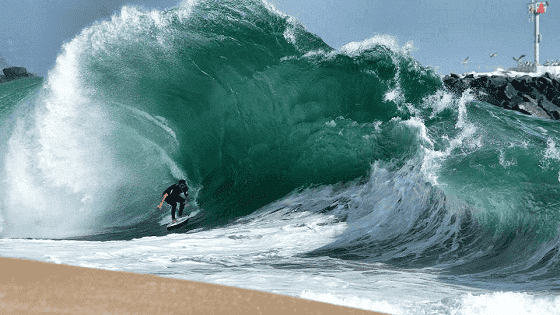
Did you know that one of the most brutal waves in California was never meant to exist? And once it did, it was never meant to be surfed. And yet… here it is. The Wedge.
The Wedge, at the very end of the Balboa Peninsula in Newport Beach, is a completely man‑made surf break. On big days, it can reach 20 or even 30 feet. It’s short, violent, and absolutely spectacular.
The Wedge was born in the 1930s among some tragic events. In 1926, a Newport teenager, and a son of George Rogers who was the president of Union Rock, tragically died in a boating accident. Following his death, his father launched a campaign to make the harbor safer. The U.S. Army Corps of Engineers responded by extending the west jetty out to nearly 2,000 feet.
It made the harbor calmer, but it also turned the ocean beside it into something somewhat inexplicable.
️ How the Wedge works
What happened is the long granite jetty started reflecting waves. Each time a south or southwest swell hits the rocks, the wave bounces back out to sea, where it collides with the next incoming swell. The collision doubles the height and power, sending a new, mutant peak straight toward the beach.
Add the steep, sharply sloped sand, and the backwash from the previous wave, and suddenly you have a freakish “rebound” wave—one that breaks almost on the sand, with nowhere to go but down.
Sometimes the backwash adds a third wave too. You should watch the videos to see how close to the beach the riders come off the waves. The waves can move at 30 miles an hour before exploding into the sand. No wonder Newport Beach lifeguards watch it constantly, warning tourists who wander too close to “just watch, don’t swim.”
Needless to say, it’s Injury Central.
It does get bad
According to the EOS, as of 2013, it was estimated that the Wedge had killed eight people and paralyzed another 35. One surfer described it in 1971 as “the closest thing to the great trauma of being born.”
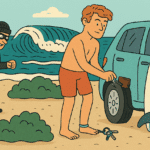
It’s not much safer on the beach. In 2024, a cameraman’s housing was knocked into his face, he passed out, and drifted toward the jetty’s rocks.
Bodysurfers, blackball, and “The Fred”
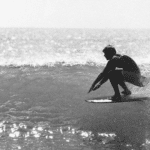
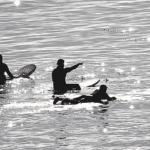
Since its inception, the Wedge primarily attracted bodysurfers, bodyboarders, kneeboarders, skimboarders, and only lately stand‑up surfers.
Back when the wave was exclusively bodysurfed, the name “The Hook” was used. Later, “The Wedge” took over as the moniker among bodysurfers. If you’ve ever seen the photos of The Wedge from the 60s and 70s, you probably spotted local legend Fred Simpson, who invented a technique called “the Fred,” extending one arm forward like an outrigger to slice through the tubes.
A circus with its own rules
Over the years, the Wedge became a circus. A dangerous circus.
While the city of Newport Beach never legislated against riding the Wedge, it introduced the Blackball rule: from 10 a.m. to 5 p.m., May through October, hardboards are banned. Only bodyboarders and bodysurfers are allowed in the water.
It’s a local law that’s been both praised and fought over for years—one more sign that at the Wedge, everything is intense.
Culturally, the Wedge has been a star for decades. It showed up in Bruce Brown’s The Endless Summer, and surf guitarist Dick Dale wrote a song about it for his 1963 album Checkered Flag.