
Now Reading: Where to hide your keys, wallet and other valuables–the ultimate guide to robbing a surfer
-
01
Where to hide your keys, wallet and other valuables–the ultimate guide to robbing a surfer
Where to hide your keys, wallet and other valuables–the ultimate guide to robbing a surfer
Surfing is hard. But the hardest thing a surfer will ever have to do—in addition to finding a parking spot in Newport Beach, California on the Fourth of July—is figure out where to store their valuables when heading into the ocean. Because you can’t take it all with you.
I recently almost lost my car key because my wetsuit key pocket got loose—and so did the elastic band holding the key. It was a moment of sheer terror. Even though I could’ve just walked back to my car, opened the door using the keypad, and used my phone to call my husband to cycle over with the spare key, it still would’ve been unwelcome. I’d have to explain where the spare key is, he wouldn’t be able to find it, and I’d ultimately Uber or walk back to get it myself and cycle back to the car. So glad I didn’t actually lose the key.
Why not leave the key in the car, you ask? I live in perpetual fear that I’ll get smacked on the head and forget the keypad code.
Car keys
If you drive an old car like me that comes with a valet key, you can easily keep the key on your person — in a wetsuit pocket or a simple aqua pack that you can hang on a lanyard around your neck and tuck behind so you’re not uncomfortable. If you’re surfing without a wetsuit, your rashguard may have a pocket. You can also use a waterproof armband pouch or strap a key to your arm using a hair tie. It all depends on how adventurous you feel.
If you have a newer car with an electronic key, you can still keep it with you, but use a Faraday pouch, making sure it’s fully waterproof.
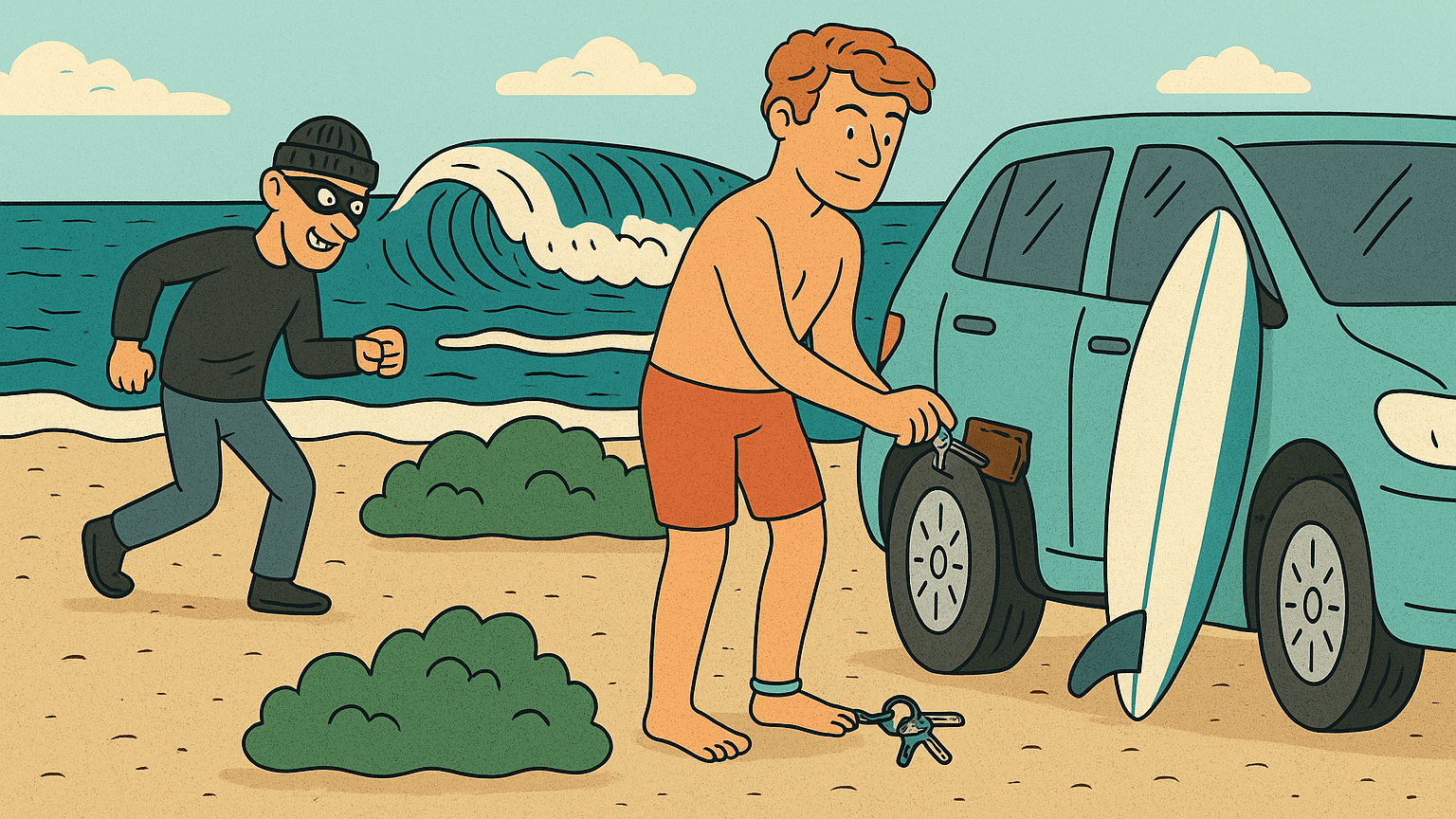
You can also hide the key on the car—on the wheel, or in a realtor-style lockbox attached to the door handle, tow hitch, undercarriage, or frame. Of course, where there’s a will, there’s a way—and thieves have been known to remove lockboxes and try their luck later. If you have a way of attaching it somewhere not clearly visible, we recommend that. Same goes for magnetic-style boxes with combo locks—hide them well.
Here are just a few places to consider for key placement (some more visible than others):
- Under the tire / wheel well
- Behind the license plate
- Under the bumper
- Tow loop or hitch
- Under the car frame
Armed with a lockbox, there might be other spots that are convenient too—like a fence or a communal surfboard rack.
Bike keys
Most of the time, I cycle to the beach on my beat-up 10-year-old cruiser. I either take a key with me, or I set up on the beach and hide it in a pouch under the towel or near a lifeguard tower. Sometimes, I have a hard time finding it in the sand afterwards—but that may just be me. I probably could leave the key in the basket on my bike too, but it really depends on where you surf.
Phones, wallets, and other valuables
As a rule of thumb, if I cycle to the beach, I don’t bring any valuables with me. But if you have no choice—and you’re not leaving them hidden under the passenger seat in a locked car, or under a seat cover, or in an old shopping bag in the trunk—you’ve still got options.
If you’re renting a board, most surf shops will happily store your valuables for you.
If it’s convenient and you can leave your stuff on the beach, either:
- Make it as unattractive as possible—surfers have been known to wrap their valuables in diapers or doggie poo bags (a ratty towel or grocery bag will do too), or
- Go elaborate—think tent, chairs, blanket, and a bunch of less-valuable decoys that a thief would have to dig through to get to your wallet.
Surfing is hard enough as it is. If you can avoid worrying about the stuff you left behind—do it. Either leave it all at home or only bring the essentials.