
Now Reading: The invention of the kook cord: a leash history
-
01
The invention of the kook cord: a leash history
The invention of the kook cord: a leash history
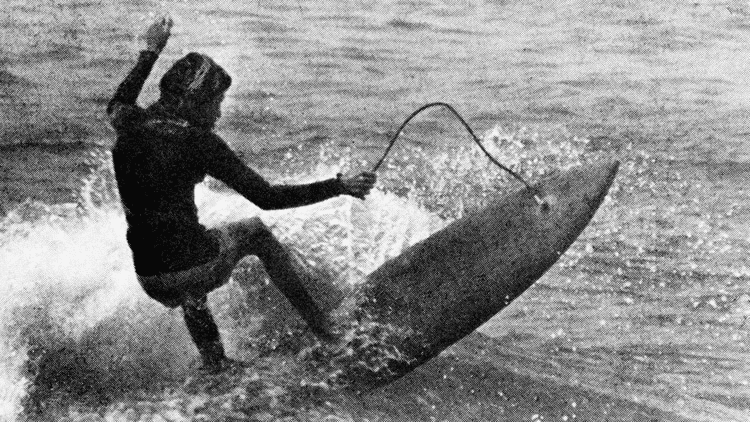
Crazy to think that once—and it wasn’t that long ago—all surfers went leashless. What might be even more insane is that once upon a time, you had to be a very good swimmer to surf! Imagine. Let’s talk about sissy strings, power cords, kook connectors, dope ropes and goon straps in today’s episode.
Since ancient Hawai’i, surfers resisted anything that might “tether” them. Some of them still do. Being boardless in the surf was like some kind of rite of passage.
But that also meant that every wipeout required a long swim—sometimes through gnarly surf—to retrieve your board. Or worse so: losing your board or getting it smashed on the rocks. Understandably, some surfers got tired of it.
Experimental tethers
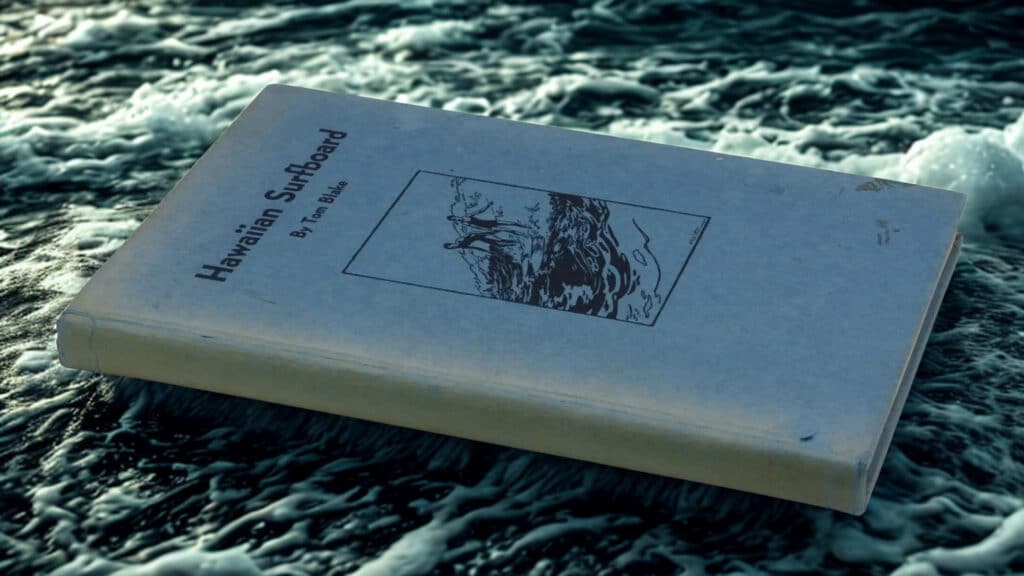
It’s hard to pinpoint the exact date when the leash was invented, as several people have laid claim to the invention. As early as the mid-1930s, Tom Blake attached a 10-foot-long cotton rope from a belt on his waist to his board. He gave it up quickly—it was just too dangerous.
Then, a French surfer, George Hennebutte, experimented with an elastic line attached to the surfboard’s tail and a double-velcro ankle strap in 1958. Velcro was also a new invention. Still—no takers.
Enter surgical tubing
Twelve years later, in 1970, Pat O’Neill, son of wetsuit inventor Jack O’Neill, attached a length of surgical tubing to the nose of his board with a suction cup, and looped the other end to his wrist. This sounds painful reading it out loud. There’s some argument that there was another Santa Cruz surfer named Roger Adams who might’ve invented the leash. But I think we can all agree that it wasn’t until the leash was finally attached to the tail of the surfboard that the modern kook cord was born.
Early leashes were made of surgical tubing, which stretched dangerously far and often snapped the board back like a slingshot. You could argue Pat is responsible for his dad’s lost eye, given that it was a surfboard on a leash that snapped back and hit him in the face.
Corky said it best
While many surfers started making their own leashes from lengths of marine surplus bungee cords, naturally, there was also a lot of resistance. Corky Carroll wrote about it in 1972, in the December issue of Surfing magazine. It’s an excellent read—let me give you a taste.
“There is a lot of controversy about the surf leash,” Corky writes. “One thing for sure is that a lot of people are using them, and at the same time, people are violently opposed to them.
Those against using the leash claim it isn’t pure and that it destroys the aesthetics of surfing. They say that if you make a mistake, you should pay the price with a swim to the beach, even if it means having your board destroyed against a cliff or jetty. They also point out the danger of being hit by your board or having the cord wrapped around your neck.
On the other side, we have people who use the leash. Their motto is: “Are you swimming while others are trimming?” They claim that the leash prevents the board from being destroyed on rocks and cliffs, and when you have a $100-or-more investment in a board, it’s worth protecting. They also claim there really isn’t much danger in using them.”
Wow, a $100 investment—maybe a secondhand one from the FB Marketplace.
“Leashes are for dogs”
The switch from surgical tubing to urethane cord happened in the mid-1970s and made leashes safer and more reliable. Ankle straps replaced wrist attachments, providing more comfort and reducing injuries. Leash plugs became standard in surfboard design by the late ’70s/early ’80s.
By the 1980s, the leash went mainstream, but the no-leash interest group didn’t go down without a fight. They argued that by relying on their leashes, surfers became lesser surfers—they lost the art of controlling their boards—and that, quoting their unofficial motto, “Leashes are for dogs.”
Did the arrival of the leash make surfing explode, or did the explosion of surfing make the leash mainstream? We may never know—because I’m not done with my research on this topic.
So, what leash should I wear? Bear in mind that the leashes are for dogs people got one thing straight: leashes create a small amount of drag (that’s not a good thing), so most surfers use the smallest and lightest leashes possible—usually the same length as their boards. The bigger the wave, the longer and stronger the leash. Length = distance from the board, and thickness = strength of the leash.
❓ Can you still go leashless?
Is it okay not to wear a leash? There’s no law against going leashless, just like there’s no law against being totally ignorant about surf etiquette. Surfing’s weird that way.
Some longboarders still prefer leashless surfing to preserve the traditional aesthetic and encourage better control of the surfboard. Noseriding is possible when you’re wearing a leash (you can attach it to your calf), but not as much fun, I’m told.
You can go leashless at uncrowded breaks (good luck finding those), and if you’re a decent swimmer.
I totally get the whole “tanglement” argument when it comes to protesting the leash. Unfortunately, there are surfers who died after their leashes got tangled underwater—on a rock or reef.
You can learn more about it by watching Riding Giants and the powerful Mavericks segment.
Plus, you might’ve experienced a leash-related surf injury yourself. The most common one? When a leash wraps around one of your fingers, leaving a nasty bruise.
According to the EOS, more than 10% of surfing injuries are related to leash recoil.
I have not yet lost a leash (or leg rope, as Australians call it), but that’s probably because I’m not surfing enough.
Again, according to the EOS, full-time surfers break 2–10 leashes a year.
It’s an expensive hobby!