
Now Reading: Cortés Bank: Truly, the most ridiculous wave in the ocean
-
01
Cortés Bank: Truly, the most ridiculous wave in the ocean
Cortés Bank: Truly, the most ridiculous wave in the ocean
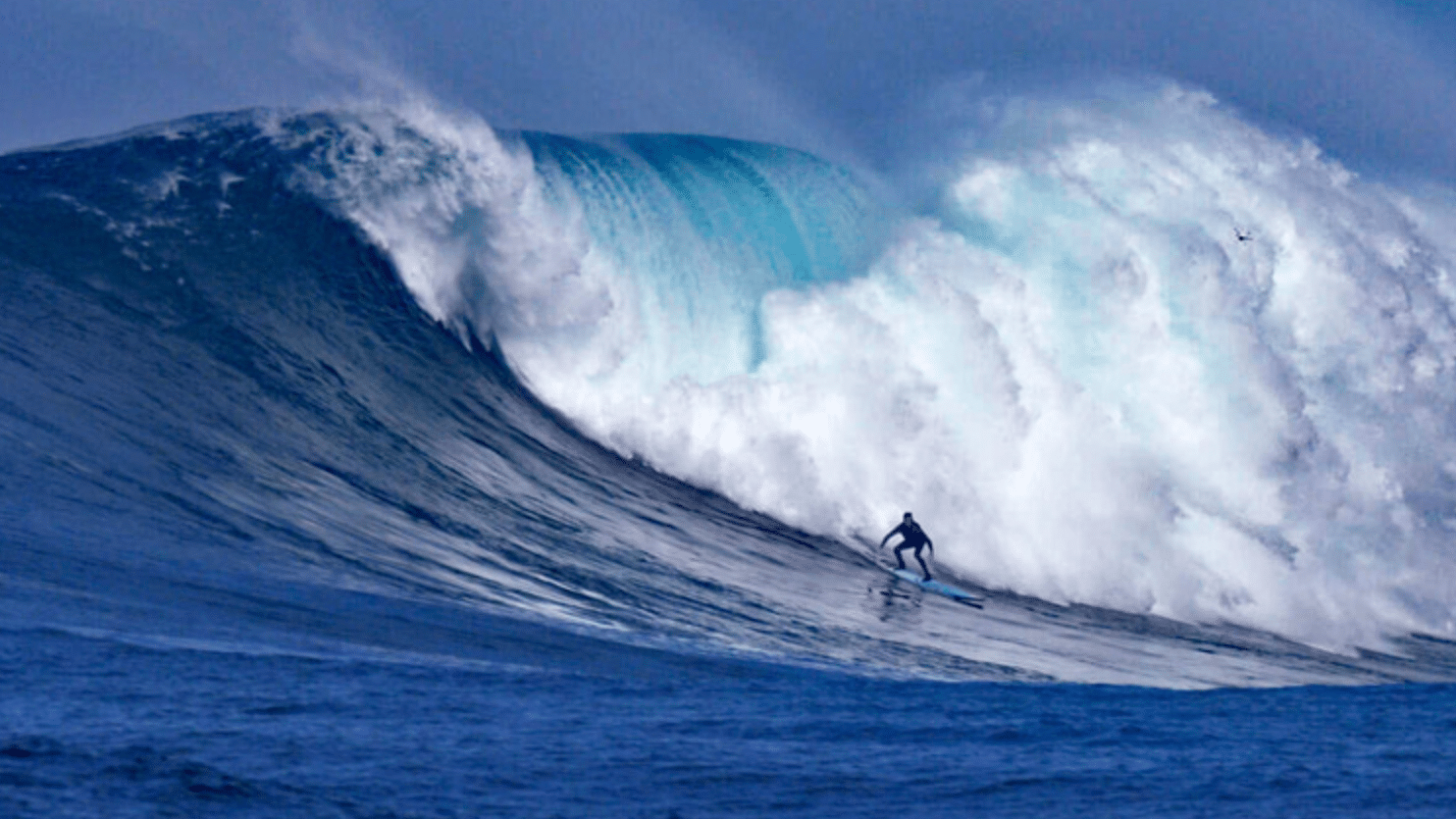
Cortés Bank. A wave so remote, so ridiculous, it practically needs its own Soundgarden soundtrack. Let’s talk about the most insane wave in the middle of the ocean.
I get Jeff Clarke’s fascination with Mavericks. It’s on his doorstep, it’s his local break, where else is he gonna go surf? Pacifica?
Why do men travel 100 miles into the ocean on boats for hours upon hours to surf a wave that has been dubbed a navigational hazard for centuries. That’s insane.
What and where is Cortés Bank?
It’s about the size, innit. Cortés Bank is one of those elusive big wave breaks that produces waves up to 85 foot on a few days a year.
It effectively is an underwater mountain range about 100 miles off the coast of California, south of San Diego. If you drew a straight line down south from Ventura that’s where you’d find it.
A part of a 25-mile underwater mountain range, Cortés Bank rises from the ocean floor to within just a few feet of the surface. At its shallowest point (called Bishop Rock), it’s basically a submerged reef — and that’s where the action happens. Waves hitting it jack up insanely fast due to the abrupt depth change — a 2,000 ft rise to just 6 ft below the surface.
As described by Matt Warshaw, “it’s a tilting, shifting peak, resembling Sunset Beach in Hawai’i, a few hundred yards east of a nightmarish white water later described by surf journalist Evan Slater as ‘half-mile chunk of reef forever doomed to 360-degree confusion.’” Why I have never done a quote within a quote before. Being in the middle of a freaking ocean, this break is totally exposed, so it gets the brunt of every Pacific swell. You already know that you can’t see the beach.
From hazard to surf spot
As for the discovery of Cortés Bank, sailors knew it was there for said centuries and avoided it like the plague, but in the 1960s it was considered by Walter and Flippy Hoffman, two big wave pioneers, as a surfing destination. In 1990, it was first checked out by air by Larry Moore who then returned by boat with some surfers and they all surfed less life-threatening 8 foot waves.
The public launch of Cortés took place more than a decade later on January 19, 2000. Like with most launches, it was carefully planned, well financed. Codenamed “Project Neptune”, with a project leader Larry Moore, supported by former Surfing magazine editor Bill Sharp. It had it all: two boats, a plane, three personal watercrafts, a camera crew of six, and six surfers.
After a night traveling by boat, Mike Parsons and Brad Gerlach (representing SoCal), and Kenny Collins and Peter Mel (representing NorCal), set out in two tow-in teams not long after dawn. Eventually Mike got towed in onto the biggest wave ever recorded to be ridden off the continent at that point — 65 feet. He beat his own record in 2008 on a return trip, riding a 75-foot giant. Although it is said that Greg Long, who accompanied him, actually rode a wave that was five or ten feet bigger.
If you’d like to see some of that great Cortés footage, watch Step Into Liquid. Or 100 Foot Wave — that’s where the French big-wave legend Justine Dupont surfed a 60-footer.