
Now Reading: 100-foot waves: The legend of Nazaré
-
01
100-foot waves: The legend of Nazaré
100-foot waves: The legend of Nazaré
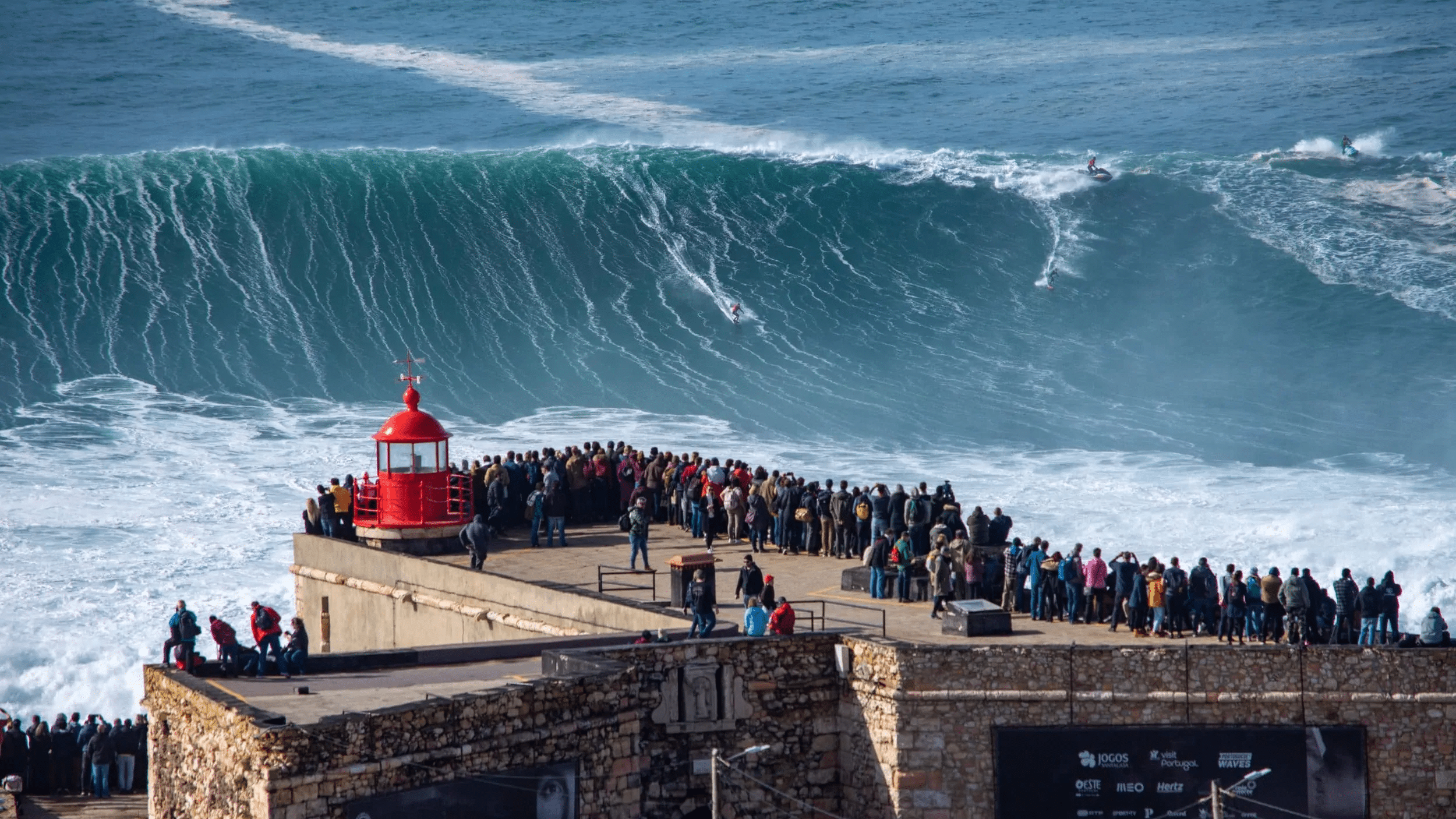
Nazaré—a teeny tiny fishing town on Portugal’s Silver Coast that every surfer and non-surfer has heard about, because Instagram. We’ll dive in a little bit deeper in today’s episode.
Nazaré? What Nazaré?
Here I am, leafing through the Encyclopedia of Surfing, thinking, Wow, Matt Warshaw must hate Nazaré. No mention. Like, none at all. But then of course I realize that I am a total idiot, because when Matt wrote the hardback version in 2003, there was no Nazaré per se.
There was a town of Nazaré in Portugal. There have been local surfers at Nazaré since 1968, maybe even earlier, riding smaller waves up to 10 feet. But the Nazaré as we know it today—that didn’t happen until November 2011.
I’m sure it would’ve happened sooner if Garrett McNamara, instead of corresponding via email with the Nazaré local who showed him the monster wave for five years, would’ve just got off his arse and got on a plane. Thank God for women—and Garrett’s wife. (Watch 100 Foot Wave for this story to make further sense.)
️ Why Nazaré is different
Nazaré is a bigger freak of nature than Mavericks. When winter swells arrive, they funnel through an underwater canyon—basically a giant underwater trench that stretches right to the shore—that is 2.5 times deeper than the Grand Canyon, producing waves that can exceed 80–100 feet.
That’s about a 3-mile-deep trench delivering a five-story building of water, you guys. Without a jet ski and tow-in, it would be unrideable. Delightful.
It also delivers the whitewater, splashing in every direction onto the rocks like I’ve never seen before. Not to mention, it’s not warm, just because you’re thinking, oh, it’s Portugal. 60°F/15°C on average. And people do almost die there. Big-wave surfer Maya Gabeira nearly drowned after breaking her ankle in a wipeout and then losing consciousness. What a fun wave!
️ The first big ride
Okay, back to Garrett McNamara at Nazaré. It’s the morning of November 1, 2011. A massive North Atlantic swell is peaking. Light offshore winds are holding the wave face clean.
Garrett is being towed in behind Andrew Cotton (the British big-wave surfer who was part of his team). He catches the monster, drops in on a steep, lurching face, disappearing into a cloud of spray as he outran the avalanche of whitewater behind him.
The rest is history. The wave he caught was estimated at 78 feet (23.8 meters)—the biggest wave ever surfed.
Records keep on falling
Not for long, though. Rodrigo Koxa rode an 80-foot wave, according to the Guinness World Record book, in 2017. Then in 2020, Sebastian Steudtner came down an estimated 86-foot wave.
And yes—there are women charging these giants too, including Maya Gabeira, who holds the women’s world record for the biggest wave ever surfed (73.5 feet).
Surfers are a tad obsessed with riding Nazaré and measuring their wave height records. Last year, Sebastian once again braved Nazaré and rode a 93.73-foot wave measured using state-of-the-art drone technology developed by Porsche Engineering and Team Steudtner—or so says the press release.
And just before Christmas 2024, Alessandro “Alo” Slebir rode a 108-foot wave. These records are yet to be recognized.
I get the feeling that Nazaré is not universally loved in the surfing world. Perhaps because it’s a novelty wave, according to Greg Long, a big-wave rider: It stands up for half a second and then it’s over, he said. A regular wave has a rest and a trough. And Nazaré sometimes just doesn’t have the trough at all.